Parts of Wave
Interactive passage with audio narration, comprehension questions, and printable PDF.
By completing this purchase you agree to our Terms of Use and Privacy Policy. Your subscription renews automatically until you cancel. You can cancel anytime from your account settings. All sales are final and non-refundable. Digital content is available for download in your account immediately upon purchase.
What's included
Parts of Wave preview and details
About this printable Parts of Wave science reading passage, NGSS-aligned (Grades 5-8)
Sample passage and quiz from Parts of Wave
Reading passage and comprehension quiz preview
Parts of a Wave

Sound travels from a speaker to your ears, and sunlight passes through your window each morning. These events happen because of waves, which are patterns of energy moving through matter or space. Whether you are listening to music or watching ocean tides, understanding the parts of a wave helps explain how energy is transferred in different systems. Scientists study the anatomy of waves to predict, measure, and harness their energy in technology, nature, and medicine.
Wave Anatomy: Crest, Trough, Wavelength, and Amplitude
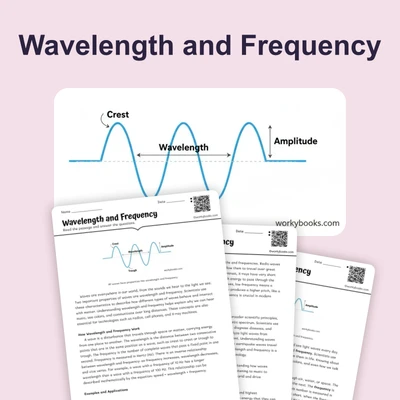
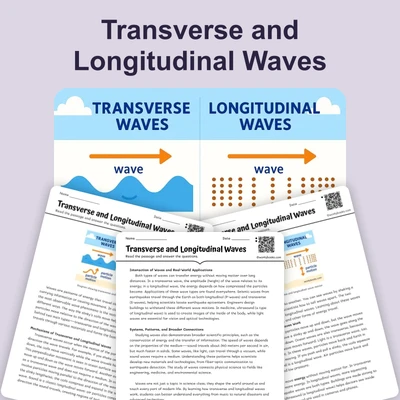
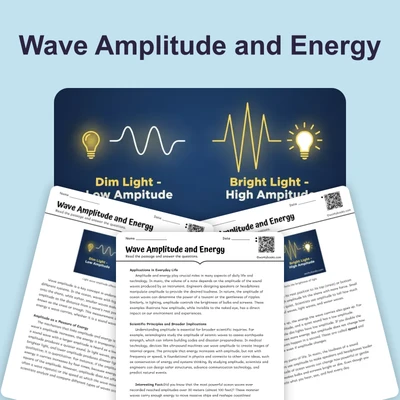
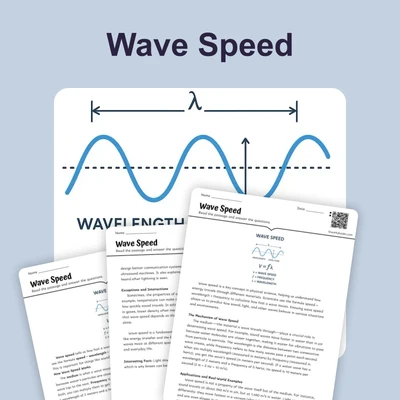
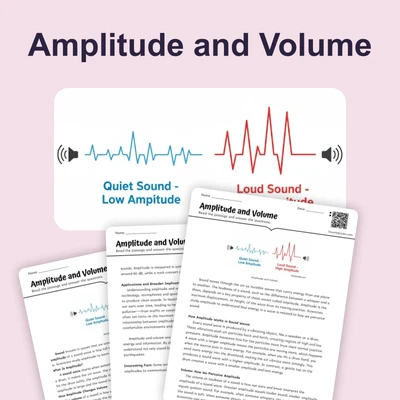
All waves have certain basic parts. In a transverse wave, like a wave on a string, the highest point is called the crest and the lowest point is the trough. The wavelength is the distance from one crest to the next, measured in meters (m) or centimeters (cm). The amplitude is the height from the middle, or rest position, to the crest. Amplitude tells us how much energy the wave carries. For example, a loud sound wave has a larger amplitude than a soft sound. Scientists use special instruments to measure these properties, allowing precise control of wave energy in fields like telecommunications and medicine.
Longitudinal Waves: Compression and Rarefaction
Not all waves move in the same way. A longitudinal wave, such as a sound wave in air, moves energy by compressing and stretching particles along the direction of travel. The crowded areas are called compressions, while the stretched-out areas are rarefactions. The wavelength in a longitudinal wave is measured from one compression to the next. These patterns help explain how sound moves through solids, liquids, and gases. For example, sound travels faster in water than in air because the particles are closer together, leading to more efficient compressions and rarefactions.
Connecting Wave Structure to Real Life
The structure of waves affects how they interact with their environment. For example, earthquake waves move through the ground as both transverse and longitudinal waves, helping scientists locate the source of the quake. In fiber optic cables, only certain wavelengths of light are used for fast, clear communication. Even medical imaging, like ultrasound, depends on understanding wave anatomy to produce detailed pictures inside the human body. These examples show that the parts of a wave are not just labels—they are essential for controlling and applying wave energy in science and technology.
By analyzing wave patterns, scientists can predict storms, design safer buildings, create new medical tools, and improve communication devices. The study of wave anatomy connects to broader scientific principles such as energy transfer, system interactions, and technological innovation.
Interesting Fact: Some earthquake waves can travel at speeds of up to 8 kilometers per second (about 18,000 miles per hour) through the Earth's crust!
Comprehension quiz (10 questions)
1. What is the highest point of a transverse wave called?
2. Which part of a wave shows how much energy it carries?
3. What is the name for the area in a longitudinal wave where particles are spread apart?
4. How do scientists measure the wavelength of a transverse wave?
5. What is the main difference between a transverse wave and a longitudinal wave?
6. In the passage, which technology uses the knowledge of wave parts to send information quickly?
7. What does a larger amplitude in a sound wave mean?
8. True or False: Compression is the lowest point of a transverse wave.
9. True or False: Scientists use the parts of a wave to create better communication devices.
10. Which statement best describes 'rarefaction' in a longitudinal wave?
Perfect for the way you teach
- Build comprehension skills
- Auto-graded quiz
- Differentiated reading
- Read together at home
- Improve fluency
- Quiet reading time
- Reading curriculum support
- Independent practice
- Track Lexile growth