Wavelength and Frequency
Interactive passage with audio narration, comprehension questions, and printable PDF.
By completing this purchase you agree to our Terms of Use and Privacy Policy. Your subscription renews automatically until you cancel. You can cancel anytime from your account settings. All sales are final and non-refundable. Digital content is available for download in your account immediately upon purchase.
What's included
Wavelength and Frequency preview and details
About this printable Wavelength and Frequency science reading passage, NGSS-aligned (Grades 5-8)
Sample passage and quiz from Wavelength and Frequency
Reading passage and comprehension quiz preview
Wavelength and Frequency
Waves are everywhere in our world, from the sounds we hear to the light we see. Two important properties of waves are wavelength and frequency. Scientists use these characteristics to describe how different types of waves behave and interact with matter. Understanding wavelength and frequency helps explain why we can hear music, see colors, and communicate over long distances. These concepts are also essential for technologies such as radios, cell phones, and X-ray machines.
How Wavelength and Frequency Work
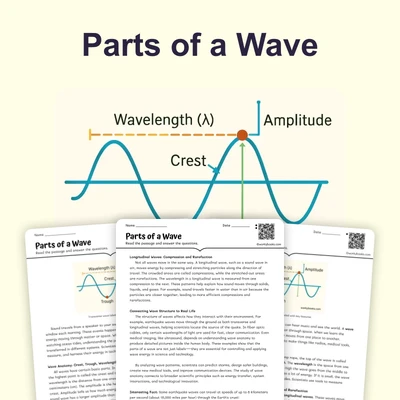
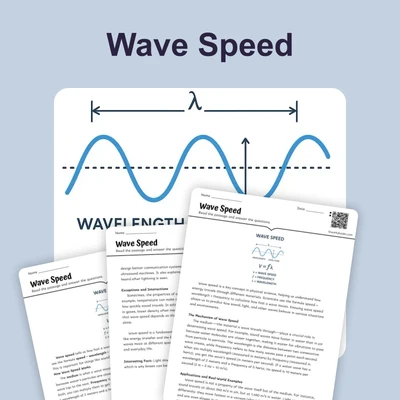
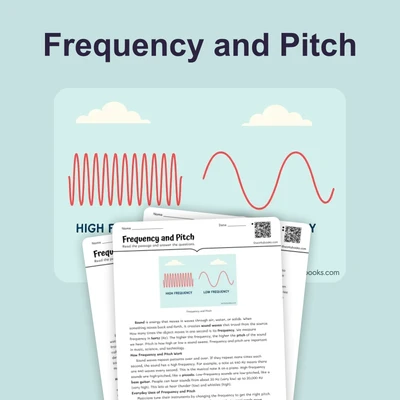
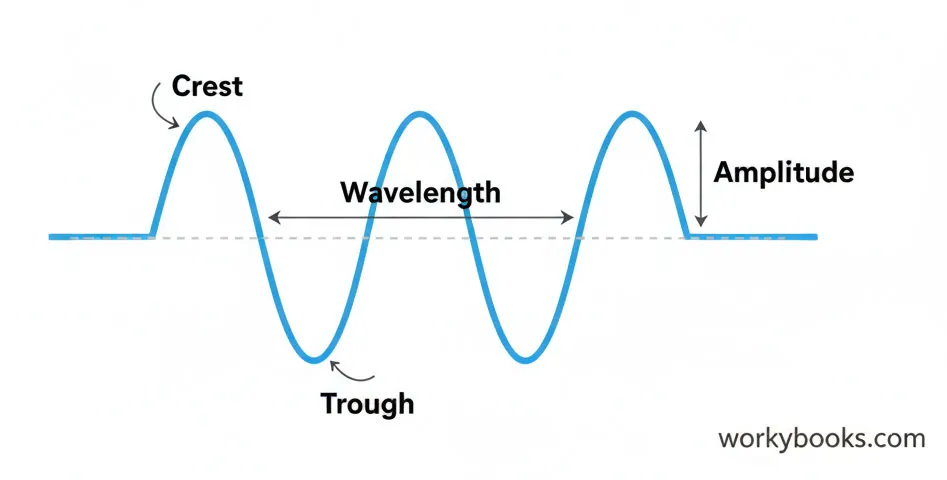
A wave is a disturbance that travels through space or matter, carrying energy from one place to another. The wavelength is the distance between two consecutive points that are in the same position on a wave, such as crest to crest or trough to trough. The frequency is the number of complete waves that pass a fixed point in one second. Frequency is measured in Hertz (Hz). There is an inverse relationship between wavelength and frequency: as frequency increases, wavelength decreases, and vice versa. For example, a wave with a frequency of 10 Hz has a longer wavelength than a wave with a frequency of 100 Hz. This relationship can be described mathematically by the equation: speed = wavelength × frequency.
Examples and Applications
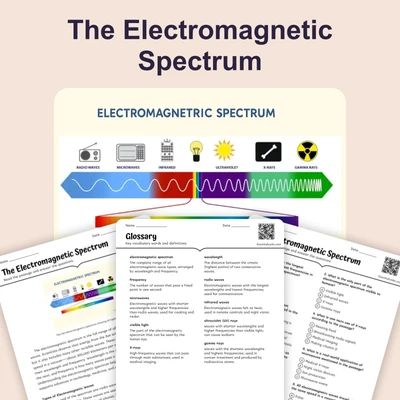
Different types of waves show varying wavelengths and frequencies. Radio waves have long wavelengths and low frequencies, which allow them to travel over great distances and through obstacles like buildings. In contrast, X-rays have very short wavelengths and high frequencies, giving them enough energy to pass through the human body and create images of bones. In sound waves, low frequency means a lower pitch, such as a bass drum, while high frequency produces a higher pitch, like a whistle. The ability to manipulate wavelength and frequency is crucial in modern technology, from broadcasting to medical diagnostics.
Connections to Science and Society
The study of wavelength and frequency connects to broader scientific principles, such as the conservation of energy and the electromagnetic spectrum. Scientists use these concepts to develop new ways to send information, diagnose diseases, and even explore the universe. For instance, astronomers analyze light waves from distant stars to learn about their composition and movement. Understanding waves also helps engineers design safer buildings by studying how earthquake waves travel through the ground. The inverse relationship between wavelength and frequency is a foundational idea that links many areas of science and technology.
In summary, wavelength and frequency are key to understanding how waves behave and why they are important in our daily lives. From listening to music to getting an X-ray, these wave properties shape much of our world and drive innovation in science and technology.
Interesting Fact: Gamma rays have the shortest wavelengths and highest frequencies in the electromagnetic spectrum, carrying so much energy that they can be used to treat cancer cells.
Comprehension quiz (10 questions)
1. What is the wavelength of a wave?
2. How is frequency measured?
3. What happens to the wavelength when the frequency increases?
4. Which type of wave is used to make images of bones inside the body?
5. What is the relationship between wavelength and frequency called?
6. In the passage, what does a low-frequency sound produce?
7. Why are radio waves useful for communication over long distances?
8. True or False: Frequency and wavelength both increase together.
9. True or False: Engineers study earthquake waves to design safer buildings.
10. What is the main idea of the passage?
Perfect for the way you teach
- Build comprehension skills
- Auto-graded quiz
- Differentiated reading
- Read together at home
- Improve fluency
- Quiet reading time
- Reading curriculum support
- Independent practice
- Track Lexile growth