This learning resource is available in interactive and printable formats. The interactive worksheet can be played online and assigned to students. The Printable PDF version can be downloaded and printed for completion by hand.
This comprehensive passage for grades 6-8 explores the science behind the speed of sound and how it varies depending on the medium—solid, liquid, or gas. Aligned with NGSS standards MS-PS4-1 and MS-PS4-2, the text delves into the mechanisms that determine how fast sound travels, using real-world phenomena like thunder and fireworks to anchor understanding. Students will learn that sound moves fastest in solids, slower in liquids, and slowest in gases due to particle arrangement. The passage also covers the impact of temperature on sound speed and connects the topic to broader scientific principles, such as energy transfer and wave behavior. The resource includes a glossary, quiz, writing prompts, and engaging graphic organizers. Audio integration makes this resource accessible for diverse learners and supports students in building both scientific and academic vocabulary.
CONTENT PREVIEW
Expand content preview
Sound is a type of energy that travels in waves. When you see lightning during a storm, you often hear the thunder seconds later. This delay is caused by the speed at which sound travels from the lightning to your ears. Understanding the speed of sound helps scientists explain natural events and design better technology for communication.
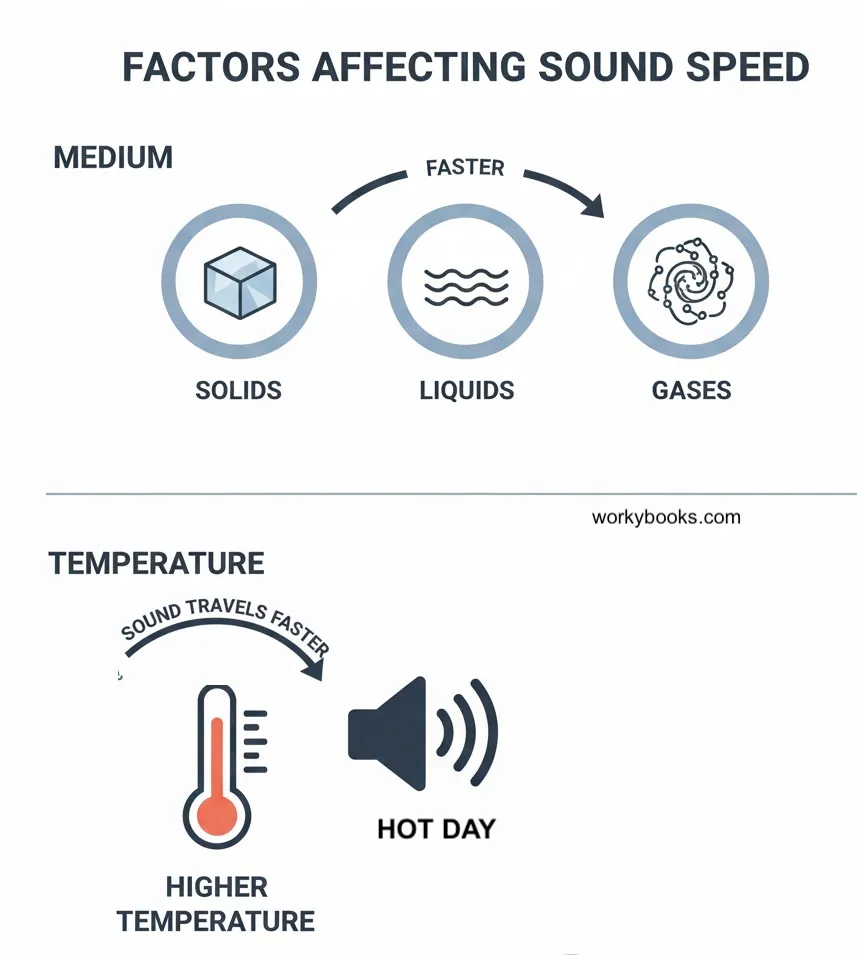
What Determines the Speed of Sound? The speed of sound does not depend on the sound itself, but rather on the medium through which it moves. A medium is any substance—solid, liquid, or gas—that sound waves can travel through. In solids, particles are packed closely together, allowing sound waves to move quickly from one particle to the next. In liquids, the particles are less tightly packed, so sound moves a bit slower. In gases like air, particles are spread far apart, making it harder for sound waves to travel. At room temperature, the speed of sound in air is about 343 meters per second (m/s), but in water it is around 1,480 m/s, and in steel it can be as high as 5,960 m/s. This difference is because sound waves need particles to transfer energy, and particles in solids are closer together than in liquids or gases.
How Temperature and Medium Affect Sound Speed The speed of sound can also change with temperature. When air is warmer, its particles move faster and are slightly closer together, making it easier for sound waves to travel. For example, on a hot day, sound may travel faster than on a cold day. This explains why you may hear distant noises more clearly in summer. The relationship between medium, temperature, and sound speed is a key concept in physics. Some scientific instruments, like ultrasound machines, use high-frequency sound waves that move through different tissues in the body at different speeds to create images for doctors.
Examples and Real-World Applications Everyday experiences show how sound speed varies. When you watch fireworks, you see the explosion before you hear the boom. This is because light travels much faster than sound. In weather forecasting, the time between seeing lightning and hearing thunder helps estimate how far away a storm is—every 3 seconds of delay means the storm is about 1 kilometer away. Engineers use the properties of sound speed to design buildings, concert halls, and even submarines, making sure that sound travels in controlled and useful ways.
Understanding the speed of sound connects to broader scientific principles, such as energy transfer and wave behavior. By studying how sound interacts with different materials and conditions, scientists and engineers can solve real-world problems and create new technologies.
Interesting Fact: Whales communicate with each other over hundreds of kilometers because sound travels much faster and farther in water than in air!
What is the primary factor that determines the speed of sound?
The medium through which sound travelsThe loudness of the soundThe color of the object producing soundThe size of the sound wave
Which state of matter allows sound to travel fastest?
SolidLiquidGasPlasma
At room temperature, what is the speed of sound in air?
343 meters per second1,480 meters per second5,960 meters per second100 meters per second
According to the passage, why do you see fireworks before you hear them?
Light travels much faster than soundSound is louder than lightTemperature affects light speedFireworks make no sound
What happens to the speed of sound as temperature increases?
It increasesIt decreasesIt stays the sameIt stops completely
In the context of the passage, what does 'medium' mean?
A substance that sound waves travel throughA tool used to measure soundA type of energyA temperature scale
Why do whales use sound to communicate over long distances?
Because sound travels faster and farther in waterBecause light cannot travel in waterBecause water is a solidBecause sound is always loud
If the air gets colder, what happens to the speed of sound according to the passage?
It decreasesIt increasesIt stays the sameIt turns into light
True or False: The speed of sound is always the same in every material.
TrueFalse
True or False: Engineers use the knowledge of sound speed in designing buildings and submarines.
TrueFalse
Perfect For:
👩🏫 Teachers
• Reading comprehension practice
• Auto-graded assessments
• Literacy skill development
👨👩👧👦 Parents
• Reading practice at home
• Comprehension improvement
• Educational reading time
🏠 Homeschoolers
• Reading curriculum support
• Independent reading practice
• Progress monitoring
Reading Features:
📖
Reading Passage
Engaging fiction or nonfiction text
❓
Comprehension Quiz
Auto-graded questions
📊
Instant Feedback
Immediate results and scoring
📄
Printable Version
Download for offline reading
🔊
Read Aloud
Voice-over with word highlighting
Reviews & Ratings
No reviews yet. Be the first to share your experience!
Related Content
Wavelength and Frequency
This engaging middle school science passage explores the concepts of wavelength and frequency, aligning with NGSS standa...
MS-PS4-1
Remote Sensing
This middle school science passage introduces students to the concept of remote sensing—the collection of information ab...
MS-ESS3-3MS-PS4-2MS-ETS1-1MS-ETS1-3
The Electromagnetic Spectrum
This comprehensive science reading passage introduces middle school students (grades 6-8) to the electromagnetic spectru...
MS-PS4-1MS-PS4-2
Transverse and Longitudinal Waves
This passage introduces middle school students to the fundamental concepts of transverse and longitudinal waves, in alig...
MS-PS4-1
Parts of a Wave
This informational passage, aligned with NGSS MS-PS4-1, introduces middle school students (grades 6-8) to the anatomy of...
MS-PS4-1
Wave Amplitude and Energy
This comprehensive middle school science passage explores the connection between wave amplitude and energy, aligned with...
MS-PS4-1
Wave Speed
This comprehensive middle school science passage explores the concept of wave speed, aligned with NGSS MS-PS4-1. Student...
MS-PS4-1
How Sound Is Produced
This comprehensive middle school science passage explores the fundamental question of how sound is produced, perfectly a...
MS-PS4-1
What Is Sound?
This passage explores the science of sound for middle school students, aligned with NGSS standards MS-PS4-1 and MS-PS4-2...
MS-PS4-1MS-PS4-2
Frequency and Pitch
This comprehensive passage for grades 6-8 introduces students to the concepts of frequency and pitch, aligned to NGSS st...
MS-PS4-1
Amplitude and Volume
This comprehensive middle school science reading passage introduces students to the concepts of amplitude and volume in ...
MS-PS4-1
Measuring Sound in Decibels
This science reading passage introduces middle school students to the concept of measuring sound using decibels (dB). Al...
MS-PS4-1
Ultrasound and Infrasound
This engaging middle school science passage introduces students to the concepts of ultrasound and infrasound, frequencie...
MS-PS4-1
Musical Instruments and Sound
This comprehensive science passage for grades 6-8 explores how musical instruments create sound through vibration, align...
MS-PS4-1
Visible Light and Color
This comprehensive science passage for grades 6-8 explores visible light as the part of the electromagnetic spectrum tha...
MS-PS4-2
Light Waves
This middle school science passage introduces students in grades 6-8 to the concept of light as an electromagnetic wave,...
MS-PS4-2
Wave Absorption
This engaging science passage for grades 6-8 explores the mechanism of wave absorption, where waves transfer energy to m...
MS-PS4-2
Wave Behavior: Transmission
This informational science reading passage for grades 6-8 explores the concept of wave behavior, focusing on transmissio...
MS-PS4-2
Wave Refraction
This comprehensive science passage introduces middle school students to the concept of refraction, a key phenomenon in w...