Measuring Sound in Decibels
Interactive passage with audio narration, comprehension questions, and printable PDF.
By completing this purchase you agree to our Terms of Use and Privacy Policy. Your subscription renews automatically until you cancel. You can cancel anytime from your account settings. All sales are final and non-refundable. Digital content is available for download in your account immediately upon purchase.
What's included
Measuring Sound in Decibels preview and details
About this printable Measuring Sound in Decibels science reading passage, NGSS-aligned (Grades 5-8)
Sample passage and quiz from Measuring Sound in Decibels
Reading passage and comprehension quiz preview
Measuring Sound in Decibels
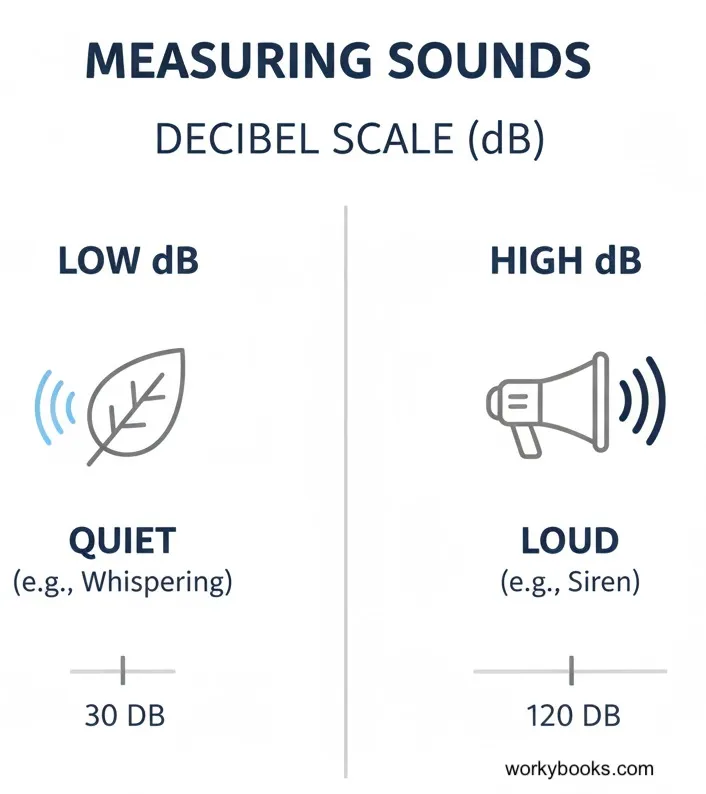
Sound is a type of energy that travels in waves through the air and other materials. In daily life, people often need to know how loud a sound is, whether it’s for safety, comfort, or communication. The decibel (dB) is the unit used to measure the intensity of sound. Understanding how decibels work is important for protecting our hearing and for designing quieter, safer environments.
How the Decibel Scale Works
The decibel scale is not a regular, or linear, scale. Instead, it is logarithmic. This means that every 10 dB increase on the scale represents a sound that is 10 times more intense. For example, a normal conversation at about 60 dB is 10 times more intense than a whisper at 50 dB, and 100 times more intense than a whisper at 40 dB. This system allows scientists and engineers to easily compare very quiet and very loud sounds using manageable numbers. The decibel scale starts at 0 dB, which is the faintest sound a human can hear. A whisper is about 30 dB, a typical conversation is around 60 dB, a lawn mower is about 90 dB, a rock concert can reach 110 dB, and a jet engine at close range measures about 140 dB.
Sound, Hearing, and Safety
Human ears are sensitive organs that can detect a wide range of sound intensities. However, exposure to loud noises can damage the tiny hair cells inside the ear that help us hear. Scientists have found that sounds above 85 dB can cause hearing loss if you are exposed to them for a long time. For example, using a lawn mower (90 dB) without ear protection for more than an hour can be risky. At 110 dB, such as at a rock concert, even short exposure can be harmful. A jet engine at 140 dB can cause immediate pain and permanent damage. That is why safe listening guidelines recommend using ear protection in loud environments and keeping the volume down when using headphones. The logarithmic nature of the decibel scale helps explain why small increases in dB can mean much greater danger to our ears.
Real-World Applications and Broader Implications
The decibel scale is used in many fields, from environmental science to engineering and medicine. City planners use it to monitor noise pollution and design quieter neighborhoods. Doctors and audiologists use it to test hearing and diagnose hearing loss. In technology, sound engineers use decibels to control the volume and quality of audio devices. Understanding the logarithmic relationship also helps researchers develop better materials for soundproofing and protecting hearing. This connects to larger scientific ideas about energy, waves, and the impact of technology on society and health. It shows how scientific measurement helps solve real-world problems.
In summary, measuring sound in decibels allows us to compare, control, and understand the world of sound. It helps us stay safe, design better technology, and make informed decisions about our environment and health.
Interesting Fact:
The loudest sound ever recorded on Earth was the 1883 eruption of Krakatoa, which reached about 180 dB and was heard over 3,000 miles away!
Comprehension quiz (10 questions)
1. What is the unit used to measure sound intensity?
2. Which of the following is closest to the intensity of a normal conversation?
3. What happens if you are exposed to sounds over 85 dB for long periods?
4. What does it mean that the decibel scale is 'logarithmic'?
5. Which term refers to harmful or annoying noise in the environment?
6. Based on the passage, why is a jet engine (140 dB) dangerous without protection?
7. If a whisper is 30 dB and a rock concert is 110 dB, how many times more intense is the rock concert compared to the whisper?
8. City planners use the decibel scale to:
9. The decibel scale helps us understand and control sound. (True/False)
10. Listening to music at high volume for a long time is always safe. (True/False)
Perfect for the way you teach
- Build comprehension skills
- Auto-graded quiz
- Differentiated reading
- Read together at home
- Improve fluency
- Quiet reading time
- Reading curriculum support
- Independent practice
- Track Lexile growth