This learning resource is available in interactive and printable formats. The interactive worksheet can be played online and assigned to students. The Printable PDF version can be downloaded and printed for completion by hand.
This comprehensive middle school science passage explores the concept of wave speed, aligned with NGSS MS-PS4-1. Students learn that wave speed is the rate at which a wave travels through a medium and is calculated using the formula: speed = wavelength × frequency. The passage explains why wave speed changes depending on the medium—such as air, water, or glass—but not on the wave itself. Real-world examples, like sound moving faster in water than in air and light slowing down in glass, help students connect theory to application. Activities include multiple choice questions, writing prompts, and graphic organizers to deepen understanding. Both the standard and simplified versions are available in English and Spanish, supporting differentiated instruction. Audio integration makes the content accessible for various learners. Key vocabulary is highlighted and defined in a dedicated glossary, ensuring students grasp essential science terms.
CONTENT PREVIEW
Expand content preview
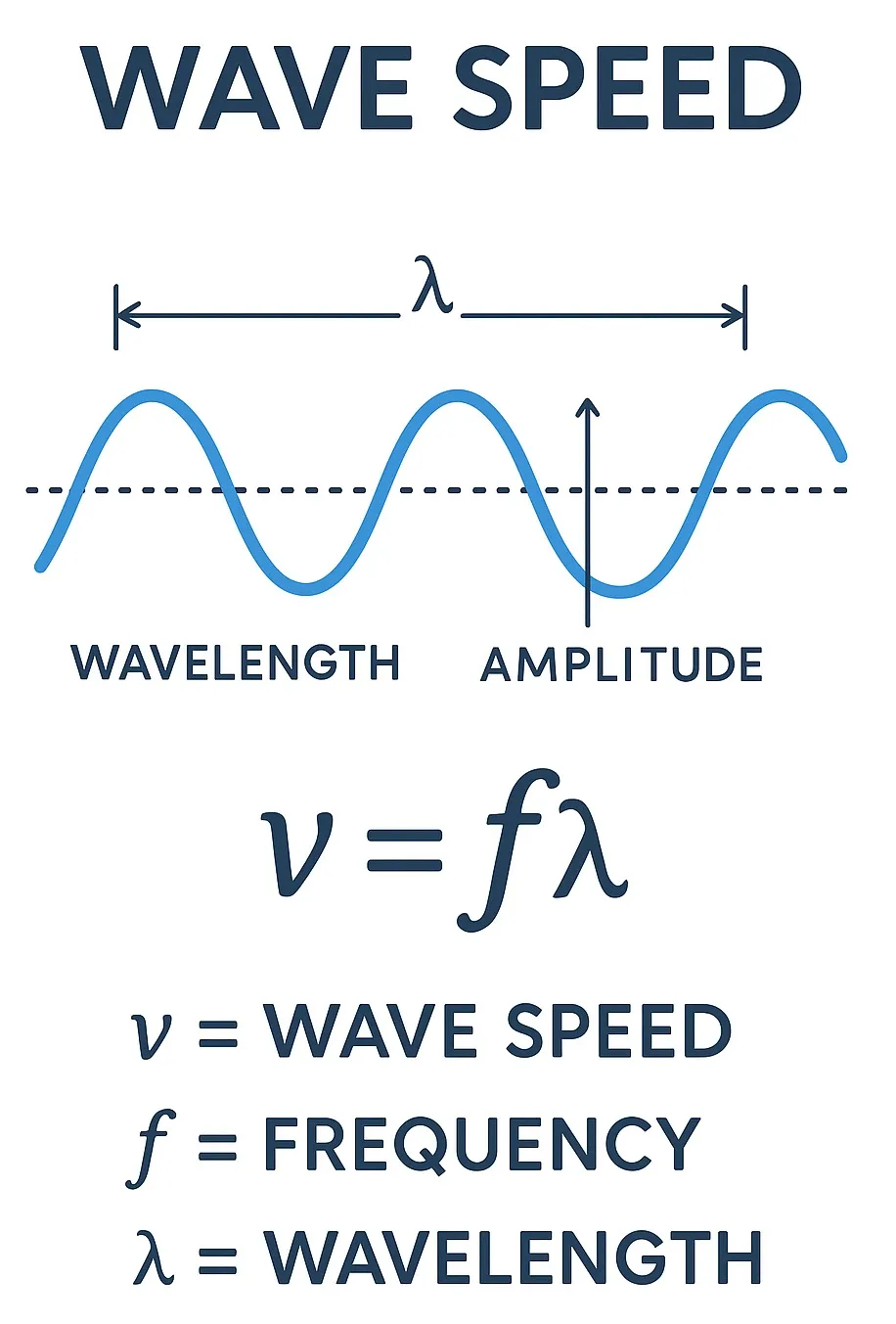
Wave speed is a key concept in physical science, helping us understand how energy travels through different materials. Scientists use the formula speed = wavelength × frequency to calculate how fast a wave moves. Knowing wave speed allows us to predict how sound, light, and other waves behave in various situations and environments.
The Mechanism of Wave Speed
The medium—the material a wave travels through—plays a crucial role in determining wave speed. For example, sound waves move faster in water than in air because water molecules are closer together, making it easier for vibrations to pass from particle to particle. The wavelength is the distance between two consecutive wave crests, while frequency refers to how many waves pass a point each second. When you multiply wavelength (measured in meters) by frequency (measured in hertz), you get the wave’s speed (in meters per second). If a water wave has a wavelength of 2 meters and a frequency of 5 hertz, its speed is 10 meters per second (2 m × 5 Hz = 10 m/s).
Applications and Real-World Examples
Wave speed is not a property of the wave itself but of the medium. For instance, sound travels at about 343 m/s in air, but at 1,480 m/s in water. Light waves behave differently: they move fastest in a vacuum (about 300,000,000 m/s), slow down in air, and are even slower in glass. This explains why light bends, or refracts, when it passes from air into water or glass. Understanding wave speed helps engineers design better communication systems and medical imaging devices, such as ultrasound machines. It also explains phenomena like echoes and why thunder is heard after lightning is seen.
Exceptions and Interactions
Sometimes, the properties of a medium can change, affecting wave speed. For example, temperature can make air molecules move faster or slower, which changes how quickly sound travels. In solids, wave speed generally increases with density, but in gases, lower density often means faster wave movement. These interactions show that wave speed depends on the system as a whole, not just the wave or the medium alone.
Wave speed is a fundamental principle in science, connecting to broader ideas like energy transfer and the behavior of matter. By understanding how and why waves move at different speeds, scientists can solve problems in technology, safety, and everyday life.
Interesting Fact: Light slows down by about 33% when it passes from air into glass, which is why lenses can bend and focus light to form images in cameras and glasses.
What formula is used to calculate wave speed?
speed = wavelength × frequencyspeed = mass × accelerationspeed = energy × distancespeed = frequency ÷ wavelength
Which factor does NOT affect wave speed?
The mediumThe wavelengthThe frequencyThe color of the wave
What is the main reason sound travels faster in water than in air?
Water molecules are closer together than air moleculesSound is louder in waterWater is colder than airWaves are smaller in water
What happens to light when it passes from air into glass?
It speeds upIt slows downIt stops movingIt disappears
In the passage, what does 'frequency' mean?
How many waves pass a point each secondHow tall a wave isHow loud a sound isHow dense the medium is
What does the term 'refraction' refer to in the passage?
The bending of a wave as it passes from one medium to anotherThe speed of a wave in a vacuumThe vibration of particlesThe loudness of sound
Why do we hear thunder after we see lightning?
Sound waves travel slower than light wavesLight waves are louder than soundThunder happens after lightningWavelength is shorter for lightning
If the wavelength is 3 meters and the frequency is 4 hertz, what is the wave speed?
7 m/s12 m/s1.33 m/s0.75 m/s
True or False: Wave speed is always the same for a wave, no matter what it travels through.
TrueFalse
True or False: Temperature can change the speed of sound in air.
TrueFalse
Perfect For:
👩🏫 Teachers
• Reading comprehension practice
• Auto-graded assessments
• Literacy skill development
👨👩👧👦 Parents
• Reading practice at home
• Comprehension improvement
• Educational reading time
🏠 Homeschoolers
• Reading curriculum support
• Independent reading practice
• Progress monitoring
Reading Features:
📖
Reading Passage
Engaging fiction or nonfiction text
❓
Comprehension Quiz
Auto-graded questions
📊
Instant Feedback
Immediate results and scoring
📄
Printable Version
Download for offline reading
🔊
Read Aloud
Voice-over with word highlighting
Reviews & Ratings
No reviews yet. Be the first to share your experience!
Related Content
Wavelength and Frequency
This engaging middle school science passage explores the concepts of wavelength and frequency, aligning with NGSS standa...
MS-PS4-1
Remote Sensing
This middle school science passage introduces students to the concept of remote sensing—the collection of information ab...
MS-ESS3-3MS-PS4-2MS-ETS1-1MS-ETS1-3
The Electromagnetic Spectrum
This comprehensive science reading passage introduces middle school students (grades 6-8) to the electromagnetic spectru...
MS-PS4-1MS-PS4-2
Transverse and Longitudinal Waves
This passage introduces middle school students to the fundamental concepts of transverse and longitudinal waves, in alig...
MS-PS4-1
Parts of a Wave
This informational passage, aligned with NGSS MS-PS4-1, introduces middle school students (grades 6-8) to the anatomy of...
MS-PS4-1
Wave Amplitude and Energy
This comprehensive middle school science passage explores the connection between wave amplitude and energy, aligned with...
MS-PS4-1
How Sound Is Produced
This comprehensive middle school science passage explores the fundamental question of how sound is produced, perfectly a...
MS-PS4-1
What Is Sound?
This passage explores the science of sound for middle school students, aligned with NGSS standards MS-PS4-1 and MS-PS4-2...
MS-PS4-1MS-PS4-2
Frequency and Pitch
This comprehensive passage for grades 6-8 introduces students to the concepts of frequency and pitch, aligned to NGSS st...
MS-PS4-1
Amplitude and Volume
This comprehensive middle school science reading passage introduces students to the concepts of amplitude and volume in ...
MS-PS4-1
Speed of Sound
This comprehensive passage for grades 6-8 explores the science behind the speed of sound and how it varies depending on ...
MS-PS4-1MS-PS4-2
Measuring Sound in Decibels
This science reading passage introduces middle school students to the concept of measuring sound using decibels (dB). Al...
MS-PS4-1
Ultrasound and Infrasound
This engaging middle school science passage introduces students to the concepts of ultrasound and infrasound, frequencie...
MS-PS4-1
Musical Instruments and Sound
This comprehensive science passage for grades 6-8 explores how musical instruments create sound through vibration, align...