Animals of the Taiga Biome — Reading Comprehension
Rate this
Premium Resource
Present
Present in classroom. No work saved
Assign
Classroom with student accounts, Track progress
Quick Play
No student accounts, assign with a link
Grades
6
PRINT+DIGITAL RESOURCE
This learning resource is available in interactive and printable formats. The interactive worksheet can be played online and assigned to students. The Printable PDF version can be downloaded and printed for completion by hand.
This educational passage, audio integrated for an enhanced learning experience, delves into the fascinating world of animals inhabiting the Taiga biome. Students will discover how genetic variations in traits allow creatures like the snowshoe hare, lynx, and moose to thrive in extremely cold conditions. The content explores key adaptations such as camouflage, thick fur, and specialized diets, directly addressing NGSS standard MS-LS4-4 by explaining how these variations increase an individual's probability of surviving and reproducing. It's a perfect resource for understanding natural selection and environmental pressures in a boreal forest setting, featuring relevant keywords like animal adaptations, genetic variations, and survival.
CONTENT PREVIEW
Expand content preview
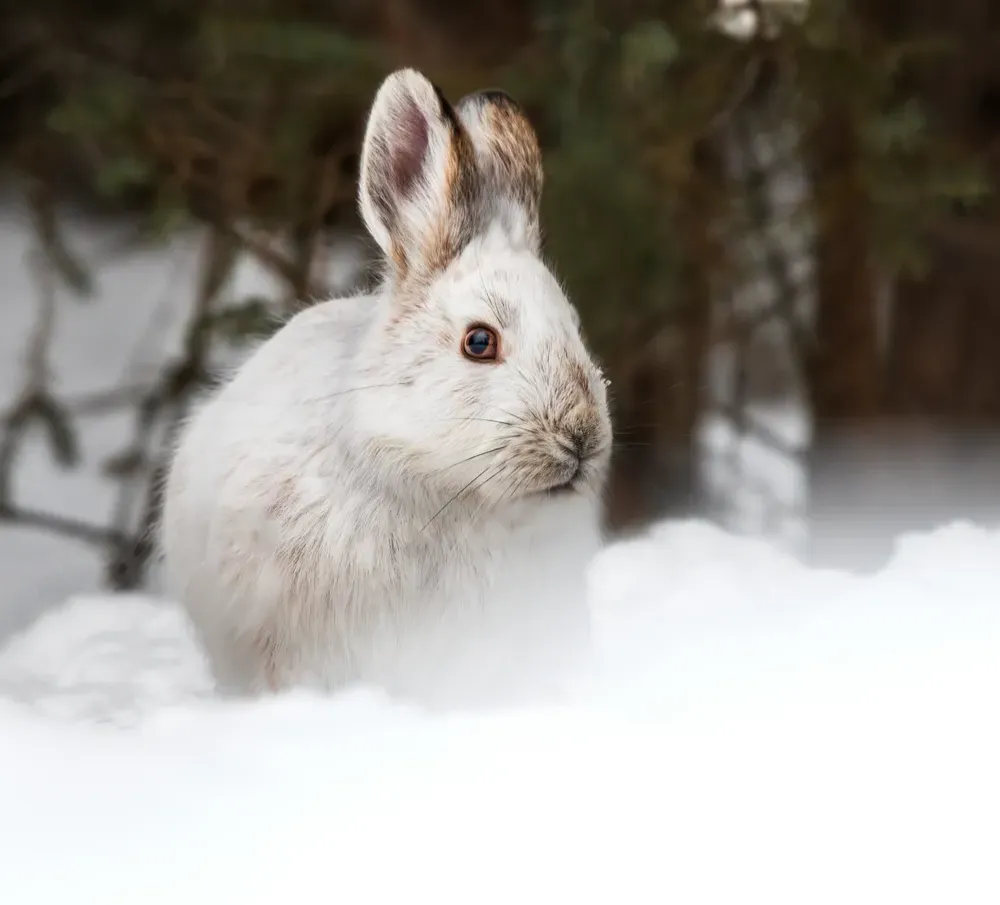
"Snowshoe hare" by USFWS Midwest Region from Midwest Region, United States / Wikimedia Commons.
Imagine a vast, evergreen forest stretching across cold northern lands. This is the Taiga biome, also known as the boreal forest. It's a challenging place to live, with long, harsh winters, heavy snowfall, and short, cool summers. Yet, many incredible animals call this icy world home. How do they survive? The answer lies in their adaptations – special features or behaviors that help them live in their specific environment.
One remarkable example is the snowshoe hare. These hares have a brilliant trick: their fur changes color with the seasons. In summer, it's brown, blending in perfectly with the dirt and trees. But as winter approaches, their fur turns bright white, making them almost invisible against the snow. This color change is a genetic variation, a difference in their genes, that gives them a huge advantage. Hares with this ability are better at hiding from predators like the lynx, increasing their chances of surviving and reproducing. Hares that don't change color as effectively are more easily spotted, making them less likely to pass on their genes.
The lynx itself is also perfectly adapted to the Taiga. It has extremely thick fur, providing excellent insulation against the cold. Its large, wide paws act like natural snowshoes, spreading its weight and allowing it to move silently over deep snow without sinking. These traits are also genetic variations that have become common in the lynx population because they help the lynx hunt snowshoe hares, its primary food source, effectively.
Another iconic Taiga animal is the moose. Moose are the largest members of the deer family, and their size helps them conserve heat in the cold. They also have a thick coat and a layer of fat for insulation. A unique adaptation is their long legs, which help them wade through deep snow and marshy areas to find food like twigs, bark, and aquatic plants. Their broad muzzles are perfect for grabbing these tough plants. Like other Taiga animals, moose with these successful traits are more likely to survive and pass on their genetic variations to their offspring.
In the Taiga, every successful trait, from a hare's changing fur to a lynx's wide paws, is a testament to how genetic variations help animals survive and reproduce in a specific, challenging environment. These traits are passed down through generations, making the species stronger and better suited to their home.
Interesting Fact: A single lynx can eat up to two snowshoe hares a day, which shows how important the hare population is to the lynx's survival.
Which animal changes its fur color?
LynxMooseSnowshoe hareBear
What is another name for the Taiga biome?
DesertRainforestBoreal forestSavanna
Why do snowshoe hares change fur color?
To attract matesTo find foodTo hide from predatorsTo keep warm
What helps a lynx move in deep snow?
Small feetStrong tailLarge, wide pawsLight body
How do moose conserve heat?
Thin furSmall sizeThick coat, fatRunning fast
Genetic variations help animals survive.
TrueFalse
Which term describes special features that help an organism survive?
MigrationHibernationAdaptationsPredation
Why is a lynx's thick fur an adaptation?
For swimmingFor camouflageFor insulationFor hunting
If a snowshoe hare was born without the ability to change fur color, what would likely happen?
It would be faster.It would eat more.Less likely to survive.It would grow larger.
What would happen if the Taiga biome became much warmer all year round?
Animals need less fur.Snowshoe hares thrive.Lynx would eat more.Moose would shrink.
Perfect For:
👩🏫 Teachers
• Reading comprehension practice
• Auto-graded assessments
• Literacy skill development
👨👩👧👦 Parents
• Reading practice at home
• Comprehension improvement
• Educational reading time
🏠 Homeschoolers
• Reading curriculum support
• Independent reading practice
• Progress monitoring
Reading Features:
📖
Reading Passage
Engaging fiction or nonfiction text
❓
Comprehension Quiz
Auto-graded questions
📊
Instant Feedback
Immediate results and scoring
📄
Printable Version
Download for offline reading
🔊
Read Aloud
Voice-over with word highlighting
Reviews & Ratings
No reviews yet. Be the first to share your experience!
Related Content
Understanding Biological Evolution and Diversity
This passage addresses the NGSS standard 3-LS4-2 focusing on biological evolution and the unity and diversity of life. T...
RI.3.3RI.4.3RI.5.33-LS4-2
Theory of Evolution
This middle school science passage explains the theory of evolution and the concept of common ancestry, aligning with NG...
MS-LS4-1MS-LS4-2
Evidence for Evolution: Comparative Anatomy
This middle school science reading passage explores the evidence for evolution through comparative anatomy, aligning wit...
MS-LS4-2MS-LS4-3
The Nature of Life Science
This passage, aligned with NGSS MS-LS1-1, introduces students in grades 6-8 to the foundational concepts of life science...
MS-LS1-1
Human Evolution
This middle school science passage explains the scientific evidence for human evolution, aligning with NGSS standards MS...
MS-LS4-1MS-LS4-2
The Giant Isopod: Biological Evolution
This NGSS passage examines how giant isopods evolved for deep-sea survival, including slow metabolism for food scarcity,...
MS-LS4-4RI.6.3RI.7.3RI.8.8
Evidence for Evolution: The Fossil Record
This middle school science passage explains the importance of fossils as preserved evidence of ancient life and their ro...
MS-LS4-1
Science Vocabulary
This worksheet on domain-specific words will help students learn some science vocabulary. Students will be asked to matc...
L.3.6L.3.4.A
Simple Machines Science Report
This science writing task requires students to clearly explain how three simple machines work using precise domain-speci...
W.5.4
The Science of Hibernation
This educational module, featuring an audio-integrated reading passage titled 'The Science of Hibernation,' is designed ...
What is an amphibian
This audio-integrated reading passage, "The Life of Amphibians," is designed for 4th-grade students to explore the fasci...
The Levels of Australopithecus
This educational content offers an engaging, audio-integrated reading passage titled 'The Levels of Biological Classific...
The Pumpkin Life Cycle
This informational worksheet explores the pumpkin lifecycle, guiding students through procedural steps in a scientific t...
RI.2.3RI.2.10
The Nature of Science
This passage explores the nature of science for middle school students, aligning with NGSS standards MS-ETS1-4, MS-PS1-1...
MS-ETS1-4MS-PS1-1MS-LS1-1
What Is Earth Science?
This engaging middle school science passage introduces students to the field of Earth science, aligning with NGSS standa...
MS-ESS1MS-ESS2MS-ESS3SEP
The Life Cycle of an Angiosperm
This educational content package delves into the intriguing world of angiosperms and their complex life cycles, perfectl...
Citizen Science and Ecological Monitoring
This engaging passage for grades 6-8 introduces the concept of citizen science and its critical role in ecological monit...
MS-LS2-1
Tools and Technology in Earth Science
This middle school science reading passage explores the wide range of tools and technologies used in Earth science, from...
MS-ESS2-2MS-ESS3-2MS-ETS1-1MS-PS4-3
Barnacle Life Cycle
This audio-integrated reading passage, "Barnacle Life Cycle," delves into the intriguing growth and development of barna...
History of Life on Earth
This comprehensive middle school science reading passage provides an engaging overview of the history of life on Earth, ...