What Fossil Evidence Supports Drift
Interactive passage with audio narration, comprehension questions, and printable PDF.
By completing this purchase you agree to our Terms of Use and Privacy Policy. Your subscription renews automatically until you cancel. You can cancel anytime from your account settings. All sales are final and non-refundable. Digital content is available for download in your account immediately upon purchase.
What's included
What Fossil Evidence Supports Drift preview and details
About this printable What Fossil Evidence Supports Drift science reading passage, NGSS-aligned (Grades 5-8)
Sample passage and quiz from What Fossil Evidence Supports Drift
Reading passage and comprehension quiz preview
What Fossil Evidence Supports Drift
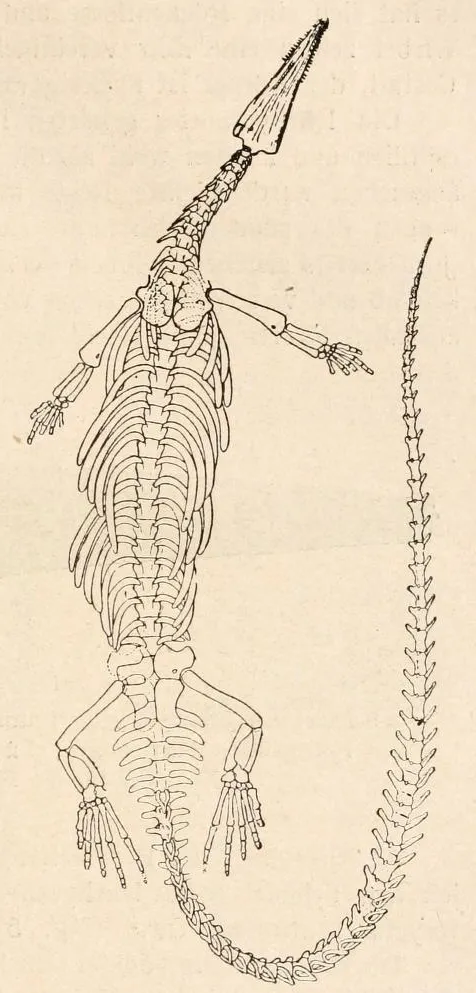
"Mesosaurus skeleton, by Othenio Abel (1919) / Wikimedia Commons
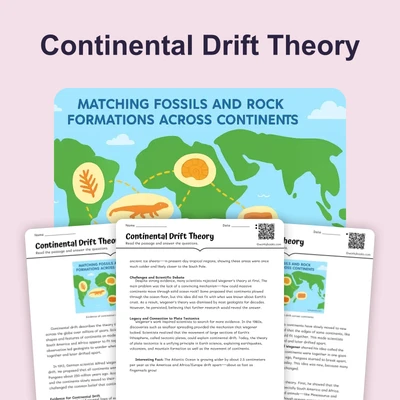
Some of the strongest evidence for continental drift comes from fossils found on continents now separated by thousands of miles of ocean. Scientists have discovered identical fossils of the same ancient species on landmasses that are far apart today. This creates a fascinating puzzle that helps explain Earth's history.
One key example is Mesosaurus, a small freshwater reptile that lived about 280 million years ago. Fossils of this creature appear only in South America and Africa. Evidence shows that Mesosaurus could not have swum across a salty ocean. Its body was adapted for freshwater environments, not saltwater. The Atlantic Ocean between these continents is over 3,000 miles wide today. No freshwater reptile could survive such a journey through salt water.
Another important example is Glossopteris, an ancient fern-like plant. Scientists have found Glossopteris fossils across South America, Africa, India, Australia, and even Antarctica. This distribution pattern seems impossible at first. The seeds of Glossopteris were too heavy to be carried by wind across oceans. They could not drift thousands of miles on ocean currents either. Yet the same plant species appears on all these separated continents.
The simplest explanation for these matching fossils is that the continents were once joined together. When landmasses were connected, species like Mesosaurus and Glossopteris could spread across them easily. Animals walked across the land, and plant seeds fell nearby and grew. Later, the continents slowly drifted apart over millions of years. This process is called continental drift. The fossils remained in the rocks as evidence of this ancient connection.
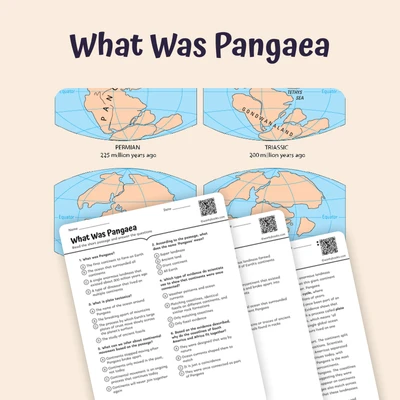
Scientists use fossil distribution patterns to reconstruct how continents fit together in the past. When researchers match fossil locations on a map, they can see how landmasses once formed a supercontinent called Pangaea. This giant landmass existed about 300 million years ago. Over time, Pangaea broke apart, and the pieces drifted to their current positions.
Understanding fossil evidence for continental drift matters because it helps explain Earth's dynamic surface. The same forces that moved continents in the past continue to shape our planet today. Mountain ranges form, earthquakes occur, and volcanoes erupt because of these ongoing movements. Fossil evidence provides a window into Earth's ancient past and helps us understand how our planet changes over geologic time.
Interesting Fact: Scientists have found fossils of the same species of earthworm on continents now separated by the Atlantic Ocean, providing additional evidence that these landmasses were once connected.
Comprehension quiz (10 questions)
1. Where are Mesosaurus fossils found today?
2. Why couldn't Mesosaurus have swum across the Atlantic Ocean?
3. What does the term 'distribution' mean in the context of fossil evidence?
4. Why couldn't Glossopteris seeds have drifted across oceans?
5. Based on the passage, what is the simplest explanation for matching fossils on separated continents?
6. What was Pangaea?
7. How do scientists use fossil distribution patterns?
8. Why does understanding continental drift matter today?
9. True or False: Glossopteris fossils have been found on five different continents including Antarctica.
10. True or False: Continental drift happened quickly over just a few hundred years.
Perfect for the way you teach
- Build comprehension skills
- Auto-graded quiz
- Differentiated reading
- Read together at home
- Improve fluency
- Quiet reading time
- Reading curriculum support
- Independent practice
- Track Lexile growth