What Was Pangaea
Interactive passage with audio narration, comprehension questions, and printable PDF.
What's included
What Was Pangaea preview and details
About this printable What Was Pangaea science reading passage, NGSS-aligned (Grades 5-8)
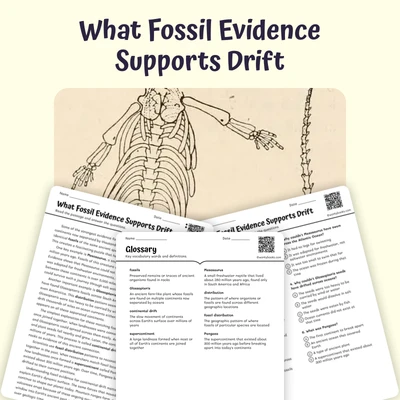
Sample passage and quiz from What Was Pangaea
Reading passage and comprehension quiz preview
What Was Pangaea
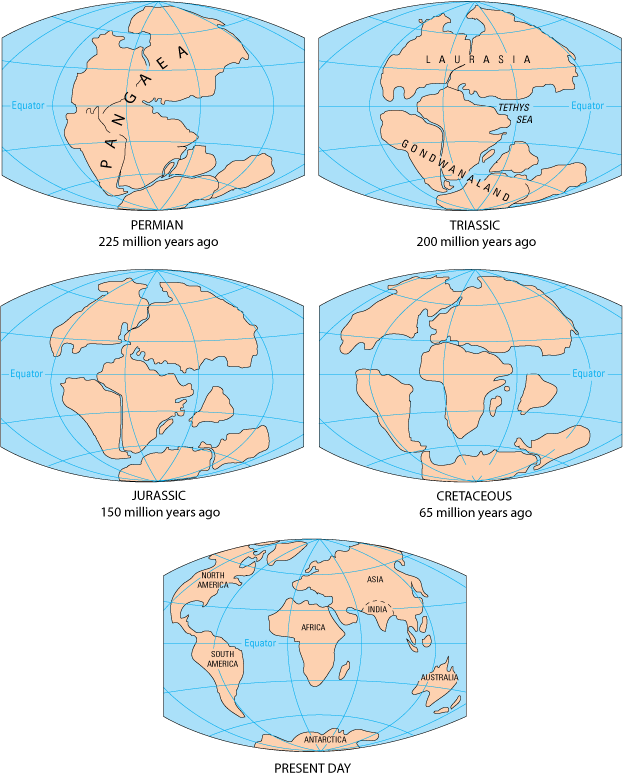
The breakup of Pangaea and motion of their continents to their present-day positions by Kious, Jacquelyne; Tilling, Robert I.; Kiger, Martha, Russel, Jane.This Dynamic Earth: The Story of Plate Tectonics. (Online ed.). Reston, Virgina, USA: United States Geological Survey.
Pangaea was Earth's most recent supercontinent, a single enormous landmass that existed about 300 million years ago. Scientists explain that this giant continent formed when separate landmasses collided and joined together. Pangaea represented just one stage in Earth's ongoing supercontinent cycle, where continents repeatedly join and separate over hundreds of millions of years.
The formation of Pangaea began when continents that had once been part of an earlier supercontinent called Rodinia drifted back together. Evidence shows that these landmasses moved slowly across Earth's surface through a process called plate tectonics. When the continents collided, they formed Pangaea, which means "all Earth" in Greek. This massive continent was surrounded by a single global ocean called Panthalassa. During this time, reptiles and early dinosaurs lived on one connected landmass rather than separate continents.
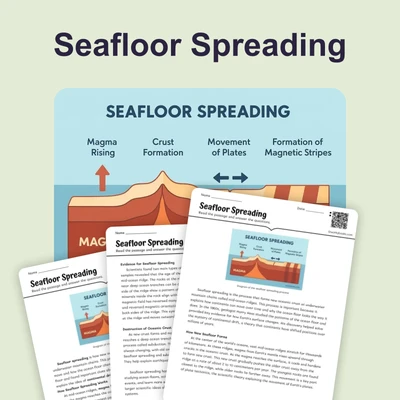
Around 200 million years ago, Pangaea began to break apart. The continent split into smaller pieces that slowly drifted toward their current positions. Scientists observe that this breakup created the Atlantic Ocean as the Americas separated from Europe and Africa. The process of continental drift continues today, with continents still moving a few centimeters each year. Because Pangaea is the most recent supercontinent, it left clearer evidence than older supercontinents.
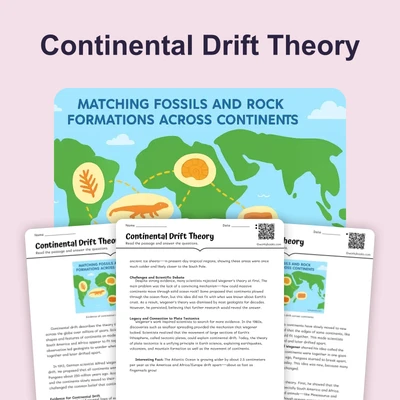
Scientists study several types of evidence to understand Pangaea. The coastlines of South America and Africa fit together like puzzle pieces, suggesting they were once connected. Fossils of identical plant and animal species appear on continents now separated by oceans. Rock formations and mountain ranges also match across different continents. This evidence supports the explanation that these landmasses were once part of a single supercontinent.
Understanding Pangaea helps scientists explain Earth's geological history and predict future changes. The supercontinent cycle shows that Earth's surface can change dramatically over time. Pangaea's formation and breakup influenced climate patterns, ocean currents, and the evolution of life. Scientists use evidence from Pangaea to better understand how plate tectonics shapes our planet.
Interesting Fact: When Pangaea existed, you could walk from what is now North America to Africa without crossing any ocean!
Comprehension quiz (10 questions)
1. What was Pangaea?
2. According to the passage, what does the name 'Pangaea' mean?
3. What is plate tectonics?
4. Which type of evidence do scientists use to show that continents were once connected?
5. What can we infer about continental movement based on the passage?
6. Based on the evidence described, why do the coastlines of South America and Africa fit together?
7. How might understanding Pangaea help scientists predict future changes to Earth?
8. If identical fossils of a land animal are found on two continents separated by an ocean, what does this suggest?
9. True or False: Pangaea began to break apart around 200 million years ago.
10. True or False: Rodinia was formed after Pangaea broke apart.
Perfect for the way you teach
- Build comprehension skills
- Auto-graded quiz
- Differentiated reading
- Read together at home
- Improve fluency
- Quiet reading time
- Reading curriculum support
- Independent practice
- Track Lexile growth