How Do Scientists Date Seafloor Rocks
Interactive passage with audio narration, comprehension questions, and printable PDF.
By completing this purchase you agree to our Terms of Use and Privacy Policy. Your subscription renews automatically until you cancel. You can cancel anytime from your account settings. All sales are final and non-refundable. Digital content is available for download in your account immediately upon purchase.
What's included
How Do Scientists Date Seafloor Rocks preview and details
About this printable How Do Scientists Date Seafloor Rocks science reading passage, NGSS-aligned (Grades 5-8)
Sample passage and quiz from How Do Scientists Date Seafloor Rocks
Reading passage and comprehension quiz preview
How Do Scientists Date Seafloor Rocks
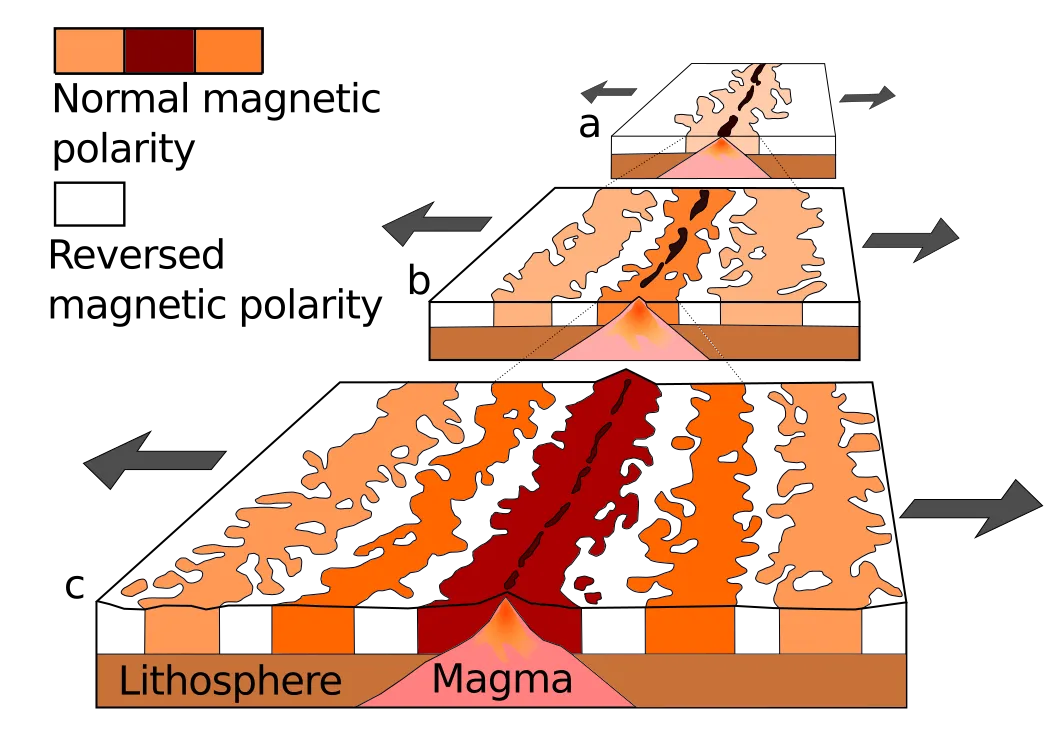
A theoretical model of the formation of magnetic striping by Chmee2 / Wikimedia Commons. New oceanic crust forming continuously at the crest of the mid-ocean ridge cools and becomes increasingly older as it moves away from the ridge crest with seafloor spreading:
a. the spreading ridge about 5 million years ago.
b. about 2 to 3 million years ago.
c. present-day.
To confirm the theory of seafloor spreading, scientists needed to determine the age of ocean floor rocks at different distances from mid-ocean ridges. Evidence shows that the seafloor gets steadily older as you move away from these underwater mountain chains. Scientists use three main methods to date seafloor rocks, and all three methods produce consistent results.
The first method is radiometric dating, which measures the steady decay of radioactive elements inside rocks. Radioactive elements break down at known rates, acting like a built-in clock. Scientists measure how much of the original radioactive element remains compared to its decay products. This calculation reveals how long ago the rock formed. When scientists apply this method to seafloor rocks, they find that rocks closest to mid-ocean ridges are youngest.
The second method uses magnetic stripes found in seafloor rocks. Earth's magnetic field has reversed many times throughout history, and rocks record the direction of the magnetic field when they form. Scientists have created a timeline of these magnetic reversals by studying rocks on land. When they match a magnetic stripe on the seafloor to a known reversal in the timeline, they can determine when that strip of ocean floor formed. This pattern creates symmetrical stripes on both sides of mid-ocean ridges.
The third method involves drilling ships that collect sediment cores from the ocean floor. These cores contain layers of sediment that have accumulated on top of the seafloor rock over millions of years. Scientists observe that sediment is thicker and contains older fossils farther from the ridge. Near the ridge, sediment layers are thin because the rock is young and has had less time to collect sediment. This observation supports the pattern revealed by the other two methods.
In the 1960s and 1970s, the Deep Sea Drilling Project collected hundreds of core samples from ocean floors worldwide. Scientists analyzed these samples and found the same pattern everywhere: youngest rocks at ridges, oldest rocks farthest away. The oldest ocean floor rocks are about 200 million years old, while the oldest continental rocks can be over 4 billion years old. This difference occurs because seafloor rocks eventually sink back into Earth's mantle at subduction zones, while continental rocks remain at the surface.
Understanding seafloor age patterns matters because it confirms how Earth's outer layer moves and changes. This knowledge helps scientists explain earthquakes, volcanic activity, and the formation of ocean basins. The agreement among multiple dating methods strengthens scientific confidence in the theory of plate tectonics.
Interesting Fact: The Atlantic Ocean grows about 2.5 centimeters wider each year as new seafloor forms at the Mid-Atlantic Ridge. That means the ocean has widened by about 25 meters since your grandparents were born!
Comprehension quiz (10 questions)
1. What pattern do scientists observe when they date seafloor rocks at different distances from mid-ocean ridges?
2. How does radiometric dating determine the age of rocks?
3. What does the term 'magnetic reversals' mean in the context of seafloor dating?
4. Why is sediment thicker farther from mid-ocean ridges?
5. According to the passage, what is the approximate age of the oldest ocean floor rocks?
6. What happens to seafloor rocks at subduction zones?
7. If a scientist finds a magnetic stripe on the seafloor that matches a known magnetic reversal from 50 million years ago, what can they conclude?
8. Why does the agreement among multiple dating methods strengthen scientific confidence?
9. True or False: Continental rocks are older than ocean floor rocks because seafloor rocks eventually sink back into Earth's mantle.
10. True or False: The magnetic stripe patterns on the seafloor are random and do not show any symmetry around mid-ocean ridges.
Perfect for the way you teach
- Build comprehension skills
- Auto-graded quiz
- Differentiated reading
- Read together at home
- Improve fluency
- Quiet reading time
- Reading curriculum support
- Independent practice
- Track Lexile growth