Are Archaea Bacteria? The Three Domains
Interactive passage with audio narration, comprehension questions, and printable PDF.
By completing this purchase you agree to our Terms of Use and Privacy Policy. Your subscription renews automatically until you cancel. You can cancel anytime from your account settings. All sales are final and non-refundable. Digital content is available for download in your account immediately upon purchase.
What's included
Are Archaea Bacteria? The Three Domains preview and details
About this printable Are Archaea Bacteria? The Three Domains science reading passage, NGSS-aligned (Grade 6)
Sample passage and quiz from Are Archaea Bacteria? The Three Domains
Reading passage and comprehension quiz preview
Are Archaea Bacteria? The Three Domains
Imagine tiny living things, too small to see, thriving in places no other life could survive. These incredible creatures are often mistaken for bacteria, but scientists have discovered they are quite unique. They are called Archaea, and understanding them helps us grasp how life on Earth is classified.
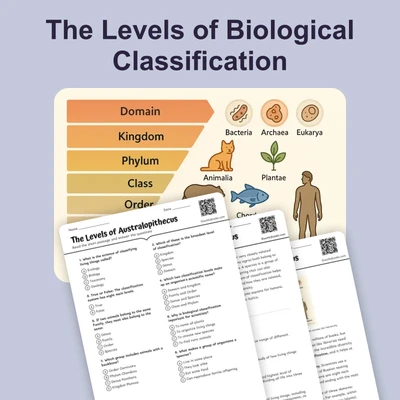
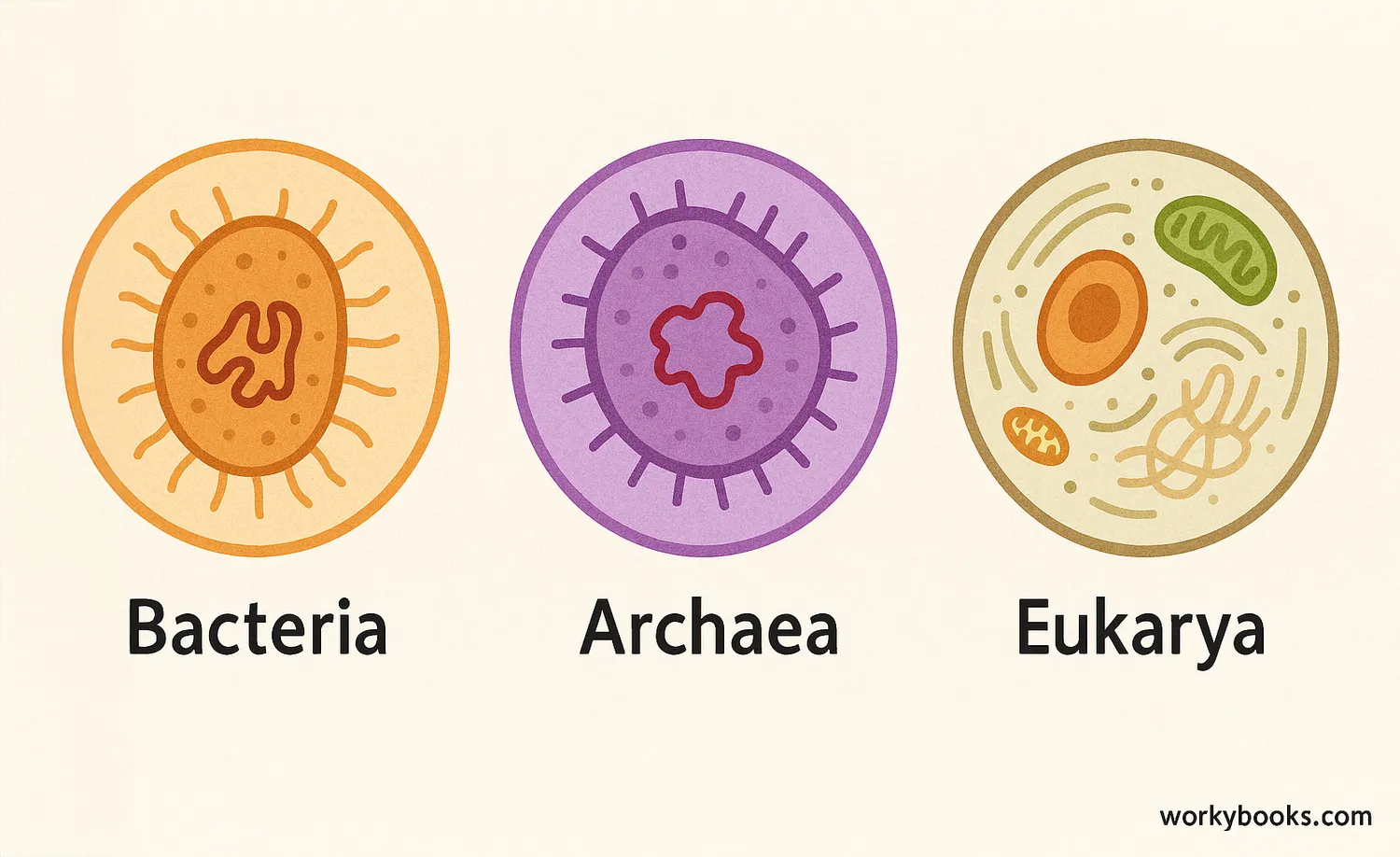
For a long time, scientists thought there were only two main types of cells: those with a nucleus (like animals and plants) and those without (like bacteria). However, new scientific ideas and genetic studies in the 1970s revealed a deeper truth about life's diversity. This led to the creation of the Three Domains of Life, which are Bacteria, Archaea, and Eukarya. This classification helps us infer evolutionary relationships, showing how different forms of life are connected.
Both Bacteria and Archaea are prokaryotes, meaning their cells do not have a nucleus or other membrane-bound organelles. They are single-celled microorganisms. So, if they both lack a nucleus, why aren't Archaea just a type of bacteria? The answer lies in their fundamental differences at a molecular level. While they might look similar under a microscope, their cell walls, cell membranes, and even the machinery they use to copy their DNA and make proteins are very different.
Think of it like this: a shark and a dolphin both live in the ocean and look somewhat similar, but one is a fish and the other is a mammal. Their internal structures and evolutionary paths are distinct. Similarly, Bacteria and Archaea have evolved along separate lines, even though they both belong to the group of prokaryotes. Archaea are often found in extreme environments, like hot springs, salt lakes, or even deep-sea vents, earning them the nickname extremophiles. Bacteria, on the other hand, are incredibly diverse and live almost everywhere else – in soil, water, and even inside our bodies.
The third domain, Eukarya, includes all organisms whose cells have a nucleus and membrane-bound organelles. This domain contains a vast array of life, from tiny protists and fungi to complex plants and animals, including humans. This scientific classification system, based on evolutionary relationships and genetic information, is crucial for understanding the incredible diversity and history of life on Earth.
Interesting Fact: Some Archaea produce methane gas and are responsible for the gas released from swamps and even from the digestive systems of cows!
Comprehension quiz (10 questions)
1. Which domain includes animals and plants?
2. What feature do Archaea lack?
3. Archaea are always found in extreme environments.
4. What does 'prokaryote' mean in biology?
5. Why were Archaea initially grouped with Bacteria?
6. How do scientists classify organisms into domains?
7. Which characteristic differentiates Archaea from Bacteria?
8. Why are Archaea called 'extremophiles'?
9. If a new microorganism is discovered without a nucleus, what domain could it belong to?
10. How does classifying organisms into domains help scientists?
Perfect for the way you teach
- Build comprehension skills
- Auto-graded quiz
- Differentiated reading
- Read together at home
- Improve fluency
- Quiet reading time
- Reading curriculum support
- Independent practice
- Track Lexile growth