This learning resource is available in interactive and printable formats. The interactive worksheet can be played online and assigned to students. The Printable PDF version can be downloaded and printed for completion by hand.
This passage addresses the common misconception that dolphins are fish by explaining their biological classification as mammals. The text details key differences in respiration (lungs vs. gills), reproduction (live birth vs. laying eggs), and thermoregulation (warm-blooded vs. cold-blooded). It also highlights unique mammalian adaptations for aquatic life, such as blubber and a vertical tail fluke. The passage is designed for middle school students and aligns with NGSS standards related to the characteristics of living organisms (MS-LS1). It uses clear, concise language to explain complex biological concepts and includes a fun fact and multiple-choice questions to assess student understanding of the key concepts presented.
CONTENT PREVIEW
Expand content preview
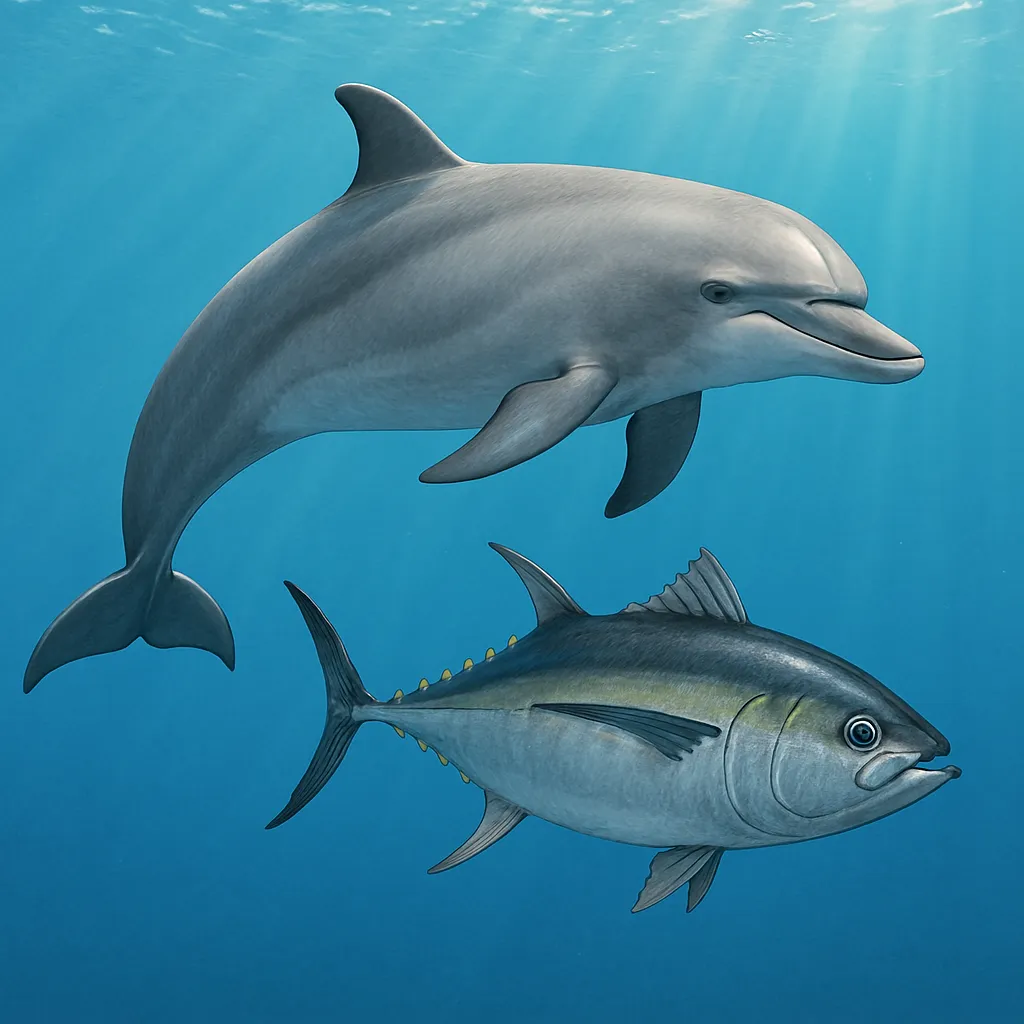
The question of whether a dolphin is a fish is a common one, likely because both live in the ocean and share some similar physical features. However, dolphins are not fish; they are mammals. This classification is based on a set of fundamental biological characteristics that distinguish them from fish and place them in the same class as humans, dogs, and whales. Understanding these differences is key to appreciating the unique adaptations of marine life.
One of the most significant differences lies in their respiratory system. Fish use gills to extract oxygen directly from the water. In contrast, dolphins have lungs and must come to the surface of the water to breathe air. A dolphin breathes through a single nostril on top of its head called a blowhole. This is a crucial adaptation for a mammal living a fully aquatic life. Another major distinction is how they reproduce. Fish typically lay eggs, a process known as spawning. Dolphins, like all mammals, give birth to live young and produce milk to feed their calves.
Beyond breathing and reproduction, dolphins possess other mammalian traits. They are warm-blooded, meaning their body can maintain a constant internal temperature regardless of the external water temperature. This is different from fish, which are cold-blooded and whose body temperature fluctuates with their environment. Dolphins also have a layer of fat called blubber under their skin, which provides insulation to help them stay warm. Their tails also move up and down to propel them through the water, while a fish's tail moves side to side. These adaptations highlight their evolutionary path as land-dwelling mammals that returned to the sea.
Dolphins are also highly intelligent and social animals, often living in groups called pods. Their complex social behaviors, communication skills, and use of echolocation—a system of using sound waves to navigate and hunt—demonstrate their advanced cognitive abilities. These behaviors, along with their physical characteristics, solidify their place in the mammalian family tree.
Fun Fact: A dolphin’s tail fin, or fluke, moves vertically (up and down) to propel it through the water, while a fish's tail fin moves horizontally (side to side).
According to the passage, what do dolphins use to breathe?
GillsLungsBlowholesBoth b and c
What is the main purpose of blubber for a dolphin?
To help it swim fasterTo provide insulationTo make it more buoyantTo store excess food
A fish's tail moves from side to side. How does a dolphin's tail move?
From side to sideUp and downIn a circular motionIt does not have a tail
Based on the passage, which characteristic is a dolphin trait?
Laying eggsHaving gillsBeing cold-bloodedGiving birth to live young
How do dolphins navigate and find prey in the water?
By using their sense of smellBy using a system of echolocationBy using their excellent eyesightBy following currents in the water
Why is a dolphin classified as a mammal instead of a fish?
It lives in the oceanIt is a warm-blooded animalIt has fins and a tailIt has a streamlined body
A scientist discovers a new marine animal. It gives birth to live young and uses lungs to breathe. Based on the passage, how should this animal be classified?
As a fish, because it lives in waterAs a mammal, because it has lungsAs a fish, because it has finsAs a mammal, because it is a new species
A student observes a fish and a dolphin swimming. The fish is moving its tail side to side, and the dolphin is moving its tail up and down. What can the student infer about their evolutionary history?
The fish and dolphin are closely relatedBoth animals evolved from the same land mammalThe dolphin evolved from a land animalThe fish evolved from a reptile
Perfect For:
👩🏫 Teachers
• Reading comprehension practice
• Auto-graded assessments
• Literacy skill development
👨👩👧👦 Parents
• Reading practice at home
• Comprehension improvement
• Educational reading time
🏠 Homeschoolers
• Reading curriculum support
• Independent reading practice
• Progress monitoring
Reading Features:
📖
Reading Passage
Engaging fiction or nonfiction text
❓
Comprehension Quiz
Auto-graded questions
📊
Instant Feedback
Immediate results and scoring
📄
Printable Version
Download for offline reading
🔊
Read Aloud
Voice-over with word highlighting
Reviews & Ratings
No reviews yet. Be the first to share your experience!
Related Content
Understanding Biological Evolution and Diversity
This passage addresses the NGSS standard 3-LS4-2 focusing on biological evolution and the unity and diversity of life. T...
RI.3.3RI.4.3RI.5.33-LS4-2
Theory of Evolution
This middle school science passage explains the theory of evolution and the concept of common ancestry, aligning with NG...
MS-LS4-1MS-LS4-2
Evidence for Evolution: Comparative Anatomy
This middle school science reading passage explores the evidence for evolution through comparative anatomy, aligning wit...
MS-LS4-2MS-LS4-3
The Nature of Life Science
This passage, aligned with NGSS MS-LS1-1, introduces students in grades 6-8 to the foundational concepts of life science...
MS-LS1-1
Human Evolution
This middle school science passage explains the scientific evidence for human evolution, aligning with NGSS standards MS...
MS-LS4-1MS-LS4-2
The Giant Isopod: Biological Evolution
This NGSS passage examines how giant isopods evolved for deep-sea survival, including slow metabolism for food scarcity,...
MS-LS4-4RI.6.3RI.7.3RI.8.8
Evidence for Evolution: The Fossil Record
This middle school science passage explains the importance of fossils as preserved evidence of ancient life and their ro...
MS-LS4-1
Science Vocabulary
This worksheet on domain-specific words will help students learn some science vocabulary. Students will be asked to matc...
L.3.6L.3.4.A
Simple Machines Science Report
This science writing task requires students to clearly explain how three simple machines work using precise domain-speci...
W.5.4
The Science of Hibernation
This educational module, featuring an audio-integrated reading passage titled 'The Science of Hibernation,' is designed ...
What is an amphibian
This audio-integrated reading passage, "The Life of Amphibians," is designed for 4th-grade students to explore the fasci...
The Levels of Australopithecus
This educational content offers an engaging, audio-integrated reading passage titled 'The Levels of Biological Classific...
The Pumpkin Life Cycle
This informational worksheet explores the pumpkin lifecycle, guiding students through procedural steps in a scientific t...
RI.2.3RI.2.10
The Nature of Science
This passage explores the nature of science for middle school students, aligning with NGSS standards MS-ETS1-4, MS-PS1-1...
MS-ETS1-4MS-PS1-1MS-LS1-1
What Is Earth Science?
This engaging middle school science passage introduces students to the field of Earth science, aligning with NGSS standa...
MS-ESS1MS-ESS2MS-ESS3SEP
The Life Cycle of an Angiosperm
This educational content package delves into the intriguing world of angiosperms and their complex life cycles, perfectl...
Citizen Science and Ecological Monitoring
This engaging passage for grades 6-8 introduces the concept of citizen science and its critical role in ecological monit...
MS-LS2-1
Tools and Technology in Earth Science
This middle school science reading passage explores the wide range of tools and technologies used in Earth science, from...
MS-ESS2-2MS-ESS3-2MS-ETS1-1MS-PS4-3
Barnacle Life Cycle
This audio-integrated reading passage, "Barnacle Life Cycle," delves into the intriguing growth and development of barna...
History of Life on Earth
This comprehensive middle school science reading passage provides an engaging overview of the history of life on Earth, ...