This learning resource is available in interactive and printable formats. The interactive worksheet can be played online and assigned to students. The Printable PDF version can be downloaded and printed for completion by hand.
This comprehensive science passage, designed for middle school students, clarifies the common misconception that snails are insects. It provides a detailed explanation of biological classification, or taxonomy, to distinguish between the two. The passage describes the defining characteristics of snails as mollusks (phylum Mollusca) and compares them to the defining traits of insects as arthropods (phylum Arthropoda). Key concepts such as the snail's soft, unsegmented body and shell, and the insect's segmented body and exoskeleton, are explained with clear and direct language. The text is aligned with NGSS standards related to organisms' structures and functions, making it a valuable resource for teachers and students.
CONTENT PREVIEW
Expand content preview
Snails and insects are often found in similar environments, such as gardens and forests, which can lead to confusion about their classification. However, they belong to entirely different scientific categories. All living things are organized into a hierarchical system of classification, starting with broad categories and narrowing down to specific species. This system, known as taxonomy, helps scientists understand the relationships between different organisms. At the highest level, snails and insects are both in the Kingdom Animalia, but their paths diverge significantly from there.
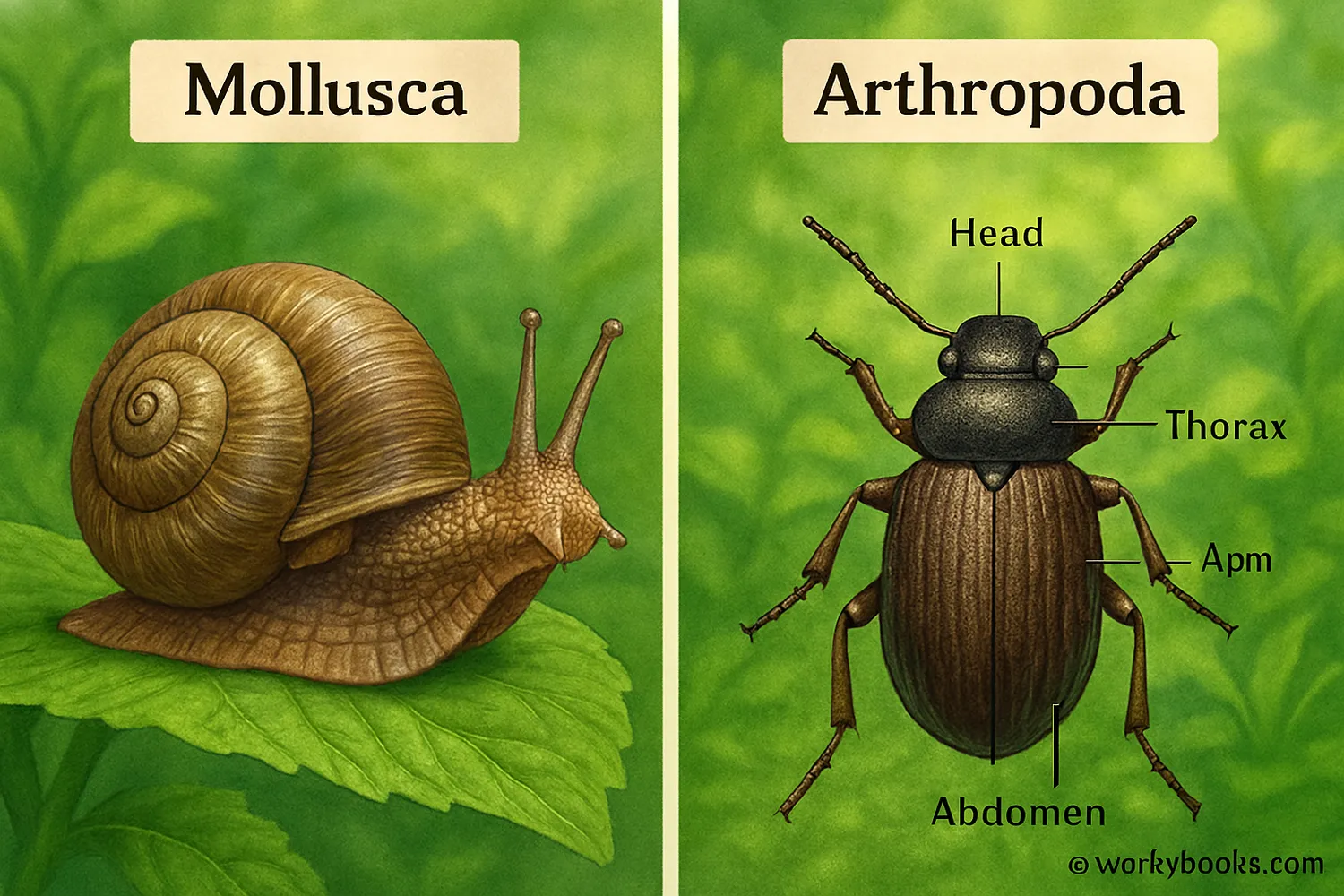
Snails are part of the phylum Mollusca, a diverse group of invertebrates that also includes clams, squid, and octopuses. A key characteristic of mollusks is their soft, unsegmented body. Snails, specifically, are a type of mollusk called a gastropod. They possess a muscular "foot" on which they glide, secreting a layer of mucus to aid in movement and protect their soft body. Their most recognizable feature is the protective, coiled shell, which is an external skeleton they can retreat into for safety.
Insects, on the other hand, belong to the phylum Arthropoda, the largest phylum in the animal kingdom. This group includes animals like spiders, crabs, and centipedes. A defining feature of arthropods is their exoskeleton, a hard outer shell made of a substance called chitin. Unlike a snail's shell, an exoskeleton is segmented and must be shed and regrown as the animal gets larger. Insects are further classified into the class Insecta, which is defined by specific physical traits: a three-part body (head, thorax, and abdomen), three pairs of jointed legs, and a pair of antennae.
While both snails and insects are invertebrates, their fundamental body plans are distinct. A snail’s soft, single-bodied structure and protective shell are characteristic of mollusks, whereas an insect's segmented body, jointed legs, and chitinous exoskeleton are hallmarks of arthropods. Understanding these differences in taxonomy helps us accurately identify and categorize the vast diversity of life on Earth.
Fun Fact: A snail's rasping tongue-like organ, called a radula, is covered in thousands of microscopic teeth, which it uses to scrape and shred food.
Which phylum do snails belong to?
ArthropodaMolluscaInsectaGastropoda
What is the hard outer covering of an insect called?
RadulaShellExoskeletonMantle
What is a defining characteristic of all arthropods, according to the passage?
Based on the passage, why are snails and insects not classified in the same group?
Snails have shells, while insects do notThey are in different kingdoms of lifeTheir fundamental body plans are differentThey live in different habitats
A scientist discovers a new animal with a soft, unsegmented body and a single muscular foot for movement. Which phylum is it most likely to be in?
InsectaArthropodaAnimaliaMollusca
According to the provided reading, which of these animals is most closely related to a snail?
A spiderA clamA grasshopperA millipede
Imagine you find a small creature with a head, a thorax, and an abdomen. It has six legs and a pair of antennae. Based on the passage, what is the best classification for this creature?
GastropodMolluskInsectArthropod
A student observes a beetle's hard outer covering and a snail's shell. What is the primary difference in how these two structures function for the animals' growth?
The beetle's covering provides more protectionThe snail's shell is shed, while the beetle's is notThe beetle's covering is shed and regrown as it growsThe snail's shell allows for faster movement
Perfect For:
👩🏫 Teachers
• Reading comprehension practice
• Auto-graded assessments
• Literacy skill development
👨👩👧👦 Parents
• Reading practice at home
• Comprehension improvement
• Educational reading time
🏠 Homeschoolers
• Reading curriculum support
• Independent reading practice
• Progress monitoring
Reading Features:
📖
Reading Passage
Engaging fiction or nonfiction text
❓
Comprehension Quiz
Auto-graded questions
📊
Instant Feedback
Immediate results and scoring
📄
Printable Version
Download for offline reading
🔊
Read Aloud
Voice-over with word highlighting
Reviews & Ratings
No reviews yet. Be the first to share your experience!
Related Content
Understanding Biological Evolution and Diversity
This passage addresses the NGSS standard 3-LS4-2 focusing on biological evolution and the unity and diversity of life. T...
RI.3.3RI.4.3RI.5.33-LS4-2
Theory of Evolution
This middle school science passage explains the theory of evolution and the concept of common ancestry, aligning with NG...
MS-LS4-1MS-LS4-2
Evidence for Evolution: Comparative Anatomy
This middle school science reading passage explores the evidence for evolution through comparative anatomy, aligning wit...
MS-LS4-2MS-LS4-3
The Nature of Life Science
This passage, aligned with NGSS MS-LS1-1, introduces students in grades 6-8 to the foundational concepts of life science...
MS-LS1-1
Human Evolution
This middle school science passage explains the scientific evidence for human evolution, aligning with NGSS standards MS...
MS-LS4-1MS-LS4-2
The Giant Isopod: Biological Evolution
This NGSS passage examines how giant isopods evolved for deep-sea survival, including slow metabolism for food scarcity,...
MS-LS4-4RI.6.3RI.7.3RI.8.8
Science Vocabulary
This worksheet on domain-specific words will help students learn some science vocabulary. Students will be asked to matc...
L.3.6L.3.4.A
Evidence for Evolution: The Fossil Record
This middle school science passage explains the importance of fossils as preserved evidence of ancient life and their ro...
MS-LS4-1
Simple Machines Science Report
This science writing task requires students to clearly explain how three simple machines work using precise domain-speci...
W.5.4
The Science of Hibernation
This educational module, featuring an audio-integrated reading passage titled 'The Science of Hibernation,' is designed ...
What is an amphibian
This audio-integrated reading passage, "The Life of Amphibians," is designed for 4th-grade students to explore the fasci...
The Levels of Australopithecus
This educational content offers an engaging, audio-integrated reading passage titled 'The Levels of Biological Classific...
The Nature of Science
This passage explores the nature of science for middle school students, aligning with NGSS standards MS-ETS1-4, MS-PS1-1...
MS-ETS1-4MS-PS1-1MS-LS1-1
The Pumpkin Life Cycle
This informational worksheet explores the pumpkin lifecycle, guiding students through procedural steps in a scientific t...
RI.2.3RI.2.10
What Is Earth Science?
This engaging middle school science passage introduces students to the field of Earth science, aligning with NGSS standa...
MS-ESS1MS-ESS2MS-ESS3SEP
Citizen Science and Ecological Monitoring
This engaging passage for grades 6-8 introduces the concept of citizen science and its critical role in ecological monit...
MS-LS2-1
The Life Cycle of an Angiosperm
This educational content package delves into the intriguing world of angiosperms and their complex life cycles, perfectl...
Tools and Technology in Earth Science
This middle school science reading passage explores the wide range of tools and technologies used in Earth science, from...
MS-ESS2-2MS-ESS3-2MS-ETS1-1MS-PS4-3
Barnacle Life Cycle
This audio-integrated reading passage, "Barnacle Life Cycle," delves into the intriguing growth and development of barna...
History of Life on Earth
This comprehensive middle school science reading passage provides an engaging overview of the history of life on Earth, ...