This learning resource is available in interactive and printable formats. The interactive worksheet can be played online and assigned to students. The Printable PDF version can be downloaded and printed for completion by hand.
"This science reading passage, ""Are Spiders Insects?,"" is a comprehensive learning module designed for middle school students, aligned with NGSS standards. It clarifies the common misconception that spiders are insects by highlighting the key differences in their scientific classification and physical anatomy. The passage explains that spiders are arachnids, distinguished by their two body segments (cephalothorax and abdomen) and eight legs, while insects have three body segments (head, thorax, and abdomen) and six legs. It also covers other differentiating features like antennae, wings, and specialized mouthparts. The passage connects these biological concepts to real-world applications, emphasizing spiders' crucial role as predators in maintaining ecosystem balance. The accompanying multiple-choice questions assess students' literal comprehension, inferential reasoning, and ability to apply their knowledge to new scenarios, making it an ideal resource for an experienced science teacher's curriculum on biological classification and diversity."
CONTENT PREVIEW
Expand content preview
The question of whether spiders are insects is a common one, and the answer is no. While both are small, multi-legged creatures often found in similar habitats, they belong to entirely different scientific classes. Spiders are classified as arachnids, while insects belong to the class Insecta. These classifications are not just for organization; they reflect fundamental differences in body structure, number of legs, and other key characteristics.
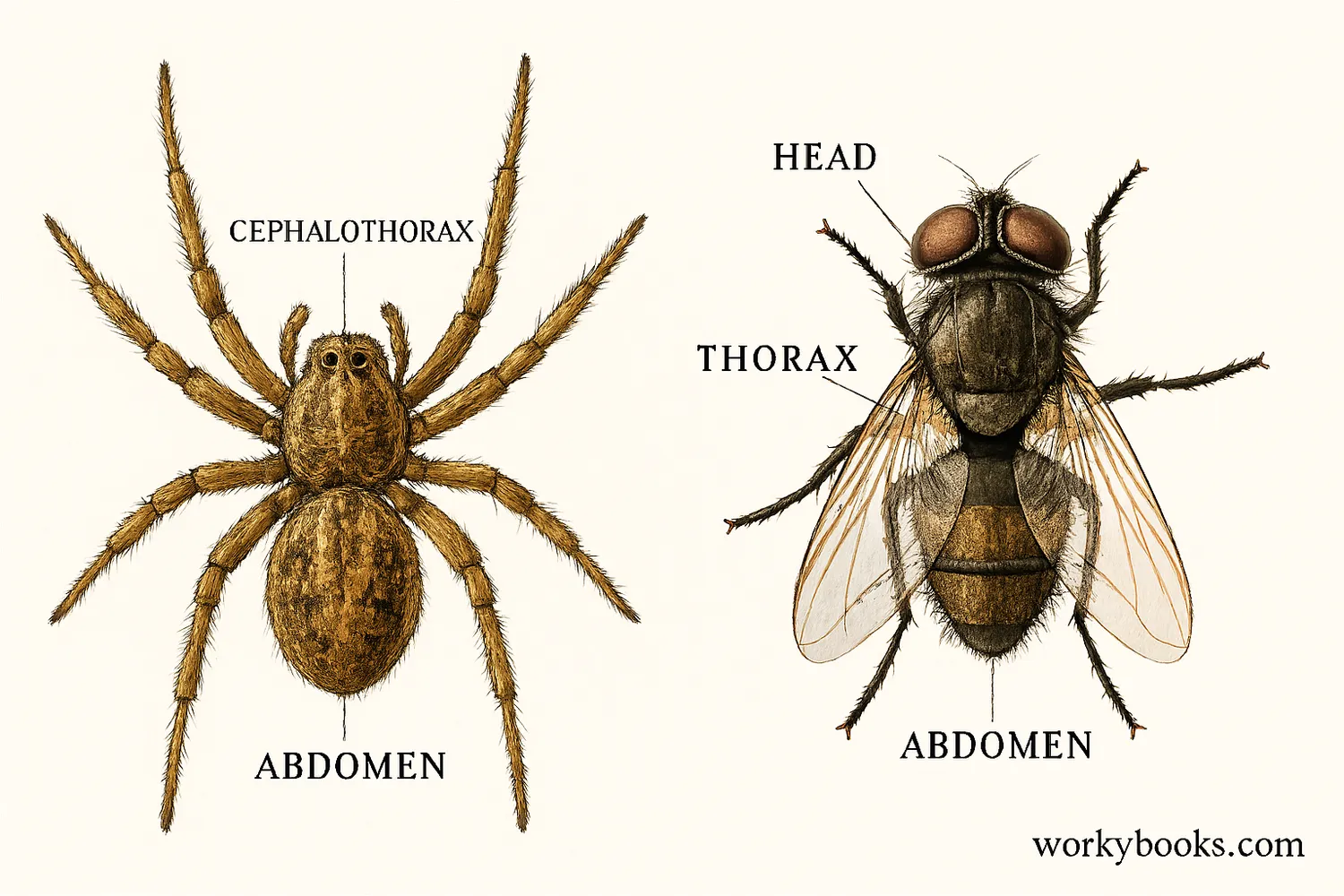
One of the most obvious differences lies in their anatomy. Insects have three distinct body sections: a head, a thorax, and an abdomen. They also have a total of six legs, which are all attached to the thorax. In contrast, a spider's body is divided into only two main sections. The head and thorax are fused together into a single segment called the cephalothorax. All eight of the spider’s legs, along with its eyes and mouthparts, are attached to the cephalothorax. The other main section is the abdomen, which contains the spider's spinnerets for producing silk.
Beyond their body structure, other features separate spiders from insects. Most insects possess antennae, which they use to sense their surroundings, and many have wings, allowing for flight. Spiders, however, have neither antennae nor wings. Instead, they have specialized mouthparts called chelicerae, which are often equipped with fangs for injecting venom into prey. They also have two small appendages called pedipalps near their mouth, which they use for handling food. These unique adaptations highlight the distinct evolutionary paths of arachnids and insects, even though they are both part of the larger phylum Arthropoda.
Spiders are important predators that help control insect populations in many ecosystems. Their role as natural pest control agents is a crucial real-world connection. By consuming vast numbers of insects like flies and mosquitoes, they help maintain a healthy balance in nature, benefiting humans by reducing disease-carrying pests.
Fun Fact: The silk produced by some spiders is stronger than steel by weight. Scientists are studying spider silk to create new super-strong materials.
To which scientific class do spiders belong?
InsectaArthropodaArachnidaChordata
How many distinct body sections does an insect have?
OneTwoThreeFour
What is the fused head and thorax of a spider called?
AbdomenThoraxCephalothoraxPedipalp
Based on the passage, what is a primary difference between a spider's legs and an insect's legs?
Spiders have six legs, while insects have eightSpiders have legs on their abdomen, while insects do notSpiders' legs are attached to the cephalothorax, insects' to the thoraxSpiders have more legs than insects
A scientist finds a new creature with eight legs and no antennae. Based on the passage, which classification would be most likely?
An insectA crustaceanAn arachnidA millipede
What function do a spider's chelicerae serve, according to the passage?
Detecting surroundingsInjecting venomProducing silkAiding in flight
How do spiders contribute to a healthy ecosystem, as described in the passage?
They pollinate flowersThey break down dead organic matterThey control insect populationsThey serve as a food source for birds
Using the information in the passage, which of these features would be most useful in identifying a creature as an insect rather than a spider?
The presence of a hard exoskeletonHaving a body divided into three segmentsPossessing specialized mouthpartsBeing part of the phylum Arthropoda
Perfect For:
👩🏫 Teachers
• Reading comprehension practice
• Auto-graded assessments
• Literacy skill development
👨👩👧👦 Parents
• Reading practice at home
• Comprehension improvement
• Educational reading time
🏠 Homeschoolers
• Reading curriculum support
• Independent reading practice
• Progress monitoring
Reading Features:
📖
Reading Passage
Engaging fiction or nonfiction text
❓
Comprehension Quiz
Auto-graded questions
📊
Instant Feedback
Immediate results and scoring
📄
Printable Version
Download for offline reading
🔊
Read Aloud
Voice-over with word highlighting
Reviews & Ratings
No reviews yet. Be the first to share your experience!
Related Content
Understanding Biological Evolution and Diversity
This passage addresses the NGSS standard 3-LS4-2 focusing on biological evolution and the unity and diversity of life. T...
RI.3.3RI.4.3RI.5.33-LS4-2
Theory of Evolution
This middle school science passage explains the theory of evolution and the concept of common ancestry, aligning with NG...
MS-LS4-1MS-LS4-2
Evidence for Evolution: Comparative Anatomy
This middle school science reading passage explores the evidence for evolution through comparative anatomy, aligning wit...
MS-LS4-2MS-LS4-3
The Nature of Life Science
This passage, aligned with NGSS MS-LS1-1, introduces students in grades 6-8 to the foundational concepts of life science...
MS-LS1-1
Human Evolution
This middle school science passage explains the scientific evidence for human evolution, aligning with NGSS standards MS...
MS-LS4-1MS-LS4-2
The Giant Isopod: Biological Evolution
This NGSS passage examines how giant isopods evolved for deep-sea survival, including slow metabolism for food scarcity,...
MS-LS4-4RI.6.3RI.7.3RI.8.8
Evidence for Evolution: The Fossil Record
This middle school science passage explains the importance of fossils as preserved evidence of ancient life and their ro...
MS-LS4-1
Science Vocabulary
This worksheet on domain-specific words will help students learn some science vocabulary. Students will be asked to matc...
L.3.6L.3.4.A
Simple Machines Science Report
This science writing task requires students to clearly explain how three simple machines work using precise domain-speci...
W.5.4
The Science of Hibernation
This educational module, featuring an audio-integrated reading passage titled 'The Science of Hibernation,' is designed ...
What is an amphibian
This audio-integrated reading passage, "The Life of Amphibians," is designed for 4th-grade students to explore the fasci...
The Levels of Australopithecus
This educational content offers an engaging, audio-integrated reading passage titled 'The Levels of Biological Classific...
The Pumpkin Life Cycle
This informational worksheet explores the pumpkin lifecycle, guiding students through procedural steps in a scientific t...
RI.2.3RI.2.10
The Nature of Science
This passage explores the nature of science for middle school students, aligning with NGSS standards MS-ETS1-4, MS-PS1-1...
MS-ETS1-4MS-PS1-1MS-LS1-1
What Is Earth Science?
This engaging middle school science passage introduces students to the field of Earth science, aligning with NGSS standa...
MS-ESS1MS-ESS2MS-ESS3SEP
The Life Cycle of an Angiosperm
This educational content package delves into the intriguing world of angiosperms and their complex life cycles, perfectl...
Citizen Science and Ecological Monitoring
This engaging passage for grades 6-8 introduces the concept of citizen science and its critical role in ecological monit...
MS-LS2-1
Tools and Technology in Earth Science
This middle school science reading passage explores the wide range of tools and technologies used in Earth science, from...
MS-ESS2-2MS-ESS3-2MS-ETS1-1MS-PS4-3
Barnacle Life Cycle
This audio-integrated reading passage, "Barnacle Life Cycle," delves into the intriguing growth and development of barna...
History of Life on Earth
This comprehensive middle school science reading passage provides an engaging overview of the history of life on Earth, ...