Reading PassagePremium

Benjamin Franklin: Printer, Inventor, and Leader

Interactive passage with audio narration, comprehension questions, and printable PDF.

No ratings yet|
1
Grades 3–5ReadingElaSocial-studiesHistoryEnglish · SpanishInteractive · Printable
Aligned toD2.HIS.2.3-5D2.HIS.3.3-5RI.4.1RI.4.3RI.4.4
Just this resource
$1.50
One-time purchase
Best value
Unlock everything
$49.99$29.99/yr
40% off until Aug 1 — 10,000+ resources
Renews at $49.99/year.
Unlock above to use these actions

What's included

Reading passage
Audio narration
Comprehension quiz
Writing activity
Glossary & flashcards
Differentiated version
Spanish translation

Part of this bundle

Benjamin Franklin: Printer, Inventor, and Leader preview and details

About this printable Benjamin Franklin: Printer, Inventor, and Leader reading passage (Grades 3-5)

This history reading passage explores the life and achievements of Benjamin Franklin, one of America's most important early leaders. Students will learn about Franklin’s early years as a printer, his clever inventions, and his role in the founding of the United States. The passage uses clear, age-appropriate language and builds vocabulary with bolded glossary words. Activities include a multiple-choice quiz and writing prompts to deepen understanding of cause and effect, historical significance, and connections to the present. A timeline helps students visualize key events. The passage and activities align with the C3 Framework for social studies and Common Core ELA standards. Read aloud audio and a Spanish translation are provided to support all learners. This resource is ideal for teaching American history, reading comprehension, and critical thinking skills.
Written by Workybooks TeamPublished by Workybooks
Preview

Sample passage and quiz from Benjamin Franklin: Printer, Inventor, and Leader

Reading passage and comprehension quiz preview

Benjamin Franklin: Printer, Inventor, and Leader
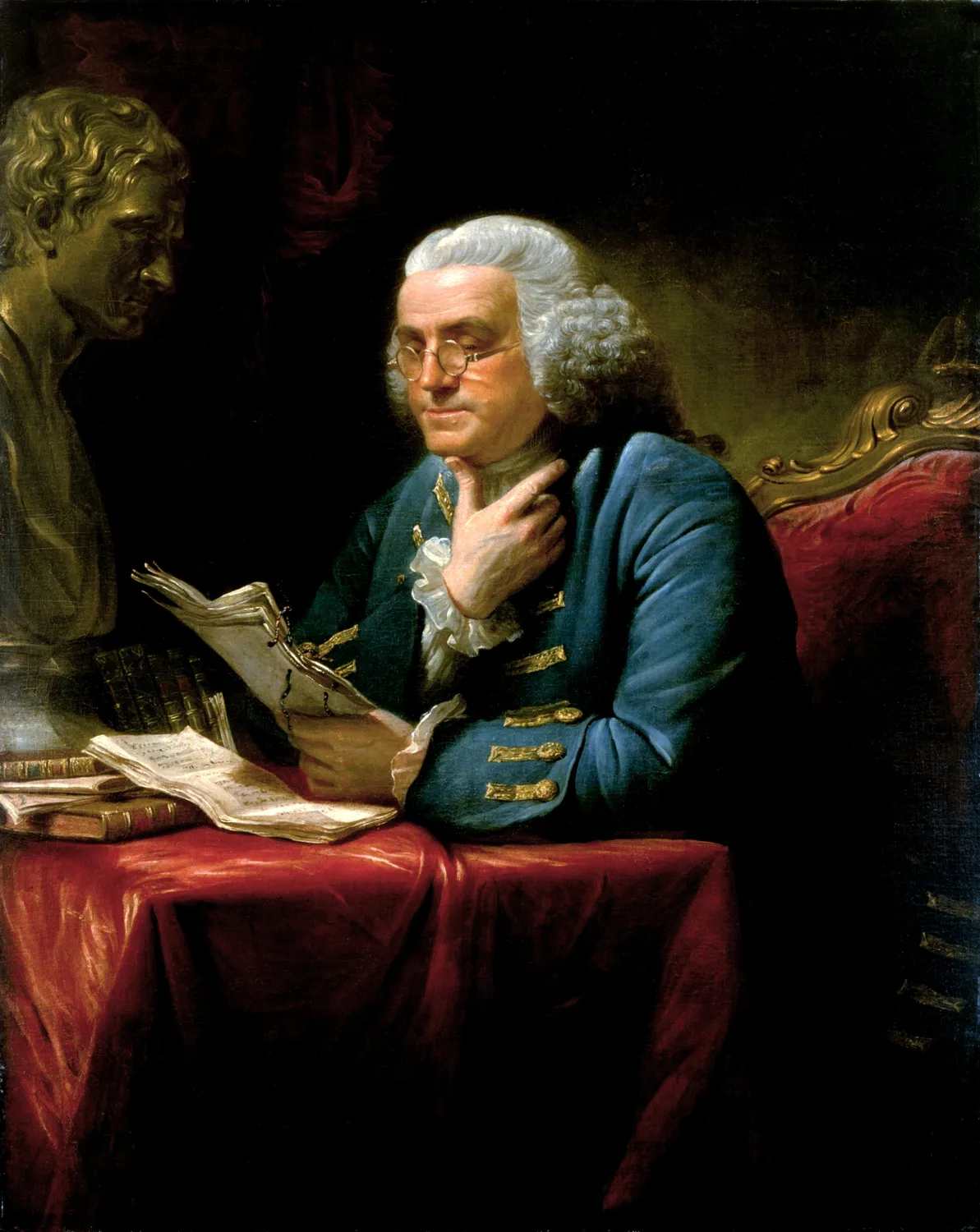
Benjamin Franklin 1767.jpg
Source: Wikimedia Commons - David Martin

Benjamin Franklin was one of the most famous Americans in history. He was born in 1706 in Boston, Massachusetts. As a young boy, Benjamin loved to read and learn about the world. His family was large and did not have much money. When he was twelve, he became an apprentice in his brother’s print shop. He learned how to set type and print newspapers.

At seventeen, Benjamin wanted more from life. He ran away to Philadelphia with only a few coins in his pocket. In Philadelphia, Benjamin worked hard in a print shop and quickly became known for his talent and honesty. Soon, he started his own print shop and published a newspaper called the Pennsylvania Gazette. He also wrote and printed Poor Richard’s Almanack, filled with advice and funny sayings.

Franklin was a true inventor. He created many useful things. He invented bifocals, which are glasses that help people see both near and far. He also invented the lightning rod to protect buildings from lightning strikes. Franklin loved to experiment and find solutions to problems.

Benjamin Franklin was not just a printer and inventor. He was also a great leader. He helped start the first public library and fire department in America. Franklin cared deeply about his city and country. During the American Revolution, he worked to unite the colonies and gain help from France. He helped write the Declaration of Independence and the U.S. Constitution. Because of his work, Franklin is known as a founding father of the United States.

Franklin lived a long and busy life. He believed in hard work, education, and helping others. His ideas and inventions changed America and the world.

Interesting Fact: Benjamin Franklin was the only person to sign all three major documents that helped create the United States: the Declaration of Independence, the Treaty of Paris, and the Constitution.

Comprehension quiz (8 questions)

1. Where was Benjamin Franklin born?

Boston
New York
Philadelphia
London

2. What did Franklin invent to protect buildings?

Lightning rod
Steam engine
Printing press
Telephone

3. What was the name of Franklin's almanac?

Poor Richard's Almanack
The Daily News
Franklin Times
New World Journal

4. Why did Franklin move to Philadelphia?

To find new opportunities
To visit family
For school
To become a teacher

5. How did Franklin help during the Revolution?

He united the colonies
He built houses
He was a soldier
He wrote stories

6. What is a bifocal?

Glasses for near and far
A type of hat
A kind of book
A lightning tool

7. Benjamin Franklin invented the telephone. True or false?

False
True

8. What does 'founding father' mean?

Helped start the country
Famous inventor
Printer of books
Wrote jokes
Curriculum

Common Core standards for Benjamin Franklin: Printer, Inventor, and Leader

RI.4.1

Refer to details and examples in a text when explaining what the text says explicitly and when drawing inferences from the text.

RI.4.3

Explain events, procedures, ideas, or concepts in a historical, scientific, or technical text, including what happened and why, based on specific information in the text.

RI.4.4

Determine the meaning of general academic and domain-specific words or phrases in a text relevant to a grade 4 topic or subject area.

Who it's for

Perfect for the way you teach

Teachers
  • Build comprehension skills
  • Auto-graded quiz
  • Differentiated reading
Parents
  • Read together at home
  • Improve fluency
  • Quiet reading time
Homeschoolers
  • Reading curriculum support
  • Independent practice
  • Track Lexile growth
Topics

Reviews & Ratings

No reviews yet. Be the first to share your experience!

More reading you might love

19 more
Passage
Native American Tribes Across America - reading educational content
Grades 3–5

Native American Tribes Across America

us history · D2.HIS.1.3-5

Free
Passage
Teepees: Homes on the Great Plains - reading educational content
Grades 3–5

Teepees: Homes on the Great Plains

us history · D2.HIS.2.3-5

$1.50
Passage
Traditional Native American Clothing - reading educational content
Grades 3–5

Traditional Native American Clothing

us history · D2.HIS.2.3-5

$1.50
Passage
The Iroquois Confederacy: A System of Peace - reading educational content
Grades 3–5

The Iroquois Confederacy: A System of Peace

us history · D2.HIS.2.3-5

Free
Passage
The Cherokee Nation: History and Culture - reading educational content
Grades 3–5

The Cherokee Nation: History and Culture

us history · D2.HIS.2.3-5

$1.50
Passage
The Sioux: Warriors and Tribal Leaders - reading educational content
Grades 3–5

The Sioux: Warriors and Tribal Leaders

us history · D2.HIS.1.3-5

$1.50
Passage
Native American Respect for Nature - reading educational content
Grades 3–5

Native American Respect for Nature

us history · D2.HIS.2.3-5

$1.50
Passage
Jamestown: The First Permanent English Colony - reading educational content
Grades 3–5

Jamestown: The First Permanent English Colony

us history · D2.HIS.1.3-5

$1.50
Passage
Pocahontas and the Powhatan People - reading educational content
Grades 3–5

Pocahontas and the Powhatan People

us history · D2.HIS.1.3-5

Free
Passage
Colonial Children: School and Chores - reading educational content
Grades 3–5

Colonial Children: School and Chores

us history · D2.HIS.2.3-5

$1.50
Passage
Colonial Clothing and Homemade Goods - reading educational content
Grades 3–5

Colonial Clothing and Homemade Goods

us history · D2.HIS.2.3-5

$1.50
Passage
Colonial Jobs: Blacksmiths, Bakers, and Craftsmen - reading educational content
Grades 3–5

Colonial Jobs: Blacksmiths, Bakers, and Craftsmen

us history · D2.HIS.2.3-5

$1.50
Passage
Colonial Towns and Village Life - reading educational content
Grades 3–5

Colonial Towns and Village Life

us history · D2.HIS.1.3-5

Free
Passage
Colonial Trade with England and Africa - reading educational content
Grades 3–5

Colonial Trade with England and Africa

us history · D2.HIS.2.3-5

$1.50
Passage
George Washington Leads the Army - reading educational content
Grades 3–5

George Washington Leads the Army

us history · D2.HIS.1.3-5

$1.50
Passage
Women and Children During the Revolutionary War - reading educational content
Grades 3–5

Women and Children During the Revolutionary War

us history · D2.HIS.2.3-5

$1.50
Passage
The Battle of Yorktown Ends War - reading educational content
Grades 3–5

The Battle of Yorktown Ends War

us history · D2.HIS.1.3-5

$1.50
Passage
Loyalists vs. Patriots: Divided Families - reading educational content
Grades 3–5

Loyalists vs. Patriots: Divided Families

us history · D2.HIS.1.3-5

$1.50
Passage
John Adams: Second President - reading educational content
Grades 3–5

John Adams: Second President

us history · D2.HIS.2.3-5

$1.50
Copyright © 2026 Workybooks. Made with ♥ in California.