Colonial Children: School and Chores
Interactive passage with audio narration, comprehension questions, and printable PDF.
By completing this purchase you agree to our Terms of Use and Privacy Policy. Your subscription renews automatically until you cancel. You can cancel anytime from your account settings. All sales are final and non-refundable. Digital content is available for download in your account immediately upon purchase.
What's included
Part of this bundle

Colonial Children: School and Chores preview and details
About this printable Colonial Children: School and Chores reading passage (Grades 3-5)
Sample passage and quiz from Colonial Children: School and Chores
Reading passage and comprehension quiz preview
Colonial Children: School and Chores
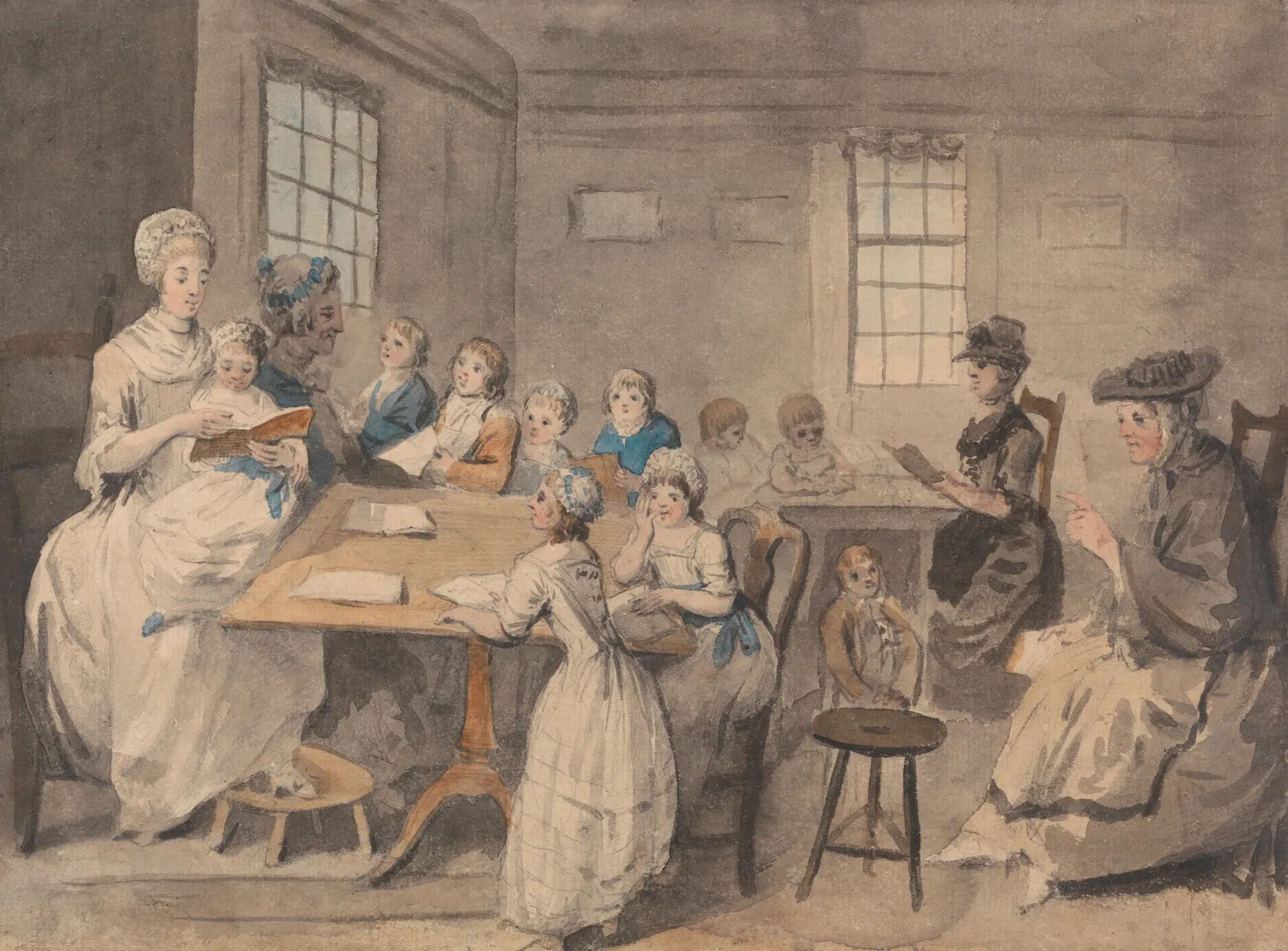
"Elias Martin - Reading Lesson at a Dame School" by Elias Martin / Wikimedia Commons (Public domain).
Colonial children in America had busy and challenging days. Their families depended on them to help with many important jobs, or chores, around the home and farm. Boys and girls often woke up before the sun rose. They started their work early to finish as much as possible before dark. Colonial homes had no electricity, so daylight was precious.
A typical day for a colonial child began with making the bed and helping to prepare breakfast. Boys often worked outside with their fathers. They would feed animals, carry water, chop wood, and help plant or harvest crops. Girls helped their mothers by sweeping the floor, making butter, sewing clothes, and caring for younger children. Every task was important. If a child forgot to feed the chickens or bring in firewood, the whole family could suffer.
Education was different for colonial children. Not all children went to school. Many learned at home. When children did attend school, it was often just one room with one teacher for all ages. Teachers focused on reading, writing, and religion. Colonial children used a tool called a hornbook to learn. A hornbook was a wooden paddle with a sheet showing the alphabet and prayers, covered by a thin layer of animal horn for protection. The hornbook was simple but very useful.
Children learned to read mostly so they could read the Bible and other religious texts. Writing was taught by copying letters and simple sentences. Few children learned math or science, because most families believed that reading and religion were most important. School lasted only a few months each year, because children were needed to help with planting and harvest seasons. Boys were more likely to attend school than girls, but many girls learned at home.
Playtime was short. Colonial children made up games with what they had, such as rolling hoops, jumping rope, or playing tag. Toys were simple, often handmade from wood, cloth, or leftover materials. Every free moment was treasured, but chores and learning always came first.
Colonial children learned responsibility and teamwork from a young age. Their hard work helped their families survive and grow. Life was not easy, but it taught them to be strong and resourceful.
Interesting Fact: Many colonial children learned to read from the Bible before they learned to write their own names.
Comprehension quiz (8 questions)
1. What did colonial children do before breakfast?
2. What tool did children use to learn reading?
3. Why was daylight important to colonial families?
4. Why did school last only a few months?
5. How did chores teach responsibility?
6. What happened if a child forgot a chore?
7. Colonial children had a lot of playtime. True or false?
8. What is a hornbook?
Common Core standards for Colonial Children: School and Chores
Determine the main idea of a text and explain how it is supported by key details; summarize the text.
Determine the meaning of general academic and domain-specific words or phrases in a text relevant to a grade 4 topic or subject area.
Write informative/explanatory texts to examine a topic and convey ideas and information clearly.
Perfect for the way you teach
- Build comprehension skills
- Auto-graded quiz
- Differentiated reading
- Read together at home
- Improve fluency
- Quiet reading time
- Reading curriculum support
- Independent practice
- Track Lexile growth