Binturong the Bearcat
Interactive passage with audio narration, comprehension questions, and printable PDF.
By completing this purchase you agree to our Terms of Use and Privacy Policy. Your subscription renews automatically until you cancel. You can cancel anytime from your account settings. All sales are final and non-refundable. Digital content is available for download in your account immediately upon purchase.
What's included
Binturong the Bearcat preview and details
About this printable Binturong the Bearcat science reading passage, NGSS-aligned (Grade 6)
Sample passage and quiz from Binturong the Bearcat
Reading passage and comprehension quiz preview
Binturong the Bearcat
Binturong: The Bearcat
The binturong, also known as the bearcat, is one of the most unusual animals living in the rainforests of Southeast Asia. Even though its name sounds like a cross between a bear and a cat, the binturong is neither! It is actually a member of the civet family—a group of small, furry mammals.
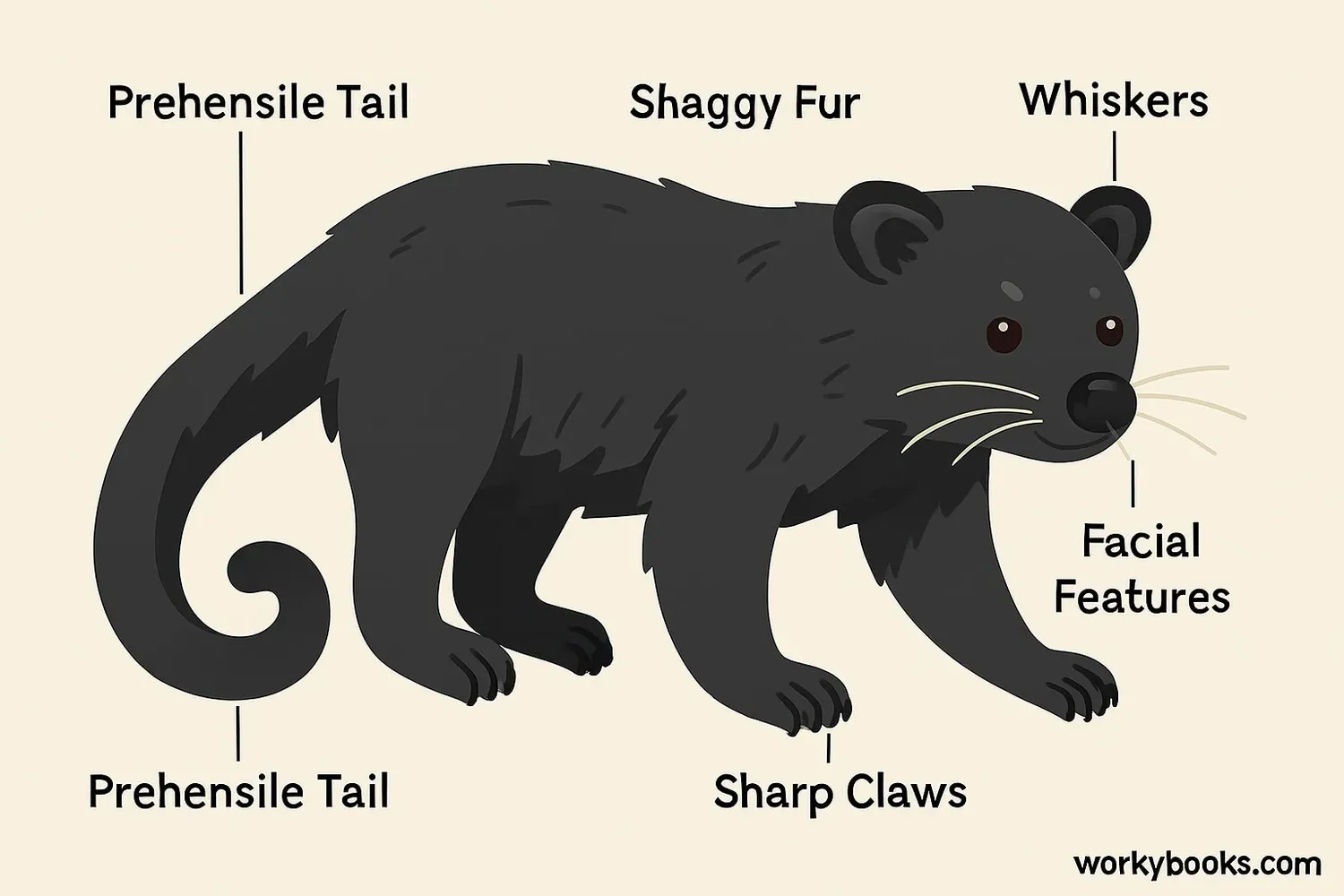
Binturongs have a strange appearance. Their shaggy black fur looks like a small bear. Their faces have long whiskers, just like cats. They have long bodies and short, sturdy legs. But scientists know that binturongs are not bears or cats at all—they are more closely related to civets.
Binturongs have some amazing adaptations that help them survive in the rainforest. One of the coolest is their prehensile tail. This tail can grip branches like a fifth hand, helping the binturong climb and hang in trees. In fact, the binturong is the only mammal in the Old World (outside the Americas) with a prehensile tail! Another adaptation is their flexible ankles, which can rotate backward. This lets them climb down trees headfirst. Their long whiskers help them feel their way through the dark, thick forest.
Binturongs spend most of their lives in trees. They are arboreal, which means they live up in the branches. They move slowly and carefully through the treetops. Binturongs are also nocturnal, so they are most active at night.
One of the strangest things about binturongs is their smell! Binturongs use their scent glands to mark their territory. Their urine contains the same chemical that gives buttery popcorn its smell. This popcorn scent tells other animals that the area is taken.
Binturongs eat many different foods. They love fruit (especially figs), but will also eat eggs, insects, and small animals. Because they eat so much fruit, binturongs are important seed dispersers. This means they spread seeds through the forest, helping new plants grow and keeping the rainforest healthy.
Sadly, binturongs are now vulnerable animals. Their rainforest homes are being cut down, and people sometimes hunt them. Protecting binturongs helps protect the whole rainforest.
Interesting Fact: The binturong is like nature’s mixed-up animal—it looks like a bear had babies with a cat, smells like a movie theater, and hangs by its tail like a monkey!
Comprehension quiz (8 questions)
1. What family does the binturong belong to?
2. What is a prehensile tail used for?
3. Where do binturongs live?
4. Why do binturongs smell like popcorn?
5. How does the binturong help the rainforest?
6. What does 'nocturnal' mean?
7. Binturongs are only active during the day.
8. What is an adaptation?
Common Core standards for Binturong the Bearcat
Ask and answer questions to demonstrate understanding of a text, referring explicitly to the text as the basis for the answers.
Determine the meaning of general academic and domain-specific words and phrases in a text relevant to a grade 3 topic or subject area.
Explain events, procedures, ideas, or concepts in a historical, scientific, or technical text, including what happened and why, based on specific information in the text.
Perfect for the way you teach
- Build comprehension skills
- Auto-graded quiz
- Differentiated reading
- Read together at home
- Improve fluency
- Quiet reading time
- Reading curriculum support
- Independent practice
- Track Lexile growth