California Economic Growth — Reading Comprehension
Rate this
Premium Resource
Present
Present in classroom. No work saved
Assign
Classroom with student accounts, Track progress
Quick Play
No student accounts, assign with a link
Grades
3
4
5
Standards
D2.HIS.2.3-5
D2.HIS.3.3-5
D2.ECO.2.3-5
RI.4.3
RI.4.4
W.4.2
PRINT+DIGITAL RESOURCE
This learning resource is available in interactive and printable formats. The interactive worksheet can be played online and assigned to students. The Printable PDF version can be downloaded and printed for completion by hand.
This engaging reading passage introduces students to how California’s economy changed from farming to high technology. It explains the important role of immigration, diversity, and new inventions in shaping modern California. Students will learn about the Gold Rush, the growth of farming, and the rise of Silicon Valley. The passage uses simple language and clear examples to help students understand cause and effect, while building key vocabulary. Activities include a quiz, writing prompts, a timeline, and a graphic organizer to reinforce learning. The passage is aligned with C3 Framework and Common Core State Standards (CCSS), making it perfect for history and literacy classrooms. With a Spanish translation and read aloud audio, this resource supports all learners and helps connect the past with the present.
CONTENT PREVIEW
Expand content preview
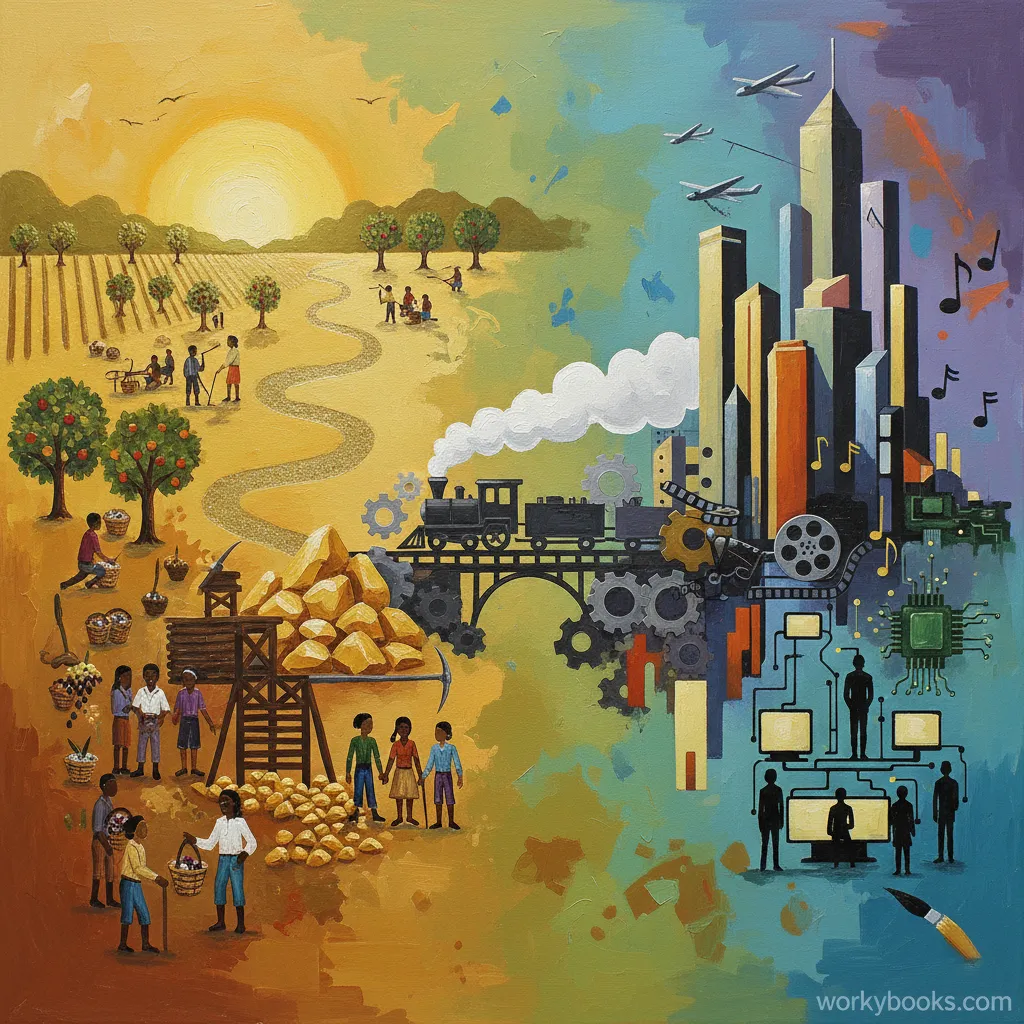
Artistic Representation of California's economic journey: from agriculture and gold to innovation and diversity.
California is the largest state economy in the United States. If it were a country, California would have the fifth-largest economy in the world. Many different industries have helped California grow. These include technology, agriculture, entertainment, and international trade.
In the early 1900s, California was mostly known for its farms. The state’s long, sunny seasons and rich soil helped farmers grow fruits, vegetables, and nuts. These crops were sent all over the country and the world. Agriculture made California important to the nation’s food supply.
In the mid-1900s, California became famous for movies and television. Hollywood, a place in Los Angeles, grew into the center of the entertainment world. Movies and TV shows made in California were watched by people everywhere. This helped California earn money and become well-known around the globe.
After World War II, new industries came to California. People built airplanes, rockets, and computers. Silicon Valley, near San Francisco, became the heart of the technology industry. Many innovative companies, like Apple and Google, started there. These companies created jobs and brought people from around the world to work in California.
California’s ports are some of the busiest in the world. Ships from Asia and other places bring goods to California. These goods travel by truck and train to other parts of the United States. California also sends its own products, like computers and food, to other countries. This is called global trade.
All these industries help California’s economy grow. The value of everything made and sold in California is called its gross domestic product (GDP). California’s GDP is so large that, if it were a country, it would be richer than most nations.
Today, millions of people live and work in California. The state’s economy is diverse because it has many kinds of businesses. This diversity helps California stay strong, even when some industries face problems. People from all over the world come to California for jobs and a better life. California’s growth shows how working together in many fields can create success.
Interesting Fact: California’s economy is bigger than the entire economy of countries like the United Kingdom and India!
Which state has the largest economy?
CaliforniaTexasFloridaNew York
What industry is Silicon Valley known for?
TechnologyFarmingMoviesShipping
Where is Hollywood located?
Los AngelesSan DiegoSan FranciscoSacramento
Why is California’s economy called diverse?
It has many industriesIt has only farmsIt is the smallestIt has no ports
How do California’s ports help the economy?
They bring and send goodsThey grow foodThey make moviesThey mine gold
Why did companies start in Silicon Valley?
To develop technologyFor farmingTo build shipsFor gold mining
California has the fifth largest economy. True or false?
TrueFalse
What does GDP stand for?
Gross Domestic ProductGreat Daily PriceGeneral Data PlaceGoods Delivery Port
Perfect For:
👩🏫 Teachers
• Reading comprehension practice
• Auto-graded assessments
• Literacy skill development
👨👩👧👦 Parents
• Reading practice at home
• Comprehension improvement
• Educational reading time
🏠 Homeschoolers
• Reading curriculum support
• Independent reading practice
• Progress monitoring
Reading Features:
📖
Reading Passage
Engaging fiction or nonfiction text
❓
Comprehension Quiz
Auto-graded questions
📊
Instant Feedback
Immediate results and scoring
📄
Printable Version
Download for offline reading
🔊
Read Aloud
Voice-over with word highlighting
Reviews & Ratings
No reviews yet. Be the first to share your experience!
Related Content
Native American Tribes Across America
This engaging history reading passage introduces students to Native American tribes across America, focusing on their da...
D2.HIS.1.3-5D2.HIS.2.3-5RI.4.1RI.4.2
Teepees: Homes on the Great Plains
This engaging history reading passage introduces students to teepees, the unique homes of Native American tribes on the ...
D2.HIS.2.3-5D2.HIS.14.3-5RI.4.1RI.4.2RI.4.4
Traditional Native American Clothing
This engaging history passage explores traditional Native American clothing and how it reflected the environment, values...
D2.HIS.2.3-5D2.HIS.3.3-5RI.4.3RI.4.4
The Iroquois Confederacy: A System of Peace
This engaging U.S. History reading passage introduces students to the Iroquois Confederacy, a powerful alliance of Nativ...
D2.HIS.2.3-5D2.HIS.3.3-5RI.4.3RI.4.4
The Cherokee Nation: History and Culture
This reading passage explores the rich history and culture of the Cherokee Nation, one of the largest Native American tr...
D2.HIS.2.3-5D2.HIS.14.3-5RI.4.3RI.4.4RI.4.10
The Sioux: Warriors and Tribal Leaders
This history reading passage explores the Sioux Nation, focusing on their roles as warriors and tribal leaders. Students...
D2.HIS.1.3-5D2.HIS.2.3-5RI.4.1RI.4.3
Native American Respect for Nature
This engaging history reading passage explores Native American respect for nature, emphasizing the close relationship be...
D2.HIS.2.3-5D2.HIS.3.3-5RI.4.3RI.4.4
Jamestown: The First Permanent English Colony
This engaging history passage explores the founding of Jamestown, the first permanent English colony in America. Aligned...
D2.HIS.1.3-5D2.HIS.2.3-5RI.4.3RI.4.4
Pocahontas and the Powhatan People
This engaging reading passage explores the life of Pocahontas and the Powhatan people and their important role in early ...
D2.HIS.1.3-5D2.HIS.2.3-5RI.4.1RI.4.3
Colonial Children: School and Chores
This reading passage explores the daily lives of colonial children, focusing on their experiences at school and their ma...
D2.HIS.2.3-5D2.HIS.3.3-5RI.4.1RI.4.2RI.4.4
Colonial Clothing and Homemade Goods
This engaging U.S. history passage explores the daily life of early American colonists with a focus on colonial clothing...
D2.HIS.2.3-5RI.4.3RI.4.4
Colonial Jobs: Blacksmiths, Bakers, and Craftsmen
This engaging history reading passage explores the vital roles of blacksmiths, bakers, and craftsmen in colonial America...
D2.HIS.2.3-5D2.HIS.3.3-5RI.4.3RI.4.4
Colonial Towns and Village Life
This engaging history reading passage explores the daily life, work, and unity found in colonial towns and villages. Ali...
D2.HIS.1.3-5D2.HIS.2.3-5RI.4.3RI.4.4
Colonial Trade with England and Africa
This history reading passage explores colonial trade between the American colonies, England, and Africa, focusing on the...
D2.HIS.2.3-5D2.HIS.14.3-5RI.4.3RI.4.4
Benjamin Franklin: Printer, Inventor, and Leader
This history reading passage explores the life and achievements of Benjamin Franklin, one of America's most important ea...
D2.HIS.2.3-5D2.HIS.3.3-5RI.4.1RI.4.3
George Washington Leads the Army
This engaging history reading passage explores how George Washington bravely led the Continental Army during the America...
D2.HIS.1.3-5D2.HIS.2.3-5RI.4.3RI.4.4
Women and Children During the Revolutionary War
This reading passage explores the important roles women and children played during the Revolutionary War. Students will ...
D2.HIS.2.3-5RI.4.3RI.5.3
African Americans Fight for Freedom
This educational passage explores the brave and inspiring story of how African Americans fought for freedom in the Unite...
D2.HIS.2.3-5D2.HIS.3.3-5RI.4.3RI.4.4
The Battle of Yorktown Ends War
This engaging U.S. history reading passage explores the Battle of Yorktown, a key event that ended the American Revoluti...