Canaan and the Hebrews
Interactive passage with audio narration, comprehension questions, and printable PDF.
By completing this purchase you agree to our Terms of Use and Privacy Policy. Your subscription renews automatically until you cancel. You can cancel anytime from your account settings. All sales are final and non-refundable. Digital content is available for download in your account immediately upon purchase.
What's included
Part of this bundle

Canaan and the Hebrews preview and details
About this printable Canaan and the Hebrews reading passage (Grades 5-8)
Sample passage and quiz from Canaan and the Hebrews
Reading passage and comprehension quiz preview
Canaan and the Hebrews
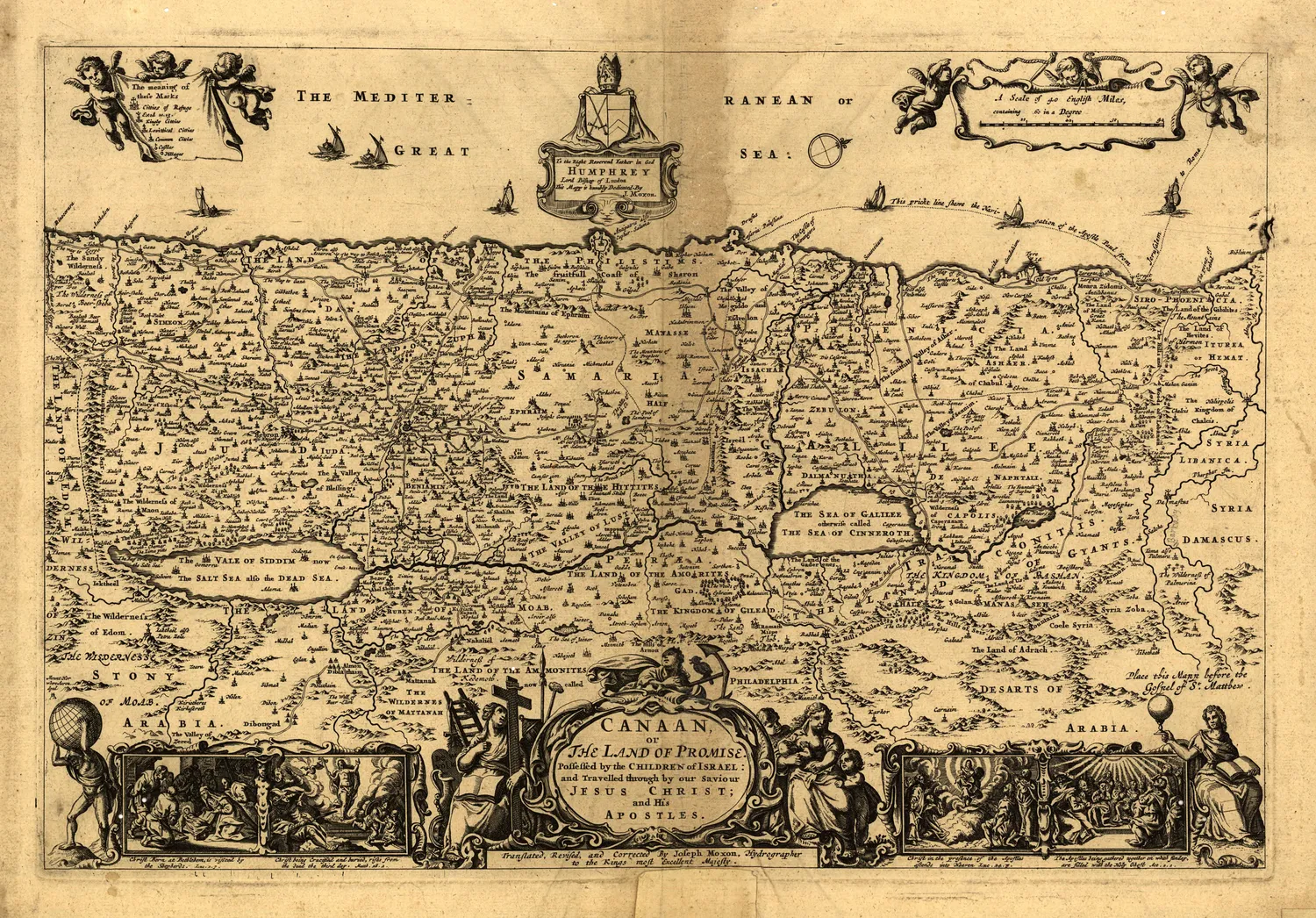
Canaan, or The Land of promise. LOC 99466735 by Moxon, Joseph / Wikimedia Commons
The land of Canaan was located in the eastern Mediterranean, between the Jordan River and the Mediterranean Sea. This region, which includes parts of today’s Israel, Palestine, Lebanon, and Jordan, became the homeland of the ancient Israelites. Canaan was a crossroads for trade and migration, making it a place of great cultural and historical significance.
Archaeological evidence shows that Canaan had thriving cities as early as 3000 BCE. The people of Canaan lived in city-states such as Jericho and Hazor, where agriculture and trade flourished. The land’s geography, with its fertile valleys and access to water, allowed for successful farming. However, Canaan’s position also made it vulnerable to invasion and conquest by powerful neighbors like Egypt and Mesopotamia. Ancient Egyptian records, such as the Merneptah Stele from around 1207 BCE, mention a group called "Israel" living in Canaan. This is one of the earliest written references to the Israelites outside the Bible.
The Israelites were a group of people who, according to tradition, migrated from Mesopotamia and Egypt into Canaan. Their story is told in the Hebrew Bible, especially the book of Exodus, which describes their escape from slavery in Egypt and their journey to Canaan. Archaeologists have found remains of ancient settlements, like at Tel Hazor, which show evidence of destruction and rebuilding. This supports the idea that Canaan was a place of frequent conflict and change, as different groups competed for control.
Religion played a central role in ancient Israelite society. Unlike many neighboring peoples who worshipped many gods, the Israelites practiced monotheism, the belief in a single God. They believed they had a special covenant, or agreement, with their God. The Ten Commandments, a set of moral laws, became a foundation for their society. Social life in Canaan and early Israel included family farming, local markets, and community gatherings. The Israelites organized themselves into tribes, each with their own leaders, before eventually forming the kingdom of Israel under kings like Saul, David, and Solomon.
Over time, the land of Canaan changed as new peoples arrived and empires rose and fell. However, its legacy as the birthplace of the Israelites and their religious traditions continues to influence world history. The story of Canaan connects to larger themes of migration, cultural exchange, and the development of early civilizations in the ancient world.
Interesting Fact: Archaeologists have found ancient letters written in cuneiform from Canaanite rulers to Egyptian pharaohs, showing how important diplomacy was in the region.
Comprehension quiz (8 questions)
1. Where was Canaan located?
2. What did the Merneptah Stele mention?
3. Which city-state was in Canaan?
4. Why was Canaan important for trade?
5. How did geography affect Canaan?
6. What does monotheism mean?
7. Canaan was home to the ancient Israelites. True or false?
8. What is a covenant?
Perfect for the way you teach
- Build comprehension skills
- Auto-graded quiz
- Differentiated reading
- Read together at home
- Improve fluency
- Quiet reading time
- Reading curriculum support
- Independent practice
- Track Lexile growth