This learning resource is available in interactive and printable formats. The interactive worksheet can be played online and assigned to students. The Printable PDF version can be downloaded and printed for completion by hand.
This educational passage, designed for grade 5 and audio-integrated, delves into the fascinating world of fruit colors and their crucial role in plant reproduction. It aligns with NGSS LS1.B: Growth and Development of Organisms, explaining how fruit color is a key adaptation for attracting animals. Students will learn about the process of seed dispersal, understanding how colorful fruits serve as a signal to animals, encouraging them to eat the fruit and spread the seeds. Keywords like 'fruit color,' 'seed dispersal,' 'plant reproduction,' and 'animal attraction' are woven throughout, making complex scientific concepts accessible and engaging. This passage highlights the incredible strategies plants use to ensure their survival and growth.
CONTENT PREVIEW
Expand content preview
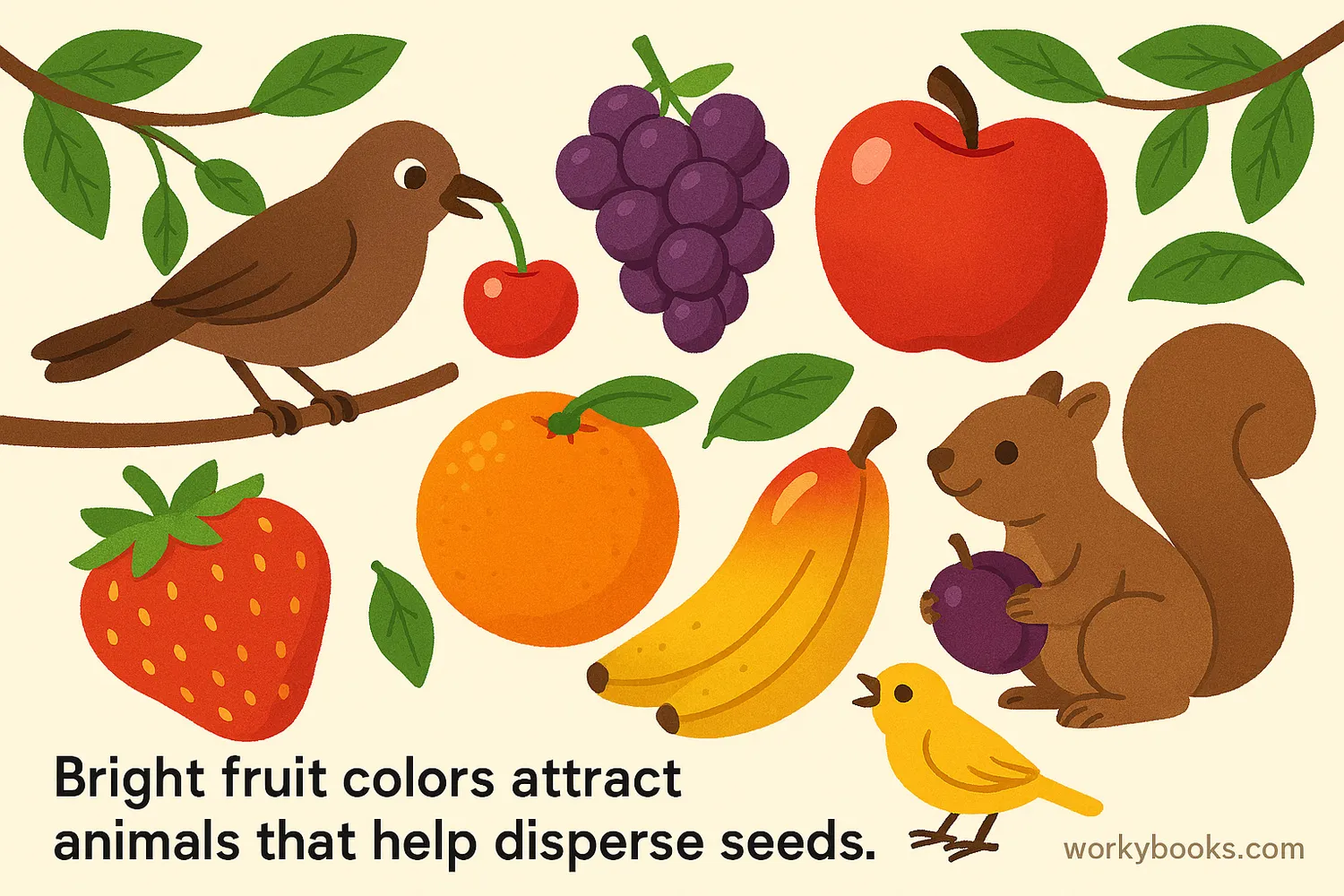
Bright fruit colors attract animals that help disperse seeds.
Color in Fruits
Fruits come in many bright colors, but these colors are not just for looks. The colors of fruits are important for plants. Plants want animals to eat their fruits. When animals eat fruit, they also eat the seeds inside. Later, the animal moves to a new place and the seeds come out in the animal’s droppings. This helps new plants grow far away from the parent plant. This process is called seed dispersal.
The colors in fruits come from special chemicals called pigments. Each pigment gives a different color. Carotenoids make fruits yellow, orange, or red, like in carrots and tomatoes. Anthocyanins give fruits red, blue, or purple colors, like in berries and grapes. Chlorophyll makes fruits green when they are unripe and still making food. When fruit ripens, chlorophyll breaks down and other pigments show up. Brown fruits are overripe and breaking down.
Fruit colors matter a lot. Bright red berries stand out against green leaves, telling birds, "I'm ripe and ready!" Green fruits are often unripe and blend in, sending the signal, "Not yet!" Animals see fruit colors in different ways. Birds see red very well, so many berries are red. Some animals can even see ultraviolet patterns we cannot see!
As fruit ripens, it usually changes color. It might start green because of chlorophyll, then turn red or yellow as it gets ripe. This color change is like nature's advertising sign—bright reds and purples shout "eat me!" to animals, while green says "still cooking, come back later!"
Fruit colors are also a sign of nutrition. Different colors often mean different vitamins and nutrients. That’s why eating a rainbow of fruits is healthy for you!
Interesting Fact: Some fruits become bright to attract many animals, while others stay hidden to only attract certain animals that help them most.
What do animals help plants do?
Spread their seedsChange colorMake more fruitGrow roots
What makes fruits green when unripe?
ChlorophyllCarotenoidsAnthocyaninsSugar
Which pigment gives berries a purple color?
AnthocyaninsCarotenoidsChlorophyllVitamins
Why do some fruits change color as they ripen?
To attract animalsTo make leavesTo grow biggerTo hide from animals
How do birds see fruit colors differently than people?
Birds see red betterBirds see no colorsBirds see only greenBirds see black and white
What happens if an animal eats a fruit's seeds?
Seeds move to new placesSeeds disappearFruit grows fasterSeeds turn blue
Fruit color never changes as it ripens.
TrueFalse
What is a pigment?
Something that gives colorA kind of fruitA type of animalA vitamin
Perfect For:
👩🏫 Teachers
• Reading comprehension practice
• Auto-graded assessments
• Literacy skill development
👨👩👧👦 Parents
• Reading practice at home
• Comprehension improvement
• Educational reading time
🏠 Homeschoolers
• Reading curriculum support
• Independent reading practice
• Progress monitoring
Reading Features:
📖
Reading Passage
Engaging fiction or nonfiction text
❓
Comprehension Quiz
Auto-graded questions
📊
Instant Feedback
Immediate results and scoring
📄
Printable Version
Download for offline reading
🔊
Read Aloud
Voice-over with word highlighting
Reviews & Ratings
No reviews yet. Be the first to share your experience!
Related Content
The Nature of Life Science
This passage, aligned with NGSS MS-LS1-1, introduces students in grades 6-8 to the foundational concepts of life science...
MS-LS1-1
Science Vocabulary
This worksheet on domain-specific words will help students learn some science vocabulary. Students will be asked to matc...
L.3.6L.3.4.A
Citizen Science and Ecological Monitoring
This engaging passage for grades 6-8 introduces the concept of citizen science and its critical role in ecological monit...
MS-LS2-1
Ecosystem Services
This engaging middle school science passage introduces students to the concept of ecosystem services, the vital benefits...
MS-LS2-5MS-ESS3-3
Simple Machines Science Report
This science writing task requires students to clearly explain how three simple machines work using precise domain-speci...
W.5.4
Photosynthesis in Ecosystems
This comprehensive passage for grades 6-8 explores the fundamental role of photosynthesis in ecosystems, aligning with N...
MS-LS1-6MS-LS2-3
Biodiversity and Ecosystem Health
This comprehensive middle school science passage explores the relationship between biodiversity and ecosystem health, al...
MS-LS2-5
Desert Ecosystems
This informative writing worksheet on desert ecosystems supports CCSS.ELA-LITERACY.W.5.2.d on using precise language and...
W.5.2.D
Biomes: Aquatic Ecosystems
This middle school science passage, aligned with NGSS standard MS-LS2-1, introduces students to the key features and mec...
MS-LS2-1
Abiotic Factors in Ecosystems
This comprehensive informational reading passage is designed for middle school science students and aligns with NGSS sta...
MS-LS2-1
Biomes: Terrestrial Ecosystems
This NGSS-aligned science reading passage for grades 6-8 provides a comprehensive survey of Earth’s major terrestrial bi...
MS-LS2-1
Water in Ecosystems
This engaging passage for grades 6-8 explores the essential role of water in ecosystems, tracing its movement through va...
MS-LS2-3MS-ESS2-4
Producers: The Foundation of Ecosystems
This comprehensive science passage explains the critical role of producers, or autotrophs, in all ecosystems. Covering b...
MS-LS2-3MS-LS1-6
What Is the Main Source of Carbon in an Ecosystem?
This NGSS-aligned science reading passage helps middle school students explore the main source of carbon in ecosystems: ...
MS-LS2-3
Arctic Fox Food Web and Ecosystem Role
This engaging audio-integrated passage, "Arctic Fox Food Web and Ecosystem Role," delves into the critical contributions...
Ecosystem Interactions Word Sort
This word sort explores different types of relationships between organisms in ecosystems. Students categorize 12 differe...
The Pumpkin Life Cycle
This informational worksheet explores the pumpkin lifecycle, guiding students through procedural steps in a scientific t...
RI.2.3RI.2.10
What Is Earth Science?
This engaging middle school science passage introduces students to the field of Earth science, aligning with NGSS standa...
MS-ESS1MS-ESS2MS-ESS3SEP
Meadow Ecosystem
This reading passage, 'Life in the Meadow', is designed for elementary students to understand NGSS LS2.A: Interdependent...
2-LS2-1
Tools and Technology in Earth Science
This middle school science reading passage explores the wide range of tools and technologies used in Earth science, from...