Coniferous Trees of the Boreal
Interactive passage with audio narration, comprehension questions, and printable PDF.
What's included
Coniferous Trees of the Boreal preview and details
About this printable Coniferous Trees of the Boreal science reading passage, NGSS-aligned (Grade 6)
Sample passage and quiz from Coniferous Trees of the Boreal
Reading passage and comprehension quiz preview
Coniferous Trees of the Boreal Forest
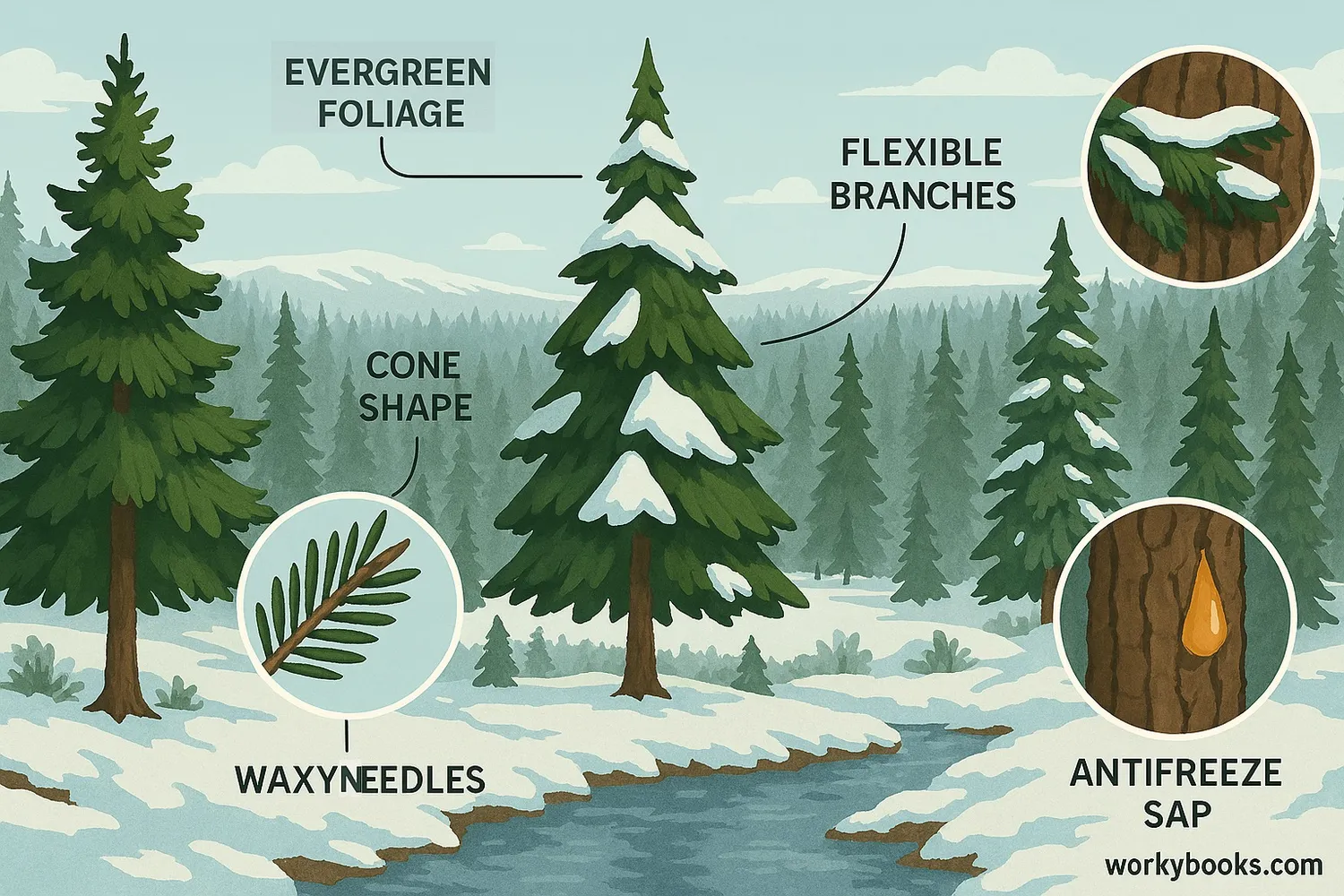
Imagine a vast, green forest stretching across cold, northern lands. This is the boreal forest, one of Earth's largest land biomes, where you'll find an incredible variety of coniferous trees. These amazing plants, like pines, spruces, and firs, have evolved special ways to thrive in environments that would be too harsh for many other trees. Understanding how they survive helps us see how genetic variations play a vital role in nature.
Coniferous trees are often called evergreens because they keep their leaves, which are typically needle-like, all year long. This is a key adaptation for surviving cold winters. Unlike broadleaf trees that drop their leaves, conifers can start photosynthesis (making food from sunlight) as soon as temperatures allow, even if there's still snow on the ground. Their thin, waxy needles have less surface area, which helps reduce water loss in freezing winds. The wax also provides a protective coating against the cold.
Think about the shape of a typical conifer – it's often like a cone. This unique phenotype, or observable trait, is another adaptation. The cone shape allows heavy snow to slide off easily, preventing branches from breaking under the weight. Their branches are also usually flexible, bending rather than snapping in strong winds or under heavy snow.
Beneath their bark, conifers have a special sap that acts like antifreeze, protecting their cells from freezing. These traits are passed down through heredity from parent trees to offspring.
Within a population of coniferous trees, there are tiny genetic differences. Some trees might have slightly thicker needles, or a slightly stronger sap, or an even more perfect cone shape. These small variations can make a big difference when conditions are extreme. Trees with traits that help them survive better in very cold or windy conditions are more likely to live long enough to reproduce. When they reproduce, they pass on those beneficial traits to their offspring. Over many generations, the population as a whole becomes better suited to its environment. This process explains why conifers are so successful in the challenging boreal forest.
Interesting Fact: The oldest living individual tree on Earth is a Great Basin Bristlecone Pine, a type of conifer, which is over 5,000 years old!
Comprehension quiz (10 questions)
1. Which biome is known for coniferous trees?
2. What are coniferous trees often called?
3. How do needle-like leaves help conifers survive?
4. Why is the cone shape beneficial for conifers?
5. What special substance helps protect conifer cells from freezing?
6. How do genetic variations contribute to conifer survival?
7. If a conifer has thicker wax on its needles, how might that help?
8. Why do conifers start photosynthesis earlier than broadleaf trees?
9. The shape of a conifer is an example of a phenotype.
10. What does 'heredity' mean in the passage?
Perfect for the way you teach
- Build comprehension skills
- Auto-graded quiz
- Differentiated reading
- Read together at home
- Improve fluency
- Quiet reading time
- Reading curriculum support
- Independent practice
- Track Lexile growth