Constructive and Destructive Forces — Reading Comprehension
Rate this
Present
Present in classroom. No work saved
Assign
Classroom with student accounts, Track progress
Quick Play
No student accounts, assign with a link
Grades
5
6
7
8
Standards
MS-ESS2-1
PRINT+DIGITAL RESOURCE
This learning resource is available in interactive and printable formats. The interactive worksheet can be played online and assigned to students. The Printable PDF version can be downloaded and printed for completion by hand.
This middle school science passage explores how Earth's surface is constantly shaped by the interplay of constructive and destructive forces. Students learn about constructive forces such as volcanic eruptions, tectonic uplift, deposition, and coral reef growth, which build up land. Destructive forces, including weathering, erosion, and mass wasting, work to break down and wear away landforms. Real-world examples, like the rising Himalayas and formation of deltas, show how these processes operate over different time scales and interact to create dynamic landscapes. The passage aligns with NGSS standard MS-ESS2-1 and includes a glossary, Spanish translations, differentiated versions for struggling readers, and engaging activities such as quizzes, writing prompts, and graphic organizers. This resource is audio-integrated and is ideal for classroom or independent science learning. Keywords: constructive forces, destructive forces, erosion, deposition, mountain formation, weathering, NGSS MS-ESS2-1.
CONTENT PREVIEW
Expand content preview
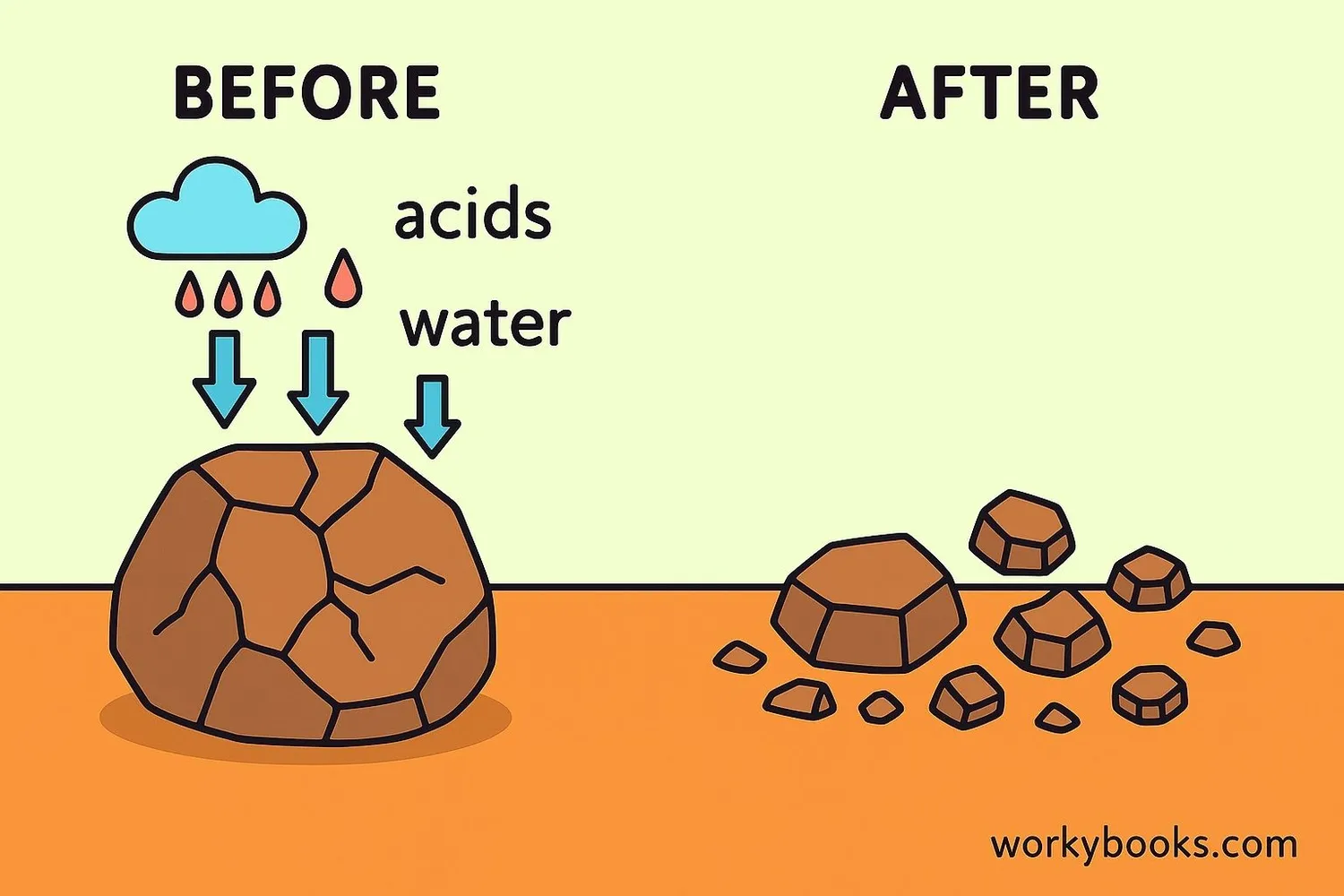
Illustration showing chemical weathering breaking down rock formations
Earth’s surface is constantly changing due to the action of powerful forces. These forces can be divided into two main types: constructive forces and destructive forces. Constructive forces, such as volcanic eruptions and tectonic uplift, build up Earth’s surface by creating new landforms. Destructive forces, like weathering and erosion, wear down and remove material from the surface. The interplay between these forces shapes the landscapes we see today and determines the size, shape, and features of mountains, valleys, deltas, and beaches.
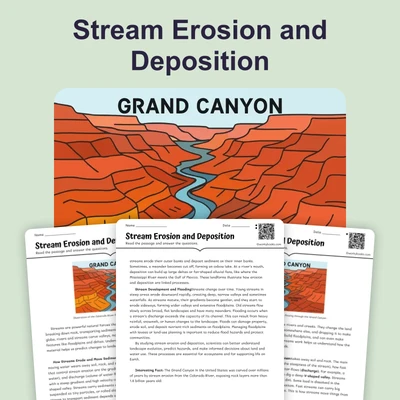
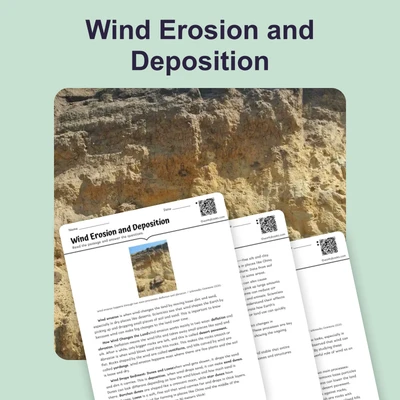
How Constructive Forces Build Up Earth Constructive forces are processes that add new material or elevate Earth’s surface. One major example is volcanic eruptions. When a volcano erupts, it releases lava, ash, and gases. The lava cools and hardens, forming new land, such as islands or mountains. The Hawaiian Islands, for instance, were built by repeated volcanic eruptions. Another constructive process is deposition. This occurs when rivers carry sediment and deposit it at their mouth, creating deltas like the Mississippi River Delta. Wind can also deposit sand to form dunes on beaches and in deserts. Tectonic uplift, caused by the movement of Earth’s plates, pushes entire regions upward, forming mountains and plateaus. Even living organisms can contribute: coral reefs are built by tiny animals called corals, which gradually accumulate their hard skeletons over thousands of years.
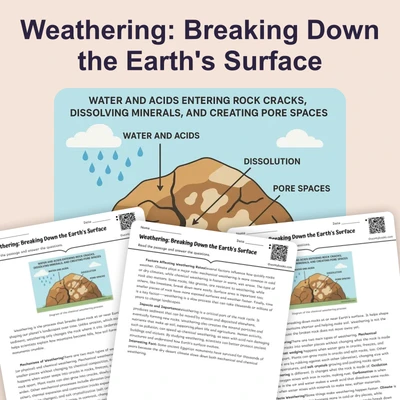
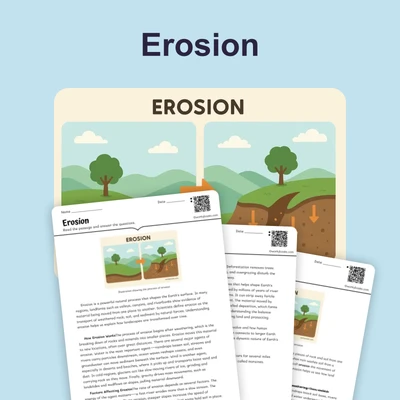
Destructive Forces That Wear Down Land Destructive forces break apart and remove material from Earth’s surface. Weathering is the process that breaks rocks into smaller pieces through physical or chemical means. For example, water can seep into cracks in rocks, freeze, and expand, causing the rock to split. Chemical weathering can occur when rainwater, which is slightly acidic, dissolves certain minerals in rock. Erosion is the movement of broken-down material by wind, water, ice, or gravity. Rivers can carve valleys, glaciers can scrape out basins, and wind can blow away loose soil. Mass wasting is when gravity causes large amounts of rock or soil to move downhill in landslides or slumps. These destructive processes can happen rapidly, as in a landslide, or very slowly, as in the gradual wearing down of a mountain over millions of years.
Dynamic Balance: Landscapes Are Always Changing The surface of Earth is shaped by both constructive and destructive forces working together. In some places, constructive forces dominate. For example, the Himalayas are still rising today due to tectonic uplift, even as weathering and erosion slowly wear them down. In other areas, destructive forces are stronger, reducing mountains to low, rolling hills. Landscapes with high relief, such as tall mountains and deep valleys, often show that uplift and building processes are faster than erosion. In contrast, flat plains and wide valleys often result from long-term erosion outpacing uplift. Scientists study rock layers, landforms, and rates of uplift or erosion to understand how these processes interact over time.
The balance between constructive and destructive forces is not always equal. Changes in climate, earthquakes, or human activities can tip the balance by accelerating erosion or increasing building processes. Understanding these forces helps us predict natural hazards, manage land use, and protect important ecosystems like beaches and deltas.
Interesting Fact: Mount Everest, the highest mountain on Earth, is still rising by about 5 millimeters each year due to tectonic uplift, even as wind and water continue to erode its slopes.
Which of the following is a constructive force that forms new land?
Volcanic eruptionErosionMass wastingWeathering
What is the main role of destructive forces on Earth's surface?
Making new mountainsWearing down and removing landBuilding coral reefsCausing tectonic uplift
Which process is responsible for creating a delta at the mouth of a river?
DepositionWeatheringMass wastingTectonic uplift
What is mass wasting?
The movement of rock and soil down a slope by gravityThe slow build-up of coral reefsThe process of wind depositing sand dunesThe raising of Earth's surface by tectonic plates
In the passage, what does the word 'uplift' most nearly mean?
The movement of material by windThe raising of Earth's surface due to tectonic activityThe breaking down of rock into smaller piecesThe process of river erosion
What does the word 'erosion' mean as used in the passage?
The movement of weathered material by natural forcesThe build-up of new land by volcanoesThe process of forming coral reefsThe chemical breakdown of rocks
Why are the Himalayas still rising, according to the passage?
Because of constant volcanic eruptionsDue to tectonic uplift from Earth's plates movingFrom mass wasting eventsBecause of wind deposition
How might human activities affect the balance between constructive and destructive forces?
They can speed up erosion or increase building processesThey only cause constructive forcesThey slow down all natural processesThey stop weathering from happening
True or False: All mountains on Earth are only getting smaller due to erosion.
TrueFalse
True or False: Beaches and deltas can be formed by the process of deposition.
TrueFalse
Perfect For:
👩🏫 Teachers
• Reading comprehension practice
• Auto-graded assessments
• Literacy skill development
👨👩👧👦 Parents
• Reading practice at home
• Comprehension improvement
• Educational reading time
🏠 Homeschoolers
• Reading curriculum support
• Independent reading practice
• Progress monitoring
Reading Features:
📖
Reading Passage
Engaging fiction or nonfiction text
❓
Comprehension Quiz
Auto-graded questions
📊
Instant Feedback
Immediate results and scoring
📄
Printable Version
Download for offline reading
🔊
Read Aloud
Voice-over with word highlighting
Reviews & Ratings
No reviews yet. Be the first to share your experience!
Related Content
Frost Wedging: How Ice Splits Rock
This passage explains frost wedging as a mechanical weathering process. Aligned with NGSS MS-ESS2-1 (Earth’s systems) a...
MS-ESS2-1MS-ESS2-2RST.6-8.3
Limestone Caves: Nature’s Underground Wonders
This passage explains limestone cave formation through carbonation, aligned with NGSS MS-ESS2-1 (Earth’s systems) and L...
MS-ESS2-1LS2.CRST.6-8.7
Chemical Weathering: The Breakdown of Rocks Through Chemical Reactions
This passage explains chemical weathering processes, aligned with NGSS MS-ESS2-1 (Earth’s systems) and ESS2-2 (surface ...
MS-ESS2-1MS-ESS2-2RST.6-8.4
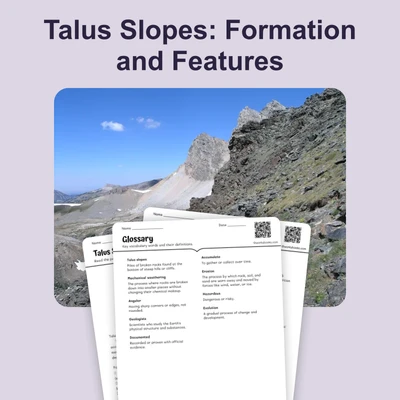
Talus Slopes: Formation and Features
This earth science passage explains talus slope formation through mechanical weathering processes, aligning with NGSS MS...
MS-ESS2-1MS-ESS2-2RST.6-8.4
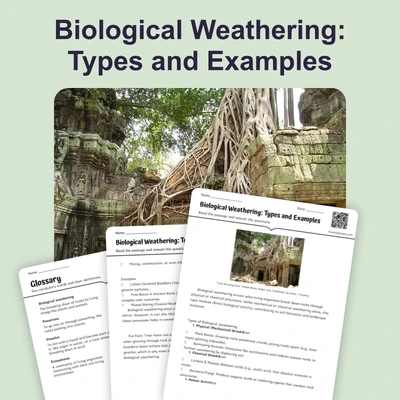
Biological Weathering: Types and Examples
This passage details biological weathering processes, connecting to NGSS MS-ESS2-1 (Earth's systems) and LS2.B (ecosyste...
MS-ESS2-1MS-PS1-2RST.6-8.3
The Coldest City in the World: Yakutsk
This NGSS-aligned science passage introduces middle school readers to Yakutsk, the coldest city on Earth. Students will ...
MS-ESS2-1
Igneous Rocks
This comprehensive passage introduces middle school students to igneous rocks, focusing on how these rocks form from mol...
MS-ESS2-1MS-ESS3-1
Sedimentary Rocks
This comprehensive middle school science passage introduces students to sedimentary rocks, detailing their step-by-step ...
MS-ESS2-1MS-ESS2-3MS-ESS3-1
Metamorphic Rocks
This engaging middle school science passage introduces students to the fascinating world of metamorphic rocks. Aligned w...
MS-ESS2-1MS-ESS3-1
Scientific Inquiry in Earth Science
This passage explores scientific inquiry in Earth science for grades 6-8, aligned with NGSS standards MS-ESS1-4, MS-ESS2...
MS-ESS1-4MS-ESS2-1MS-ESS3-5SEP
Contour Lines and Elevation
This passage, designed for grades 6-8 and aligned with NGSS standards MS-ESS2-2 and MS-ESS2-1, introduces students to th...
MS-ESS2-2MS-ESS2-1SEP.4SEP.8
Weathering
This comprehensive science reading passage for grades 6-8 focuses on the concept of weathering, aligning with NGSS stand...
MS-ESS2-1
Erosion
This comprehensive middle school science passage explains erosion—the process that transports weathered rock and soil fr...
MS-ESS2-1
Stream Erosion and Deposition
This middle school science passage, aligned to NGSS MS-ESS2-1, introduces students to the dynamic processes of stream er...
MS-ESS2-1
Wind Erosion and Deposition
This comprehensive science reading passage for grades 6-8 explores the processes of wind erosion and deposition, alignin...
MS-ESS2-1
Glacial Erosion and Deposition
This middle school science passage explores glacial erosion and deposition, focusing on the mechanisms by which glaciers...
MS-ESS2-1
Mass Movements
This NGSS-aligned passage introduces middle school students to the science of mass movements—gravity-driven motions of r...
MS-ESS2-1MS-ESS3-2
Soil Formation and Composition
This comprehensive middle school science passage explores soil formation and composition, perfectly aligned to NGSS stan...
MS-ESS2-1
Mountains and Mountain Building
This NGSS-aligned passage for grades 6-8 covers the fascinating processes that create Earth's highest landforms—mountain...