This learning resource is available in interactive and printable formats. The interactive worksheet can be played online and assigned to students. The Printable PDF version can be downloaded and printed for completion by hand.
This NGSS-aligned passage introduces middle school students to the science of mass movements—gravity-driven motions of rock and soil that shape Earth's landscapes. Students will learn about the mechanisms, types, and causes of mass movements, such as rockfalls, landslides, mudflows, slumps, and creep. The passage explores how slope angle, water, vegetation, earthquakes, and human activity can trigger these processes, and discusses the hazards and mitigation strategies communities use to reduce risks. With a focus on scientific reasoning and real-world applications, the resource supports science standards MS-ESS2-1 and MS-ESS3-2. Glossary terms, quizzes, writing prompts, and graphic organizers enhance comprehension and support diverse learners. The passage is also audio integrated for accessibility.
CONTENT PREVIEW
Expand content preview
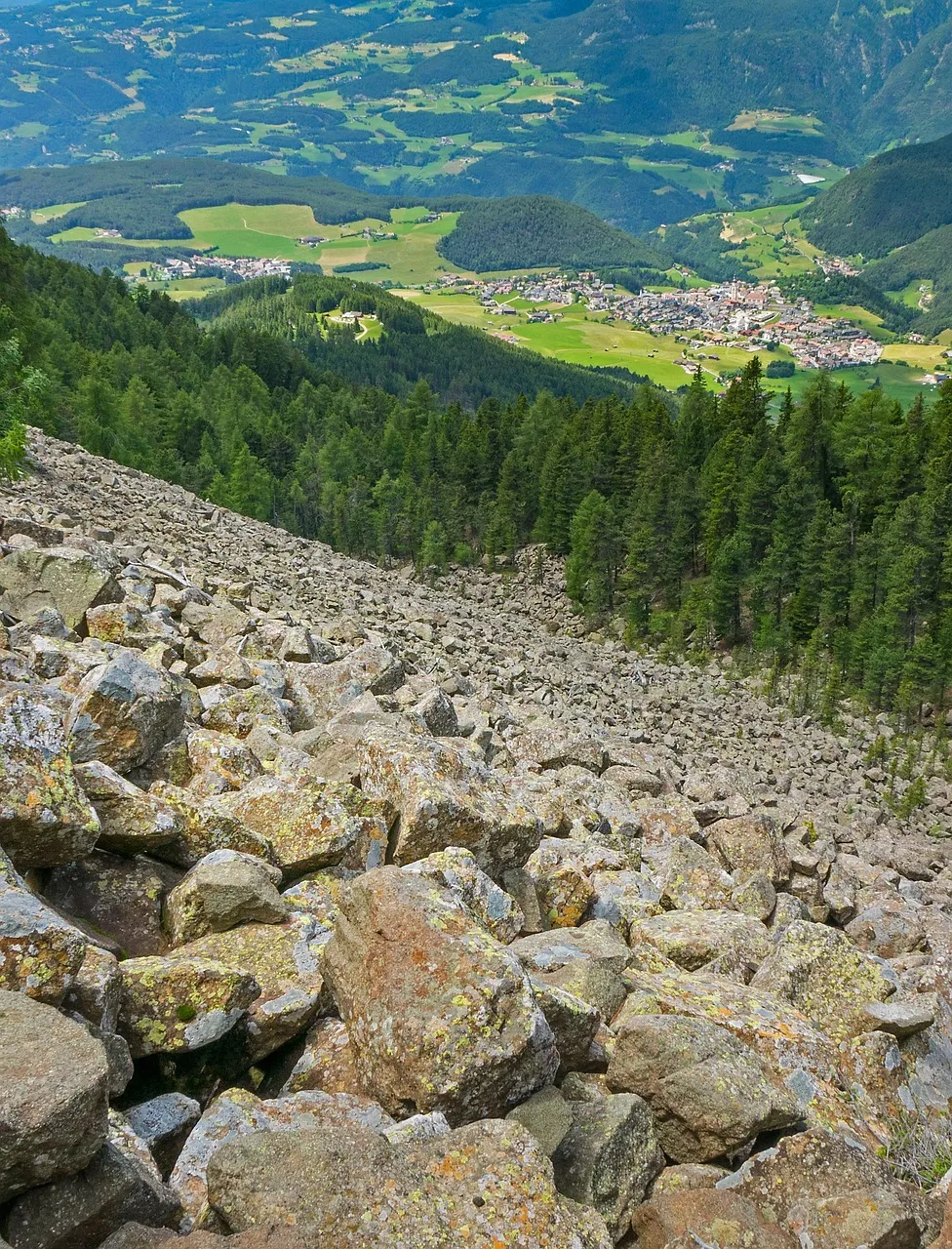
Mass movements involve large amounts of rock and soil shifting downhill due to the force of gravity. Image by adege / Pixabay.
Mass movements are one of the most important ways Earth's surface changes over time. These processes involve large amounts of rock and soil shifting downhill due to the force of gravity. Mass movements can create new landforms, block roads, or even endanger human lives. Understanding how and why mass movements occur is essential for predicting natural hazards and protecting communities.
How Mass Movements Work
Gravity is the main driving force behind mass movements. When the pull of gravity on earth materials—such as rocks, soil, and debris—becomes stronger than the forces holding them in place, movement begins. Several factors affect whether mass movement will occur. Slope angle is crucial: steeper slopes are more likely to experience movement. Water saturation from heavy rainfall or melting snow adds weight and reduces friction, making materials slip more easily. The removal of vegetation, which anchors soil with roots, destabilizes slopes. Earthquakes and volcanic eruptions can act as sudden triggers, shaking loose rocks and soil. Rock type also matters, as some rocks weather and break apart more quickly than others.
Types and Examples of Mass Movements
There are several types of mass movements, each with distinct characteristics. A rockfall occurs when rocks break free from a cliff and drop quickly to the base. These events are common in mountainous areas and can move at speeds over 100 km/h. Landslides involve rapid movement of rock, soil, and debris down a slope, often after heavy rain or an earthquake. Mudflows or debris flows happen when water-saturated earth materials rush down a slope, carrying rocks, trees, and even cars with them. A slump is a slower, rotational slide along a curved surface, often leaving a crescent-shaped scar on the hillside. Creep is the slowest type, moving soil and rocks downhill just a few millimeters or centimeters per year, but causing bent trees and tilted fences over time.
Hazards and Mitigation
Mass movements can cause serious hazards. They may block roads, damage buildings, disrupt utilities, and sometimes result in injuries or deaths. Human activities—such as construction, deforestation, and altering drainage—can increase the risk of mass movement events. Scientists use monitoring equipment to detect early signs, such as small slope movements or increased groundwater. Communities use mitigation strategies like building retaining walls, installing drainage systems, planting vegetation, and careful land-use planning to reduce risks and protect people and property.
Mass movements demonstrate how Earth's systems interact and change over time. By studying these processes, scientists can better understand landscape evolution and develop tools to predict and manage natural hazards.
Interesting Fact: Some of the fastest landslides in history have moved at speeds over 200 km/h, powerful enough to reshape entire valleys in minutes.
What is the main force that causes mass movements?
GravityWindSunlightOcean waves
Which factor can increase the risk of a landslide after heavy rain?
Water saturationIncreased sunlightLow wind speedFrozen soil
What is a rockfall?
Rocks breaking off and falling quickly from a cliffSoil moving slowly downhillWater eroding riverbanksTrees growing on a hillside
What does the term 'creep' mean in the context of mass movements?
A very slow downhill movement of soil and rocksA rapid river floodWind blowing sand dunesRoots growing underground
What is the meaning of 'mitigation' as used in the passage?
Actions to reduce the risk of hazardsMoving rocks uphillCutting down treesMeasuring rainfall
Which term describes a sudden event that starts a mass movement?
TriggerSlope angleVegetationMitigation
How can removing vegetation affect a hillside?
It makes the slope less stable and more likely to move.It increases the strength of the soil.It prevents landslides from happening.It has no effect on mass movements.
Why are retaining walls and drainage systems important in areas prone to mass movements?
They help stabilize slopes and reduce hazards.They make the ground steeper.They cause more rain to fall.They increase the chance of rockfalls.
True or False: Mudflows only occur in dry conditions.
TrueFalse
True or False: Creep can cause trees and fences to tilt over time.
TrueFalse
Perfect For:
👩🏫 Teachers
• Reading comprehension practice
• Auto-graded assessments
• Literacy skill development
👨👩👧👦 Parents
• Reading practice at home
• Comprehension improvement
• Educational reading time
🏠 Homeschoolers
• Reading curriculum support
• Independent reading practice
• Progress monitoring
Reading Features:
📖
Reading Passage
Engaging fiction or nonfiction text
❓
Comprehension Quiz
Auto-graded questions
📊
Instant Feedback
Immediate results and scoring
📄
Printable Version
Download for offline reading
🔊
Read Aloud
Voice-over with word highlighting
Reviews & Ratings
No reviews yet. Be the first to share your experience!
Related Content
Talus Slopes: Formation and Features
This earth science passage explains talus slope formation through mechanical weathering processes, aligning with NGSS MS...
MS-ESS2-1MS-ESS2-2RST.6-8.4
Biological Weathering: Types and Examples
This passage details biological weathering processes, connecting to NGSS MS-ESS2-1 (Earth's systems) and LS2.B (ecosyste...
MS-ESS2-1MS-PS1-2RST.6-8.3
Frost Wedging: How Ice Splits Rock
This passage explains frost wedging as a mechanical weathering process. Aligned with NGSS MS-ESS2-1 (Earth’s systems) a...
MS-ESS2-1MS-ESS2-2RST.6-8.3
Chemical Weathering: The Breakdown of Rocks Through Chemical Reactions
This passage explains chemical weathering processes, aligned with NGSS MS-ESS2-1 (Earth’s systems) and ESS2-2 (surface ...
MS-ESS2-1MS-ESS2-2RST.6-8.4
Limestone Caves: Nature’s Underground Wonders
This passage explains limestone cave formation through carbonation, aligned with NGSS MS-ESS2-1 (Earth’s systems) and L...
MS-ESS2-1LS2.CRST.6-8.7
The Coldest City in the World: Yakutsk
This NGSS-aligned science passage introduces middle school readers to Yakutsk, the coldest city on Earth. Students will ...
MS-ESS2-1
Igneous Rocks
This comprehensive passage introduces middle school students to igneous rocks, focusing on how these rocks form from mol...
MS-ESS2-1MS-ESS3-1
Sedimentary Rocks
This comprehensive middle school science passage introduces students to sedimentary rocks, detailing their step-by-step ...
MS-ESS2-1MS-ESS2-3MS-ESS3-1
Metamorphic Rocks
This engaging middle school science passage introduces students to the fascinating world of metamorphic rocks. Aligned w...
MS-ESS2-1MS-ESS3-1
Scientific Inquiry in Earth Science
This passage explores scientific inquiry in Earth science for grades 6-8, aligned with NGSS standards MS-ESS1-4, MS-ESS2...
MS-ESS1-4MS-ESS2-1MS-ESS3-5SEP
Contour Lines and Elevation
This passage, designed for grades 6-8 and aligned with NGSS standards MS-ESS2-2 and MS-ESS2-1, introduces students to th...
MS-ESS2-2MS-ESS2-1SEP.4SEP.8
Weathering
This comprehensive science reading passage for grades 6-8 focuses on the concept of weathering, aligning with NGSS stand...
MS-ESS2-1
Erosion
This comprehensive middle school science passage explains erosion—the process that transports weathered rock and soil fr...
MS-ESS2-1
Stream Erosion and Deposition
This middle school science passage, aligned to NGSS MS-ESS2-1, introduces students to the dynamic processes of stream er...
MS-ESS2-1
Wind Erosion and Deposition
This comprehensive science reading passage for grades 6-8 explores the processes of wind erosion and deposition, alignin...
MS-ESS2-1
Glacial Erosion and Deposition
This middle school science passage explores glacial erosion and deposition, focusing on the mechanisms by which glaciers...
MS-ESS2-1
Soil Formation and Composition
This comprehensive middle school science passage explores soil formation and composition, perfectly aligned to NGSS stan...
MS-ESS2-1
Constructive and Destructive Forces
This middle school science passage explores how Earth's surface is constantly shaped by the interplay of constructive an...
MS-ESS2-1
Mountains and Mountain Building
This NGSS-aligned passage for grades 6-8 covers the fascinating processes that create Earth's highest landforms—mountain...