This learning resource is available in interactive and printable formats. The interactive worksheet can be played online and assigned to students. The Printable PDF version can be downloaded and printed for completion by hand.
This comprehensive passage introduces middle school students to igneous rocks, focusing on how these rocks form from molten material and the differences between intrusive and extrusive types. Students will learn about the mechanisms that create coarse-grained (granite), fine-grained (basalt), glassy (obsidian), and vesicular (pumice) textures, as well as the significance of felsic and mafic compositions. Real-world applications, like granite countertops and the oceanic crust's basalt, help connect classroom learning to everyday life. The content aligns with NGSS standards MS-ESS2-1 and MS-ESS3-1, emphasizing systems thinking and interactions among Earth's materials. The passage includes a glossary, Spanish translation, a simplified version for differentiated instruction, comprehension questions, writing prompts, and graphic organizers. Audio integration supports accessibility for diverse learners. This resource is ideal for deepening understanding of Earth's dynamic processes and fostering scientific literacy in grades 6-8.
CONTENT PREVIEW
Expand content preview
Igneous Rocks
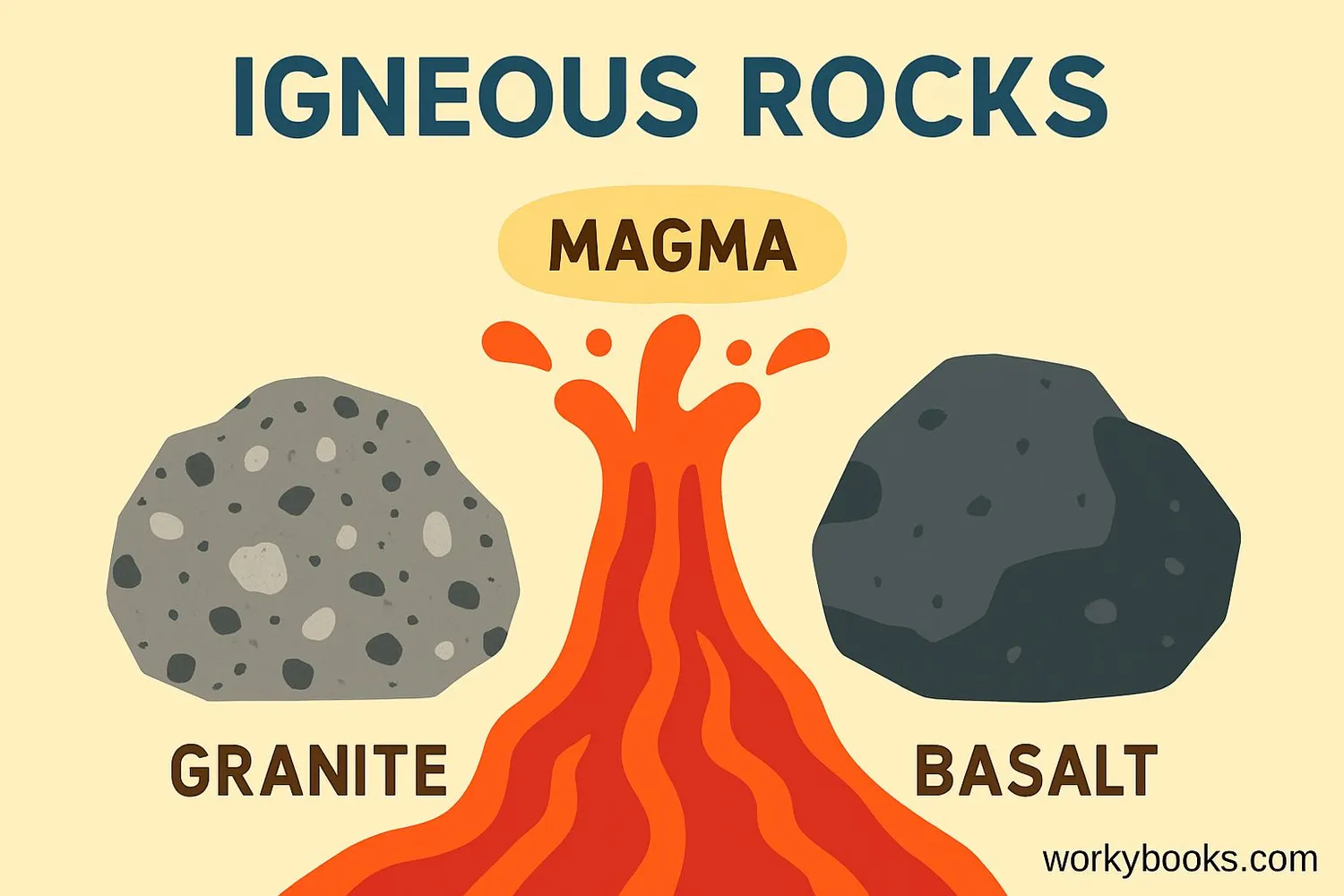
Igneous rocks are formed through the cooling and solidification of molten material called magma or lava. These rocks provide essential evidence about Earth's inner workings and the powerful forces that shape our planet. By studying their textures and composition, scientists can reconstruct past volcanic activity and tectonic events. Igneous rocks are a crucial part of the rock cycle, connecting deep Earth processes to what we observe on the surface.
How Igneous Rocks Form: Mechanisms and Textures
Igneous rocks begin as magma beneath the Earth's surface. When magma cools slowly underground, it forms intrusive (or plutonic) rocks. Slow cooling allows large mineral crystals to grow, creating a coarse-grained texture. Granite, often seen in kitchen countertops, is a common intrusive rock. In contrast, when magma erupts as lava and cools quickly at the surface, it forms extrusive (or volcanic) rocks. Fast cooling produces small crystals, leading to fine-grained rocks like basalt, which makes up much of the ocean floor. If lava cools extremely rapidly, it can form glassy rocks like obsidian. Sometimes, gases trapped within cooling lava create a frothy, vesicular texture, as seen in pumice, a rock light enough to float on water.
Types, Composition, and Real-World Applications
Igneous rocks are further classified by their mineral composition. Felsic rocks, such as granite, are light in color and rich in silica. Mafic rocks, like basalt, are darker and contain more iron and magnesium. These differences affect how the rocks form and where they are found. For example, the continents are mostly made of felsic rocks, while the ocean basins are dominated by mafic rocks like basalt. Intrusive igneous rocks can form massive underground structures called batholiths, or sheet-like features such as sills and dikes. In society, igneous rocks are used for construction, decoration, and even abrasive materials—pumice is used in soaps and cleaning products.
Scientific Evidence and Broader Connections
Scientists use laboratory experiments and field observations to analyze igneous rocks. By examining crystal size, mineral content, and the presence of vesicles, geologists infer the cooling history and environment in which a rock formed. Advances in radiometric dating have allowed researchers to determine the age of igneous rocks with high precision, sometimes within 1%. These findings help us understand plate tectonics, the cycling of elements, and Earth's geologic history. The study of igneous rocks also reveals the interconnectedness of Earth's systems, linking interior processes with surface landscapes and even human technology.
In summary, igneous rocks form from molten material and display a variety of textures and compositions based on how and where they cool. Their study unlocks secrets about Earth's interior and its ongoing geological activity.
Interesting Fact: The largest known igneous intrusion on Earth, called the Siberian Traps, covers over 2 million square kilometers—an area larger than Alaska!
What is the main process that forms igneous rocks?
Cooling and solidification of molten materialCompaction of sand and mudEvaporation of waterHeat and pressure on existing rocks
Which type of igneous rock forms when magma cools slowly underground?
What does the word 'vesicular' mean as used in the passage?
Having large crystalsContaining many gas bubblesBeing very dark in colorFormed from plant material
What is the difference between felsic and mafic igneous rocks?
Felsic rocks are lighter and rich in silica; mafic rocks are darker and rich in iron/magnesium.Felsic rocks have more gas bubbles; mafic rocks are glassy.Felsic rocks are always extrusive; mafic rocks are always intrusive.There is no difference.
If a rock formed from lava that cooled extremely rapidly, what texture would you expect?
Coarse-grainedFine-grainedGlassyVesicular
Scientists can determine the age of igneous rocks within 1% accuracy using radiometric dating.
TrueFalse
Pumice is heavy and sinks in water.
TrueFalse
Which of the following is NOT a feature formed by intrusive igneous rocks?
BatholithSillDikeVolcanic ash
Perfect For:
👩🏫 Teachers
• Reading comprehension practice
• Auto-graded assessments
• Literacy skill development
👨👩👧👦 Parents
• Reading practice at home
• Comprehension improvement
• Educational reading time
🏠 Homeschoolers
• Reading curriculum support
• Independent reading practice
• Progress monitoring
Reading Features:
📖
Reading Passage
Engaging fiction or nonfiction text
❓
Comprehension Quiz
Auto-graded questions
📊
Instant Feedback
Immediate results and scoring
📄
Printable Version
Download for offline reading
🔊
Read Aloud
Voice-over with word highlighting
Reviews & Ratings
No reviews yet. Be the first to share your experience!
Related Content
Talus Slopes: Formation and Features
This earth science passage explains talus slope formation through mechanical weathering processes, aligning with NGSS MS...
MS-ESS2-1MS-ESS2-2RST.6-8.4
Biological Weathering: Types and Examples
This passage details biological weathering processes, connecting to NGSS MS-ESS2-1 (Earth's systems) and LS2.B (ecosyste...
MS-ESS2-1MS-PS1-2RST.6-8.3
Frost Wedging: How Ice Splits Rock
This passage explains frost wedging as a mechanical weathering process. Aligned with NGSS MS-ESS2-1 (Earth’s systems) a...
MS-ESS2-1MS-ESS2-2RST.6-8.3
Chemical Weathering: The Breakdown of Rocks Through Chemical Reactions
This passage explains chemical weathering processes, aligned with NGSS MS-ESS2-1 (Earth’s systems) and ESS2-2 (surface ...
MS-ESS2-1MS-ESS2-2RST.6-8.4
Limestone Caves: Nature’s Underground Wonders
This passage explains limestone cave formation through carbonation, aligned with NGSS MS-ESS2-1 (Earth’s systems) and L...
MS-ESS2-1LS2.CRST.6-8.7
The Coldest City in the World: Yakutsk
This NGSS-aligned science passage introduces middle school readers to Yakutsk, the coldest city on Earth. Students will ...
MS-ESS2-1
Sedimentary Rocks
This comprehensive middle school science passage introduces students to sedimentary rocks, detailing their step-by-step ...
MS-ESS2-1MS-ESS2-3MS-ESS3-1
Metamorphic Rocks
This engaging middle school science passage introduces students to the fascinating world of metamorphic rocks. Aligned w...
MS-ESS2-1MS-ESS3-1
Scientific Inquiry in Earth Science
This passage explores scientific inquiry in Earth science for grades 6-8, aligned with NGSS standards MS-ESS1-4, MS-ESS2...
MS-ESS1-4MS-ESS2-1MS-ESS3-5SEP
Contour Lines and Elevation
This passage, designed for grades 6-8 and aligned with NGSS standards MS-ESS2-2 and MS-ESS2-1, introduces students to th...
MS-ESS2-2MS-ESS2-1SEP.4SEP.8
Weathering
This comprehensive science reading passage for grades 6-8 focuses on the concept of weathering, aligning with NGSS stand...
MS-ESS2-1
Erosion
This comprehensive middle school science passage explains erosion—the process that transports weathered rock and soil fr...
MS-ESS2-1
Stream Erosion and Deposition
This middle school science passage, aligned to NGSS MS-ESS2-1, introduces students to the dynamic processes of stream er...
MS-ESS2-1
Wind Erosion and Deposition
This comprehensive science reading passage for grades 6-8 explores the processes of wind erosion and deposition, alignin...
MS-ESS2-1
Glacial Erosion and Deposition
This middle school science passage explores glacial erosion and deposition, focusing on the mechanisms by which glaciers...
MS-ESS2-1
Mass Movements
This NGSS-aligned passage introduces middle school students to the science of mass movements—gravity-driven motions of r...
MS-ESS2-1MS-ESS3-2
Soil Formation and Composition
This comprehensive middle school science passage explores soil formation and composition, perfectly aligned to NGSS stan...
MS-ESS2-1
Constructive and Destructive Forces
This middle school science passage explores how Earth's surface is constantly shaped by the interplay of constructive an...
MS-ESS2-1
Mountains and Mountain Building
This NGSS-aligned passage for grades 6-8 covers the fascinating processes that create Earth's highest landforms—mountain...