This learning resource is available in interactive and printable formats. The interactive worksheet can be played online and assigned to students. The Printable PDF version can be downloaded and printed for completion by hand.
This comprehensive middle school science passage explains erosion—the process that transports weathered rock and soil from one location to another. Aligned with NGSS MS-ESS2-1, students will learn about the main agents of erosion, including water, wind, ice, and gravity, and how these forces interact with Earth's surface. The passage provides real-world examples, discusses how human activities like deforestation and construction increase erosion, and connects erosion to sedimentation and the formation of landscapes. Key vocabulary is highlighted and defined for deeper understanding. Activities include a quiz, writing prompts, and graphic organizers to support comprehension and analysis. Audio integration is available for accessibility, helping all learners engage with the topic. This resource is ideal for grades 6-8 and supports the development of scientific literacy and critical thinking.
CONTENT PREVIEW
Expand content preview
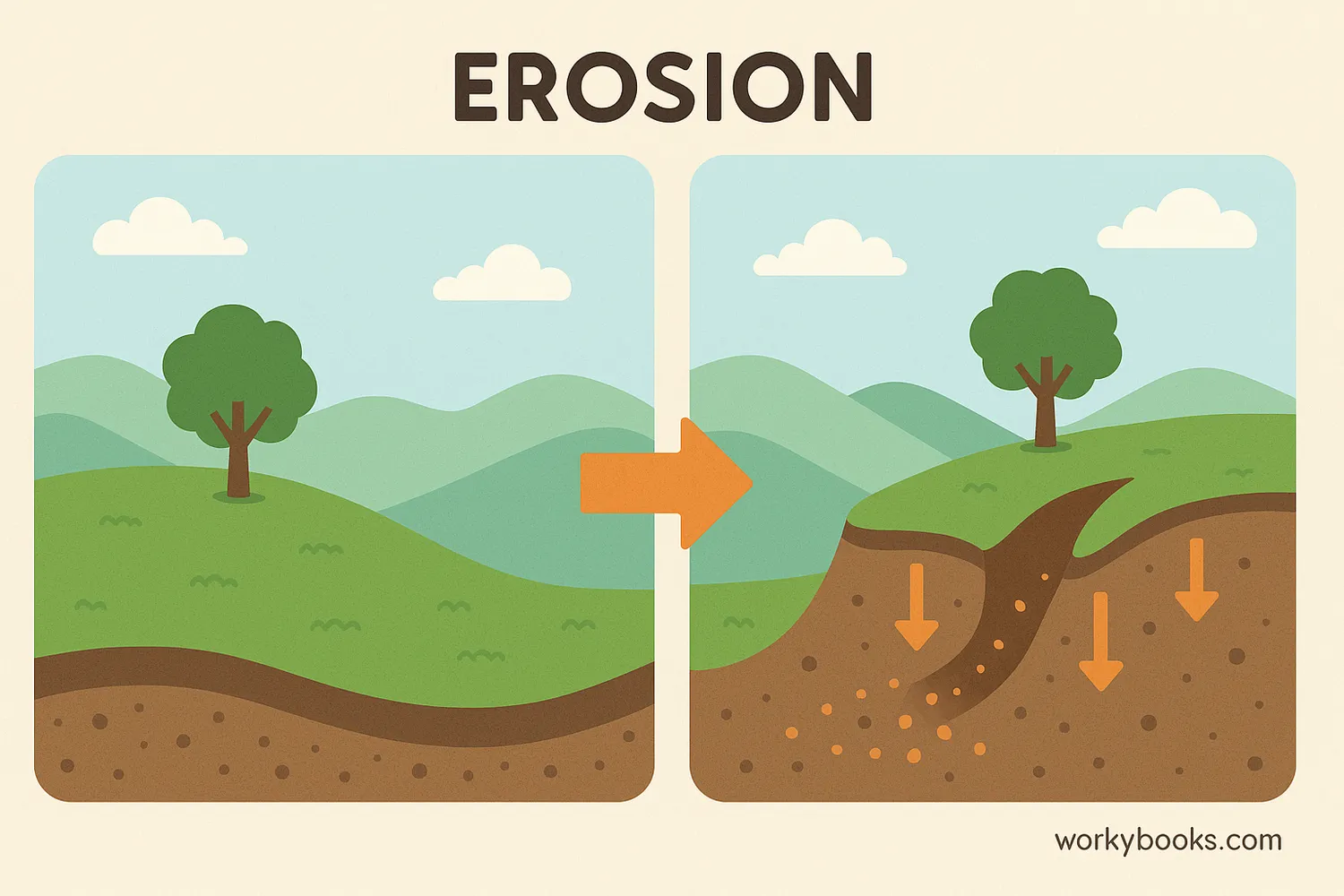
Illustration showing the process of erosion
Erosion is a powerful natural process that shapes the Earth's surface. In many regions, landforms such as valleys, canyons, and riverbanks show evidence of material being moved from one place to another. Scientists define erosion as the transport of weathered rock, soil, and sediment by natural forces. Understanding erosion helps us explain how landscapes are transformed over time.
How Erosion Works The process of erosion begins after weathering, which is the breaking down of rocks and minerals into smaller pieces. Erosion moves this material to new locations, often over great distances. There are several major agents of erosion. Water is the most important agent—raindrops loosen soil, streams and rivers carry particles downstream, ocean waves reshape coasts, and even groundwater can move sediment beneath the surface. Wind is another agent, especially in deserts and beaches, where it picks up and transports loose sand and dust. In cold regions, glaciers act like slow-moving rivers of ice, grinding and carrying rock as they move. Finally, gravity drives mass movements, such as landslides and mudflows on slopes, pulling material downward.
Factors Affecting Erosion The rate of erosion depends on several factors. The energy of the agent matters—a fast river erodes more than a slow stream. The slope of the land also affects erosion; steeper slopes increase the speed of movement. Vegetation cover can slow erosion because plant roots hold soil in place. The type of rock or sediment is important too—loose sand erodes more easily than solid rock. Human activities often increase erosion. Deforestation removes trees whose roots protect soil, while construction, farming, and overgrazing disturb the ground, making it more vulnerable to being carried away.
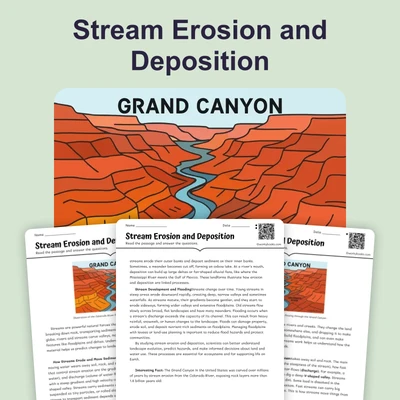
Impact and Connections Erosion is a natural process that helps shape Earth’s landscapes. The Grand Canyon, for example, was carved by millions of years of river erosion. However, excessive erosion can cause problems. It can strip away fertile soil, reduce crop yields, and pollute rivers with sediment. The material moved by erosion is eventually dropped elsewhere in a process called deposition, which forms new features like deltas, sand dunes, or alluvial fans. Understanding the balance between erosion and deposition is important for managing land and protecting environments.
By studying erosion, scientists learn how landscapes evolve and how human actions can speed up or slow down these changes. Erosion connects to larger Earth science principles, such as the cycling of materials and the dynamic nature of Earth's surface.
Interesting Fact: Some glaciers can move rocks the size of cars for several miles before depositing them in new locations, creating landforms called moraines.
What is erosion?
The movement of weathered rock and soil by natural forcesThe breaking down of rocks into smaller piecesThe formation of new rocks from magmaThe melting of glaciers into rivers
Which agent is considered the most important in causing erosion?
WindIceWaterGravity
What is the process called when rocks are broken down into smaller pieces?
SedimentationDepositionErosionWeathering
Which factor does NOT affect the rate of erosion?
Energy of the agentSlope of the landColor of the soilVegetation cover
What happens to material moved by erosion?
It is always dissolved in waterIt is deposited elsewhere, forming new featuresIt disappears completelyIt turns into magma
What does 'mass movement' refer to in the context of erosion?
Rainfall on flat groundMovement of soil and rock down a slope by gravityGrowth of vegetationDeposition of sand dunes
Which human activity increases erosion the most?
Planting treesDeforestationBuilding rock wallsIrrigating crops
Why is erosion sometimes a problem for farmers?
It creates more fertile soilIt strips away fertile topsoil needed for cropsIt increases rainfallIt adds more rocks to the fields
True or False: Glaciers are agents of erosion that only transport water.
TrueFalse
True or False: Erosion and deposition are connected processes.
TrueFalse
Perfect For:
👩🏫 Teachers
• Reading comprehension practice
• Auto-graded assessments
• Literacy skill development
👨👩👧👦 Parents
• Reading practice at home
• Comprehension improvement
• Educational reading time
🏠 Homeschoolers
• Reading curriculum support
• Independent reading practice
• Progress monitoring
Reading Features:
📖
Reading Passage
Engaging fiction or nonfiction text
❓
Comprehension Quiz
Auto-graded questions
📊
Instant Feedback
Immediate results and scoring
📄
Printable Version
Download for offline reading
🔊
Read Aloud
Voice-over with word highlighting
Reviews & Ratings
No reviews yet. Be the first to share your experience!
Related Content
Frost Wedging: How Ice Splits Rock
This passage explains frost wedging as a mechanical weathering process. Aligned with NGSS MS-ESS2-1 (Earth’s systems) a...
MS-ESS2-1MS-ESS2-2RST.6-8.3
Limestone Caves: Nature’s Underground Wonders
This passage explains limestone cave formation through carbonation, aligned with NGSS MS-ESS2-1 (Earth’s systems) and L...
MS-ESS2-1LS2.CRST.6-8.7
Chemical Weathering: The Breakdown of Rocks Through Chemical Reactions
This passage explains chemical weathering processes, aligned with NGSS MS-ESS2-1 (Earth’s systems) and ESS2-2 (surface ...
MS-ESS2-1MS-ESS2-2RST.6-8.4
Talus Slopes: Formation and Features
This earth science passage explains talus slope formation through mechanical weathering processes, aligning with NGSS MS...
MS-ESS2-1MS-ESS2-2RST.6-8.4
Biological Weathering: Types and Examples
This passage details biological weathering processes, connecting to NGSS MS-ESS2-1 (Earth's systems) and LS2.B (ecosyste...
MS-ESS2-1MS-PS1-2RST.6-8.3
The Coldest City in the World: Yakutsk
This NGSS-aligned science passage introduces middle school readers to Yakutsk, the coldest city on Earth. Students will ...
MS-ESS2-1
Igneous Rocks
This comprehensive passage introduces middle school students to igneous rocks, focusing on how these rocks form from mol...
MS-ESS2-1MS-ESS3-1
Sedimentary Rocks
This comprehensive middle school science passage introduces students to sedimentary rocks, detailing their step-by-step ...
MS-ESS2-1MS-ESS2-3MS-ESS3-1
Metamorphic Rocks
This engaging middle school science passage introduces students to the fascinating world of metamorphic rocks. Aligned w...
MS-ESS2-1MS-ESS3-1
Scientific Inquiry in Earth Science
This passage explores scientific inquiry in Earth science for grades 6-8, aligned with NGSS standards MS-ESS1-4, MS-ESS2...
MS-ESS1-4MS-ESS2-1MS-ESS3-5SEP
Contour Lines and Elevation
This passage, designed for grades 6-8 and aligned with NGSS standards MS-ESS2-2 and MS-ESS2-1, introduces students to th...
MS-ESS2-2MS-ESS2-1SEP.4SEP.8
Weathering
This comprehensive science reading passage for grades 6-8 focuses on the concept of weathering, aligning with NGSS stand...
MS-ESS2-1
Stream Erosion and Deposition
This middle school science passage, aligned to NGSS MS-ESS2-1, introduces students to the dynamic processes of stream er...
MS-ESS2-1
Wind Erosion and Deposition
This comprehensive science reading passage for grades 6-8 explores the processes of wind erosion and deposition, alignin...
MS-ESS2-1
Glacial Erosion and Deposition
This middle school science passage explores glacial erosion and deposition, focusing on the mechanisms by which glaciers...
MS-ESS2-1
Mass Movements
This NGSS-aligned passage introduces middle school students to the science of mass movements—gravity-driven motions of r...
MS-ESS2-1MS-ESS3-2
Soil Formation and Composition
This comprehensive middle school science passage explores soil formation and composition, perfectly aligned to NGSS stan...
MS-ESS2-1
Constructive and Destructive Forces
This middle school science passage explores how Earth's surface is constantly shaped by the interplay of constructive an...
MS-ESS2-1
Mountains and Mountain Building
This NGSS-aligned passage for grades 6-8 covers the fascinating processes that create Earth's highest landforms—mountain...