Soil Formation and Composition — Reading Comprehension
Rate this|
1
Premium Resource
Present
Present in classroom. No work saved
Assign
Classroom with student accounts, Track progress
Quick Play
No student accounts, assign with a link
Grades
5
6
7
8
Standards
MS-ESS2-1
PRINT+DIGITAL RESOURCE
This learning resource is available in interactive and printable formats. The interactive worksheet can be played online and assigned to students. The Printable PDF version can be downloaded and printed for completion by hand.
This comprehensive middle school science passage explores soil formation and composition, perfectly aligned to NGSS standard MS-ESS2-1. Students will learn how soil forms through the weathering of bedrock and the accumulation of organic matter over time. The passage explains the main factors influencing soil formation, such as climate, organisms, parent material, topography, and time, and details the quantitative composition of soil: minerals (45%), water (25%), air (25%), and organic matter (5%). Students will also discover the different soil horizons (O, A, B, C, and R), their characteristics, and how soil types vary across climates and ecosystems. The text emphasizes soil's role as a living ecosystem, housing billions of organisms, and highlights its essential functions—supporting plant life, filtering water, storing carbon, and providing habitat. With integrated audio, a Spanish translation, a differentiated reading version, glossary, comprehension activities, and graphic organizers, this resource offers a complete, standards-based learning experience for grades 6–8.
CONTENT PREVIEW
Expand content preview
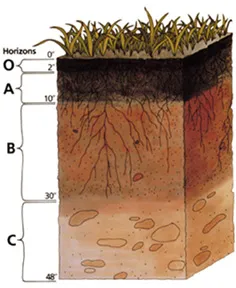
Soil Composition and Structure. Wikimedia Commons (Public domain).
Soil is a vital natural resource that supports all terrestrial life on Earth. Every handful of soil is the result of a complex, centuries-long process that transforms solid rock and decaying organic material into a mixture rich with life. Scientists study soil to understand how it forms, what it contains, and how it sustains ecosystems. Without healthy soil, plants could not grow, water could not be filtered, and most land animals—including humans—would not survive.
How Soil Forms: The Mechanisms Behind Soil Creation
The process of soil formation begins with bedrock, also known as parent material. Over time, weathering—caused by wind, water, temperature changes, and living organisms—breaks the bedrock into smaller particles. Meanwhile, plants, animals, and microbes add organic matter by dying and decomposing, enriching the developing soil. Soil formation is influenced by five main factors: parent material, climate, living organisms, topography (the landscape’s shape), and time. For example, soil in a rainy forest develops faster and contains more organic matter than soil in a dry desert. The process can take hundreds to thousands of years, making soil a non-renewable resource on a human timescale.
Soil Composition and Structure: Layers and Life
Soil is not just dirt. It is a mixture of minerals (45%), water (25%), air (25%), and organic matter (5%). Each part plays a role: minerals provide nutrients, water and air support life, and organic matter fuels decomposition and fertility. Soil is organized into horizons or layers. The O horizon is the top layer, full of organic material like leaves and twigs. Beneath it, the A horizon (topsoil) is richest in nutrients and supports most plant roots. The B horizon (subsoil) accumulates minerals washed down from above, while the C horizon consists of weathered parent material. The deepest layer, the R horizon, is solid bedrock. Each horizon has unique properties that affect water movement, root growth, and soil fertility.
Soil as an Ecosystem: Diversity and Functions
Soil is a living ecosystem teeming with life. A single handful can contain billions of bacteria, fungi, insects, and other tiny organisms. These organisms help break down organic matter, recycle nutrients, and maintain soil structure. Soil types vary depending on climate and vegetation; for example, prairie soils are dark and fertile, while tropical soils may be red and low in nutrients. Healthy soil supports plant growth, filters water, stores carbon, and provides habitat for countless species. Degraded or eroded soil can lead to food shortages, polluted water, and loss of biodiversity.
Understanding soil formation and composition helps us protect this essential resource for farming, clean water, and climate regulation. Scientists use soil studies to develop better land management practices and address environmental challenges.
Interesting Fact: A single teaspoon of healthy soil can contain more living organisms than there are people on Earth!
What is the main process that breaks down bedrock to form soil?
WeatheringErosionCondensationPhotosynthesis
Which of the following is NOT a factor that influences soil formation?
Parent materialClimateOcean tidesOrganisms
According to the passage, what percentage of typical soil is made up of minerals?
45%25%60%5%
What is found in the O horizon of soil?
Organic material like leaves and twigsSolid bedrockOnly mineralsWater and air only
What is a main function of soil mentioned in the passage?
It stores carbonIt creates rainIt produces sunlightIt forms mountains
What does the word 'topography' mean as used in the passage?
The shape and features of the landThe color of soilThe climate of an areaThe number of plants living in an area
What does the passage suggest about soil in a rainy forest compared to a desert?
It forms faster and contains more organic matterIt is always sandierIt does not support plant lifeIt has less water
Why is soil considered a non-renewable resource on a human timescale?
Because it forms very slowly over hundreds or thousands of yearsBecause it is always being replacedBecause it is made by machinesBecause it cannot be damaged
True or False: Soil is made up mostly of organic matter.
TrueFalse
True or False: A single handful of soil can contain billions of living organisms.
TrueFalse
Perfect For:
👩🏫 Teachers
• Reading comprehension practice
• Auto-graded assessments
• Literacy skill development
👨👩👧👦 Parents
• Reading practice at home
• Comprehension improvement
• Educational reading time
🏠 Homeschoolers
• Reading curriculum support
• Independent reading practice
• Progress monitoring
Reading Features:
📖
Reading Passage
Engaging fiction or nonfiction text
❓
Comprehension Quiz
Auto-graded questions
📊
Instant Feedback
Immediate results and scoring
📄
Printable Version
Download for offline reading
🔊
Read Aloud
Voice-over with word highlighting
Reviews & Ratings
No reviews yet. Be the first to share your experience!
Related Content
Frost Wedging: How Ice Splits Rock
This passage explains frost wedging as a mechanical weathering process. Aligned with NGSS MS-ESS2-1 (Earth’s systems) a...
MS-ESS2-1MS-ESS2-2RST.6-8.3
Limestone Caves: Nature’s Underground Wonders
This passage explains limestone cave formation through carbonation, aligned with NGSS MS-ESS2-1 (Earth’s systems) and L...
MS-ESS2-1LS2.CRST.6-8.7
Chemical Weathering: The Breakdown of Rocks Through Chemical Reactions
This passage explains chemical weathering processes, aligned with NGSS MS-ESS2-1 (Earth’s systems) and ESS2-2 (surface ...
MS-ESS2-1MS-ESS2-2RST.6-8.4
Talus Slopes: Formation and Features
This earth science passage explains talus slope formation through mechanical weathering processes, aligning with NGSS MS...
MS-ESS2-1MS-ESS2-2RST.6-8.4
Biological Weathering: Types and Examples
This passage details biological weathering processes, connecting to NGSS MS-ESS2-1 (Earth's systems) and LS2.B (ecosyste...
MS-ESS2-1MS-PS1-2RST.6-8.3
The Coldest City in the World: Yakutsk
This NGSS-aligned science passage introduces middle school readers to Yakutsk, the coldest city on Earth. Students will ...
MS-ESS2-1
Igneous Rocks
This comprehensive passage introduces middle school students to igneous rocks, focusing on how these rocks form from mol...
MS-ESS2-1MS-ESS3-1
Sedimentary Rocks
This comprehensive middle school science passage introduces students to sedimentary rocks, detailing their step-by-step ...
MS-ESS2-1MS-ESS2-3MS-ESS3-1
Metamorphic Rocks
This engaging middle school science passage introduces students to the fascinating world of metamorphic rocks. Aligned w...
MS-ESS2-1MS-ESS3-1
Scientific Inquiry in Earth Science
This passage explores scientific inquiry in Earth science for grades 6-8, aligned with NGSS standards MS-ESS1-4, MS-ESS2...
MS-ESS1-4MS-ESS2-1MS-ESS3-5SEP
Contour Lines and Elevation
This passage, designed for grades 6-8 and aligned with NGSS standards MS-ESS2-2 and MS-ESS2-1, introduces students to th...
MS-ESS2-2MS-ESS2-1SEP.4SEP.8
Weathering
This comprehensive science reading passage for grades 6-8 focuses on the concept of weathering, aligning with NGSS stand...
MS-ESS2-1
Erosion
This comprehensive middle school science passage explains erosion—the process that transports weathered rock and soil fr...
MS-ESS2-1
Stream Erosion and Deposition
This middle school science passage, aligned to NGSS MS-ESS2-1, introduces students to the dynamic processes of stream er...
MS-ESS2-1
Wind Erosion and Deposition
This comprehensive science reading passage for grades 6-8 explores the processes of wind erosion and deposition, alignin...
MS-ESS2-1
Glacial Erosion and Deposition
This middle school science passage explores glacial erosion and deposition, focusing on the mechanisms by which glaciers...
MS-ESS2-1
Mass Movements
This NGSS-aligned passage introduces middle school students to the science of mass movements—gravity-driven motions of r...
MS-ESS2-1MS-ESS3-2
Constructive and Destructive Forces
This middle school science passage explores how Earth's surface is constantly shaped by the interplay of constructive an...
MS-ESS2-1
Mountains and Mountain Building
This NGSS-aligned passage for grades 6-8 covers the fascinating processes that create Earth's highest landforms—mountain...