Could We Drill to Earth's Core
Interactive passage with audio narration, comprehension questions, and printable PDF.
By completing this purchase you agree to our Terms of Use and Privacy Policy. Your subscription renews automatically until you cancel. You can cancel anytime from your account settings. All sales are final and non-refundable. Digital content is available for download in your account immediately upon purchase.
What's included
Could We Drill to Earth's Core preview and details
About this printable Could We Drill to Earth's Core science reading passage, NGSS-aligned (Grades 5-8)
Sample passage and quiz from Could We Drill to Earth's Core
Reading passage and comprehension quiz preview
Could We Drill to Earth's Core
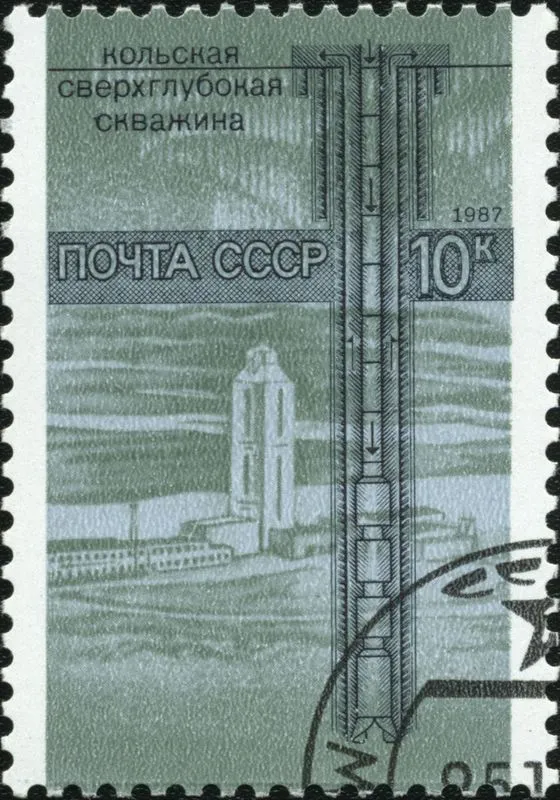
A USSR stamp, Science in USSR.Date of issue: 25th November 1987..0 K. deep dull green, blue-black and azure. Kolskaya borehole / Wikimedia Commons
Could humans ever drill all the way down to Earth's core? The answer is no, not with any technology we have today. The deepest hole ever drilled reached only about 7.5 miles into Earth's crust. This famous project, called the Kola Superdeep Borehole in Russia, had to stop in 1992. The core lies nearly 4,000 miles below the surface, making it thousands of miles beyond our reach.
Several enormous obstacles prevent us from drilling deeper. Temperature rises dramatically as you go down into Earth. The Kola borehole encountered temperatures above 350 degrees Fahrenheit, much hotter than scientists expected. At greater depths, temperatures can exceed 10,000 degrees Fahrenheit near the core. These extreme conditions cause metal drill bits to soften and fail. Pressure also increases with depth, reaching millions of pounds per square inch. This intense pressure can crush equipment and cause surrounding rock to behave more like soft plastic than solid material.
The rock itself creates problems for drilling operations. Deep underground, rock becomes so hot and compressed that it flows into drill holes. Engineers describe this as rock acting like toothpaste being squeezed from a tube. The borehole walls can collapse or seal themselves shut. Removing rock debris from such deep holes also becomes nearly impossible as friction and heat increase.
Because direct access to Earth's interior remains impossible, scientists rely on indirect evidence to study what lies below. Seismic waves from earthquakes provide the most valuable information. These energy waves travel through Earth at different speeds depending on the material they pass through. Scientists observe how seismic waves bend, reflect, and change speed as they move through different layers. This evidence reveals that Earth has distinct layers: the thin outer crust, the thick rocky mantle, and the metallic core divided into liquid outer and solid inner sections.
Scientists also study rock samples that volcanic eruptions bring to the surface from deep in the mantle. Meteorites that fall to Earth provide clues too, since they formed from the same materials as our planet. Laboratory experiments help scientists understand how materials behave under extreme pressure and temperature. Computer models combine all this evidence to create detailed pictures of Earth's interior structure.
Understanding Earth's interior matters for many reasons. The core generates Earth's magnetic field, which protects us from harmful solar radiation. Movement in the mantle drives plate tectonics, causing earthquakes and volcanic eruptions. Scientists continue developing new ways to study Earth's unreachable depths, proving that clever thinking can reveal secrets that direct observation cannot.
Interesting Fact: The Kola Superdeep Borehole took over 20 years to drill and cost millions of dollars, yet it penetrated less than one-third of one percent of the distance to Earth's center.
Comprehension quiz (10 questions)
1. How deep did the Kola Superdeep Borehole reach before drilling stopped?
2. What are the two main obstacles that prevent drilling to Earth's core?
3. What does the term 'indirect evidence' mean in the passage?
4. What type of indirect evidence provides the most valuable information about Earth's interior?
5. Based on the passage, why does rock deep underground behave like soft plastic or toothpaste?
6. What can scientists learn by observing how seismic waves change speed and direction?
7. According to the passage, what important function does Earth's core serve?
8. Why do scientists study meteorites to learn about Earth's interior?
9. True or False: The Kola Superdeep Borehole reached more than halfway to Earth's core.
10. True or False: Scientists can only study Earth's interior by drilling deep holes.
Perfect for the way you teach
- Build comprehension skills
- Auto-graded quiz
- Differentiated reading
- Read together at home
- Improve fluency
- Quiet reading time
- Reading curriculum support
- Independent practice
- Track Lexile growth