Dangers on the Oregon Trail
Interactive passage with audio narration, comprehension questions, and printable PDF.
By completing this purchase you agree to our Terms of Use and Privacy Policy. Your subscription renews automatically until you cancel. You can cancel anytime from your account settings. All sales are final and non-refundable. Digital content is available for download in your account immediately upon purchase.
What's included
Part of this bundle

Dangers on the Oregon Trail preview and details
About this printable Dangers on the Oregon Trail reading passage (Grades 3-5)
Sample passage and quiz from Dangers on the Oregon Trail
Reading passage and comprehension quiz preview
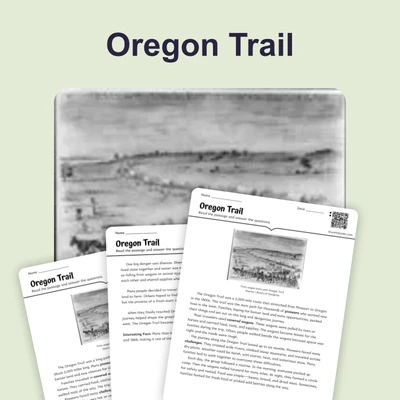
Oregon Trail Dangers
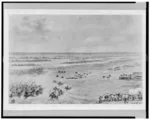
Source: Library of Congress
The Oregon Trail was a long and dangerous route used by thousands of pioneers in the 1800s. People traveled over 2,000 miles from places like Missouri to Oregon or California. Their journey was filled with many hazards. Families traveled together in covered wagons. They hoped to start a new life in the West.
One of the first dangers was crossing wide and fast rivers. The wagons could tip over, and people or animals could drown. If the river was too deep, pioneers had to build rafts or float their wagons. This was slow and risky. Many lost supplies or even their lives during these crossings.
Disease was another big threat. Cholera was a deadly illness that spread quickly in wagon camps. It caused high fever, pain, and loss of water from the body. There were no doctors or hospitals nearby. Many people died before help could arrive. The fear of cholera made every traveler worry.
Harsh weather also created problems. Pioneers faced heavy rains, strong winds, and hot sun. Storms could make the trails muddy and hard to cross. In the mountains, sudden snowstorms trapped wagons and made travel impossible. People had to work together to stay safe and keep moving forward.
Broken wagons were a common problem. The rough trails could break wheels or axles. Pioneers had to stop and fix their wagons using spare parts and tools. If a wagon could not be fixed, families had to leave things behind. This made the trip even harder.
Running out of food and water was very serious. Wild animals and rivers were not always easy to find. Sometimes, pioneers had to eat less or use water from muddy ponds. People shared what they had and helped each other survive.
Because of these dangers, about one out of every ten people died before reaching Oregon or California. But many pioneers showed great bravery and teamwork. They learned to solve problems together and never gave up on their dream.
Interesting Fact: Some pioneers wrote journals about their trip, which help us learn about the real dangers they faced on the Oregon Trail.
Comprehension quiz (8 questions)
1. How long was the Oregon Trail?
2. What was a big danger on the trail?
3. Which disease spread quickly?
4. Why did pioneers travel in groups?
5. What happened if a wagon broke?
6. Why did people run out of food?
7. About one in ten died on the trail. True or false?
8. What does 'bravery' mean?
Common Core standards for Dangers on the Oregon Trail
Refer to details and examples in a text when explaining what the text says explicitly and when drawing inferences from the text.
Explain events, procedures, ideas, or concepts in a historical, scientific, or technical text, including what happened and why, based on specific information in the text.
Determine the meaning of general academic and domain-specific words or phrases in a text relevant to a grade 4 topic or subject area.
Write informative/explanatory texts to examine a topic and convey ideas and information clearly.
Perfect for the way you teach
- Build comprehension skills
- Auto-graded quiz
- Differentiated reading
- Read together at home
- Improve fluency
- Quiet reading time
- Reading curriculum support
- Independent practice
- Track Lexile growth