James Madison and the War of 1812
Interactive passage with audio narration, comprehension questions, and printable PDF.
By completing this purchase you agree to our Terms of Use and Privacy Policy. Your subscription renews automatically until you cancel. You can cancel anytime from your account settings. All sales are final and non-refundable. Digital content is available for download in your account immediately upon purchase.
What's included
Part of this bundle

James Madison and the War of 1812 preview and details
About this printable James Madison and the War of 1812 reading passage (Grades 3-5)
Sample passage and quiz from James Madison and the War of 1812
Reading passage and comprehension quiz preview
James Madison and the War of 1812
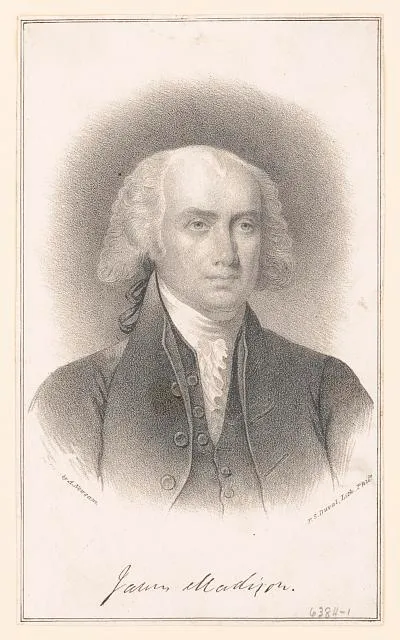
Source: Library of Congress - Duval, Peter S., 1804 or 1805-1886
The War of 1812 began when the United States fought Great Britain for a second time. President James Madison was the leader of the country. He had to make hard choices to protect America. The conflict started because British ships stopped American ships and took sailors by force. This is called impressment. Britain needed more men for its navy and forced many American sailors to work for them.
Americans were very upset by these actions. They wanted their country to be treated with respect. Many people felt that Britain was not honoring American independence. Some in Congress, called "War Hawks," pushed for war to defend America's rights. President Madison finally asked Congress to declare war on Britain in June 1812.
The early years of the war were tough for the United States. British forces captured key places, and in 1814, they burned important buildings in Washington, D.C., including the White House. Still, Americans did not give up. Soldiers, sailors, and even regular citizens worked together to defend their land.
One famous battle was at Fort McHenry in Baltimore. American troops held off the British attack. This event inspired Francis Scott Key to write a poem that became "The Star-Spangled Banner," America's national anthem.
After several years of fighting, the war ended with the Treaty of Ghent in 1814. Neither side gained new land, but Americans felt proud. They had stood up to one of the world's strongest countries. Many people started to call the War of 1812 America's "Second War of Independence." It helped the United States grow stronger and more united.
Interesting Fact: The Battle of New Orleans was fought after the peace treaty was signed, because news traveled slowly across the ocean.
Comprehension quiz (8 questions)
1. Who was president during the War of 1812?
2. What is impressment?
3. Which city had buildings burned in 1814?
4. Why did War Hawks want war?
5. What did the Treaty of Ghent do?
6. What happened at Fort McHenry?
7. The war made Americans feel proud. True or false?
8. What does 'national anthem' mean?
Common Core standards for James Madison and the War of 1812
Refer to details and examples in a text when explaining what the text says explicitly and when drawing inferences from the text.
Explain events, procedures, ideas, or concepts in a historical, scientific, or technical text, including what happened and why, based on specific information in the text.
Determine the meaning of general academic and domain-specific words or phrases in a text relevant to a grade 4 topic or subject area.
Perfect for the way you teach
- Build comprehension skills
- Auto-graded quiz
- Differentiated reading
- Read together at home
- Improve fluency
- Quiet reading time
- Reading curriculum support
- Independent practice
- Track Lexile growth