Homestead Act: Free Land for Settlers
Interactive passage with audio narration, comprehension questions, and printable PDF.
By completing this purchase you agree to our Terms of Use and Privacy Policy. Your subscription renews automatically until you cancel. You can cancel anytime from your account settings. All sales are final and non-refundable. Digital content is available for download in your account immediately upon purchase.
What's included
Part of this bundle

Homestead Act: Free Land for Settlers preview and details
About this printable Homestead Act: Free Land for Settlers reading passage (Grades 3-5)
Sample passage and quiz from Homestead Act: Free Land for Settlers
Reading passage and comprehension quiz preview
Homestead Act
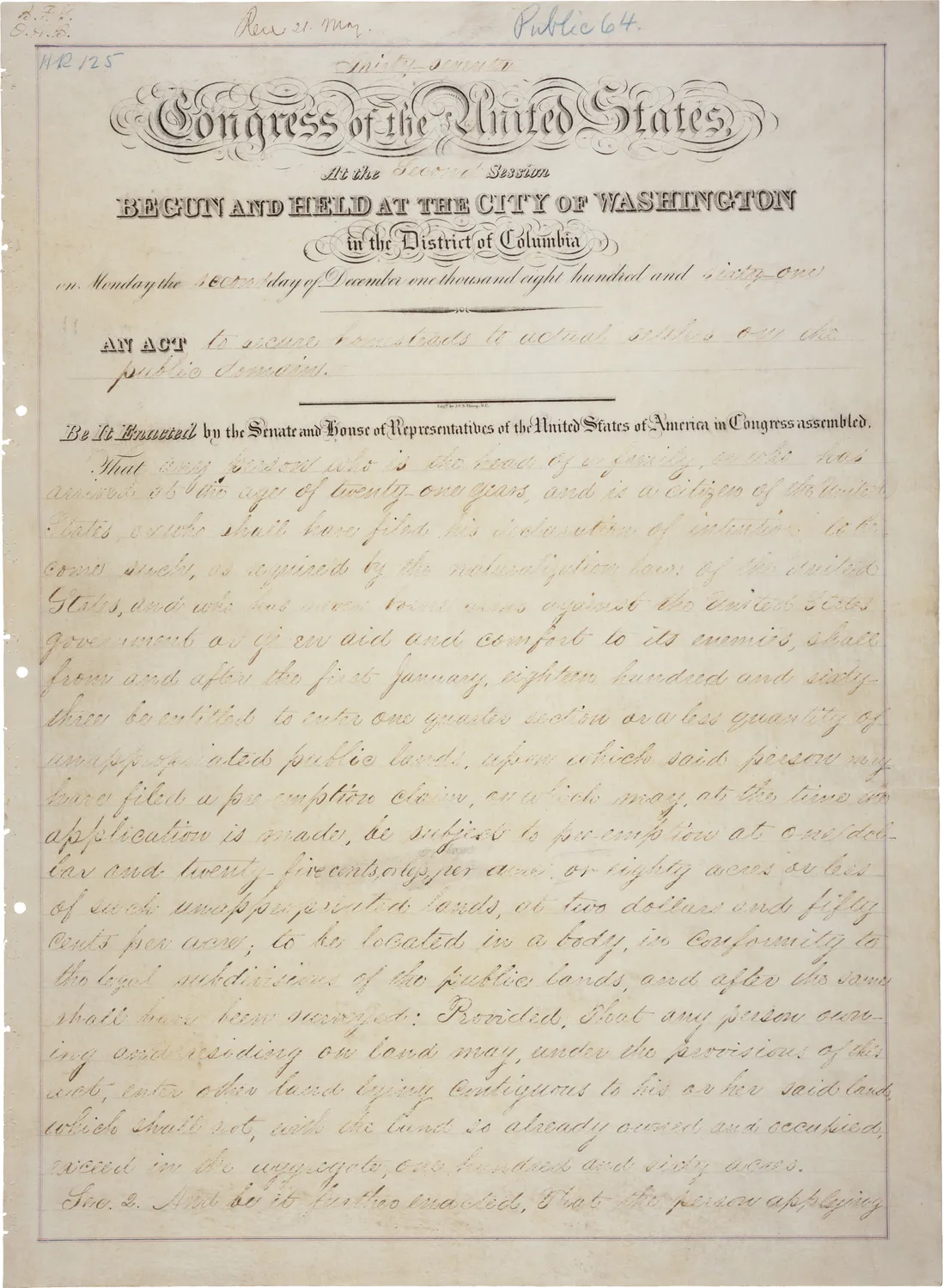
Source: Wikimedia Commons - 37th U.S. Congress
The Homestead Act was a law passed by the United States government in 1862. This law gave people a chance to own land in the West for free. The government wanted more people to settle the western parts of the country and start new farms. At that time, much of the land in the West was empty or used by Native Americans. The government believed that more settlers would help the country grow and become stronger.
Under the Homestead Act, any adult who had never fought against the United States could claim 160 acres of land. The person had to be at least 21 years old or the head of a family. To keep the land, settlers had to build a house and live on the land. They also needed to farm it for at least five years. If they did this, the land became theirs forever.
Many people took this opportunity for a new life. They traveled long distances in wagons, on horseback, or even on foot. The journey was hard and dangerous. Settlers faced bad weather, sickness, and sometimes attacks. Yet, thousands of families were brave and determined. They built homes out of wood or grass, called sod houses, and planted crops like corn and wheat. Some families even had to dig wells for water and protect their land from wild animals.
The Homestead Act helped change the American West. By 1900, over 600,000 families had claimed land under the act. New towns and farms appeared where there had only been open land. The act gave many poor people a chance to build a better life. It also helped the United States become a larger and more united country.
However, the act also meant that Native American lands were taken by settlers. This caused great hardship for many Native American people. Still, the Homestead Act remains an important part of how America grew and changed during westward expansion.
Interesting Fact: The very first person to claim land under the Homestead Act was Daniel Freeman, who filed his claim on January 1, 1863.
Comprehension quiz (8 questions)
1. What year was the Homestead Act passed?
2. How much land could settlers claim?
3. Who was the first to claim land?
4. Why did the government pass the act?
5. What did settlers have to do to keep land?
6. What was one result of the act?
7. The Homestead Act gave free land. True or false?
8. What does 'claim' mean in the passage?
Common Core standards for Homestead Act: Free Land for Settlers
Explain events, procedures, ideas, or concepts in a historical, scientific, or technical text, including what happened and why, based on specific information in the text.
Determine the meaning of general academic and domain-specific words or phrases in a text relevant to a grade 4 topic or subject area.
Perfect for the way you teach
- Build comprehension skills
- Auto-graded quiz
- Differentiated reading
- Read together at home
- Improve fluency
- Quiet reading time
- Reading curriculum support
- Independent practice
- Track Lexile growth