The Declaration of Independence and Thomas Jefferson — Reading Comprehension
Rate this|
2
Premium Resource
Present
Present in classroom. No work saved
Assign
Classroom with student accounts, Track progress
Quick Play
No student accounts, assign with a link
Grades
3
4
5
Standards
D2.HIS.1-4.3-5
RI.4.1
RI.4.2
RI.4.3
RI.4.4
PRINT+DIGITAL RESOURCE
This learning resource is available in interactive and printable formats. The interactive worksheet can be played online and assigned to students. The Printable PDF version can be downloaded and printed for completion by hand.
This engaging passage teaches students about the Declaration of Independence and Thomas Jefferson, one of America's Founding Fathers. Students will read about the causes leading up to the Declaration, the important role Thomas Jefferson played in writing the document, and how this event changed the course of American history. The passage uses grade-appropriate vocabulary, includes a glossary, and provides a Spanish translation. Students can test their knowledge with a multiple-choice quiz and deepen their understanding with a writing activity. The timeline helps put key events in order. Aligned with the C3 Framework and Common Core ELA standards, this history reading passage is designed to build foundational literacy and historical thinking skills. Read aloud audio is included for accessibility, making it perfect for all learners.
CONTENT PREVIEW
Expand content preview
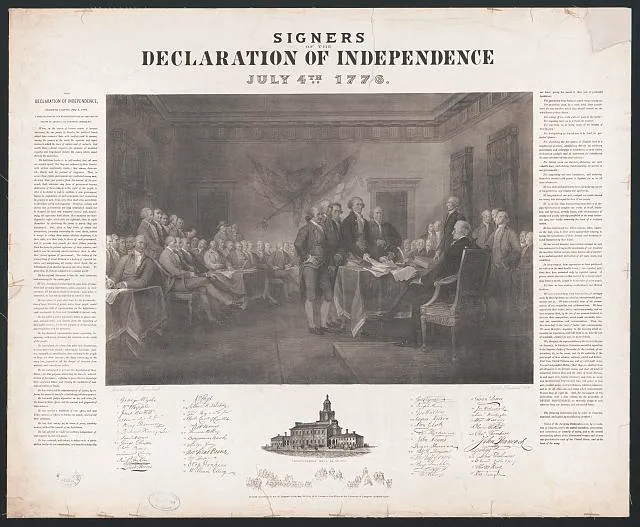
Signer of Declaration of Independence, July 4th, 1776 Source: Library of Congress
George Washington was chosen as the commander of the Continental Army in 1775. He led the American soldiers in their fight for independence from Great Britain. The British army was the most powerful in the world. Washington’s job was difficult and full of danger.
The early years of the war were hard. Washington’s army had little money, few supplies, and not enough food or warm clothes. Many soldiers wanted to quit. Some left the army, but Washington inspired the rest to keep fighting. He gave speeches and led by example. His leadership kept the army together during tough times.
One of the biggest challenges came during the winter at Valley Forge in 1777-1778. The soldiers suffered from cold, hunger, and sickness. Washington stayed with his men through the freezing winter. He worked to get them food, warm clothes, and help from other states. This showed his perseverance and care for his army.
Washington also used smart military tactics. He planned surprise attacks, such as the famous crossing of the Delaware River on December 25, 1776. His army defeated the British at the Battle of Trenton. This victory gave the soldiers hope and showed that they could win.
As the war continued, Washington made alliances with other countries, like France. These alliances brought more soldiers, ships, and supplies. In 1781, with help from the French, Washington’s army trapped the British at Yorktown. The British surrendered, ending the war. The colonies won their freedom, and Washington became a national hero.
Washington’s courage and unity helped the Continental Army never give up. His leadership was one of the main reasons the United States became a free country.
Interesting Fact: After the war, George Washington could have become a king, but he chose to return home and later became the first President of the United States.
Who led the Continental Army?
George WashingtonThomas JeffersonJohn AdamsBenjamin Franklin
What major battle was a surprise attack?
Battle of TrentonBattle of YorktownBattle of Bunker HillBattle of Saratoga
Where did the army suffer a harsh winter?
Valley ForgeBostonPhiladelphiaYorktown
Why was Washington's leadership important?
Kept army togetherMade new lawsBuilt fortsWrote the Constitution
What helped the army win Yorktown?
French allianceMore trainingNew uniformsBetter horses
How did the soldiers feel after Trenton?
HopefulTiredAngryConfused
George Washington became king after the war. True or false?
TrueFalse
What does 'perseverance' mean?
Not giving upMarching fastMaking speechesBeing friendly
Perfect For:
👩🏫 Teachers
• Reading comprehension practice
• Auto-graded assessments
• Literacy skill development
👨👩👧👦 Parents
• Reading practice at home
• Comprehension improvement
• Educational reading time
🏠 Homeschoolers
• Reading curriculum support
• Independent reading practice
• Progress monitoring
Reading Features:
📖
Reading Passage
Engaging fiction or nonfiction text
❓
Comprehension Quiz
Auto-graded questions
📊
Instant Feedback
Immediate results and scoring
📄
Printable Version
Download for offline reading
🔊
Read Aloud
Voice-over with word highlighting
Reviews & Ratings
No reviews yet. Be the first to share your experience!
Related Content
Trade and Trading Routes Between Tribes
This engaging history reading passage explores the important role of trade and trading routes between Native American tr...
D2.HIS.1-4.3-5RI.4.1RI.4.3RI.4.4
The 13 Original Colonies: An Overview
This engaging U.S. history reading passage introduces students to the 13 original colonies. It presents the story of how...
D2.HIS.1-4.3-5RI.4.3RI.4.4RI.4.10
The French and Indian War
This educational history reading passage explores the French and Indian War, a major conflict in North America before th...
D2.HIS.1-4.3-5RI.4.1RI.4.3RI.4.4
Unfair Taxes and the Stamp Act
This engaging U.S. history reading passage explores the story of the Stamp Act and unfair taxes in colonial America. Ali...
D2.HIS.1-4.3-5RI.4.1RI.4.3
Paul Revere's Midnight Ride
This U.S. History reading passage explores the famous Midnight Ride of Paul Revere, a key event in the American Revoluti...
D2.HIS.1-4.3-5RI.4.3RI.4.4RI.4.10
Soldiers at Valley Forge in Winter
Explore the inspiring story of the Continental Army at Valley Forge during the harsh winter of 1777-1778. This history r...
D2.HIS.1-4.3-5RI.4.3RI.4.4RI.5.3
The Treaty of Paris 1783
This passage introduces students to the Treaty of Paris 1783, the important agreement that officially ended the American...
D2.HIS.1-4.3-5RI.4.3RI.4.4RI.4.10
The Star-Spangled Banner and War
This reading passage explores the inspiring story of 'The Star-Spangled Banner' and its origins during the War of 1812. ...
D2.HIS.1-4.3-5RI.4.1RI.4.3RI.4.4
Thomas Jefferson and the Louisiana Purchase
This engaging U.S. history reading passage teaches students about Thomas Jefferson and the Louisiana Purchase, one of th...
D2.HIS.1-4.3-5RI.4.3RI.5.3
James Madison and the War of 1812
This engaging U.S. history reading passage focuses on James Madison and the War of 1812. Students learn about key events...
D2.HIS.1-4.3-5RI.4.1RI.4.3RI.4.4
The First Political Parties Form
This engaging passage explores the formation of America's first political parties, highlighting the Federalists and Demo...
D2.HIS.1-4.3-5RI.4.3RI.4.4
James Monroe and the Monroe Doctrine
This engaging U.S. history reading passage introduces students to President James Monroe and the Monroe Doctrine, a key ...
D2.HIS.1-4.3-5RI.4.1RI.4.2RI.4.3
Americans Move West: The Oregon Trail
This engaging history passage explores the Oregon Trail and the westward movement of Americans in the 1800s. Students wi...
D2.HIS.1-4.3-5RI.4.3RI.4.4RI.5.3
Cowboys and Cattle Drives
This engaging U.S. History reading passage introduces students to the world of cowboys and cattle drives, a key part of ...
D2.HIS.1-4.3-5RI.4.3RI.4.4RI.5.3
Life in a Frontier Town
This passage explores the daily life and challenges faced by people living in a frontier town in the early United States...
D2.HIS.1-4.3-5RI.4.3RI.4.4W.4.2
Homestead Act: Free Land for Settlers
This engaging history reading passage explores the Homestead Act and its impact on American settlers moving west. Studen...
D2.HIS.1-4.3-5RI.4.3RI.4.4
Dangers on the Oregon Trail
This reading passage explores the many dangers faced by pioneers on the Oregon Trail, one of the most significant journe...
D2.HIS.1-4.3-5RI.4.1RI.4.3RI.4.4
Native Americans Lose Their Lands: The Trail of Tears
This reading passage explores the story of the Trail of Tears, focusing on the experiences of Native Americans as they l...
D2.HIS.1-4.3-5RI.4.3RI.4.4RI.4.7
Sherman's March to the Sea
This U.S. history reading passage explores Sherman's March to the Sea, a turning point during the Civil War. Students wi...