Sherman's March to the Sea
Interactive passage with audio narration, comprehension questions, and printable PDF.
By completing this purchase you agree to our Terms of Use and Privacy Policy. Your subscription renews automatically until you cancel. You can cancel anytime from your account settings. All sales are final and non-refundable. Digital content is available for download in your account immediately upon purchase.
What's included
Part of this bundle

Sherman's March to the Sea preview and details
About this printable Sherman's March to the Sea reading passage (Grades 3-5)
Sample passage and quiz from Sherman's March to the Sea
Reading passage and comprehension quiz preview
Sherman's March to the Sea
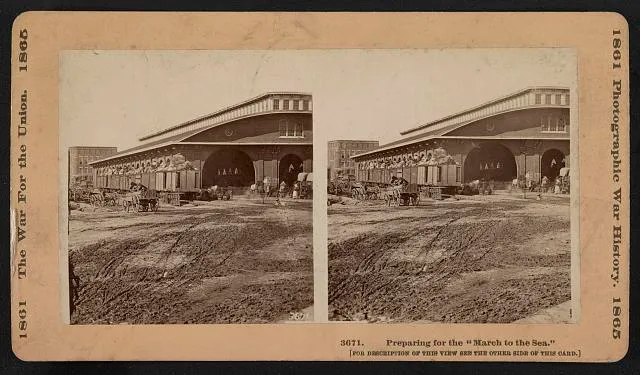
Source: Library of Congress - Barnard, George N., 1819-1902
Sherman's March to the Sea was a major event in the American Civil War. In November 1864, Union General William Tecumseh Sherman led his army from the city of Atlanta, Georgia, all the way to the port city of Savannah. His goal was to break the South's ability to keep fighting and end the war faster.
General Sherman believed that the best way to win was through total war. This meant destroying not just enemy soldiers, but also anything that could help them, like railroads, factories, and farms. By doing this, Sherman hoped the South would not have enough food, supplies, or ways to move their troops.
As Sherman's army left Atlanta in mid-November, they formed a line about 60 miles wide. They marched quickly, spreading out to cover more ground. Soldiers tore up railroad tracks and twisted them so they could not be fixed easily. They burned barns and took food. Some houses and farms were destroyed, especially if people resisted the army's orders. The goal was not to hurt people, but to make war so hard for the South that they would give up.
The march lasted about five weeks. Sherman's soldiers faced tough weather and sometimes had to find food as they went. Many towns and villages saw the Union army pass through. Some people tried to hide their food and valuables, but the soldiers searched carefully. The destruction left behind made it almost impossible for the Southern army to send supplies or receive help from other states.
Sherman's army arrived in Savannah in December 1864. The city surrendered without a fight. Sherman sent a famous message to President Abraham Lincoln, calling Savannah a "Christmas gift." The march was a turning point in the Civil War. It showed the power of the Union army and broke the spirit of the South.
After Sherman's March, many people in the South struggled to rebuild their homes and farms. The destruction made it clear that the war would soon end. Sherman's actions helped bring the country closer to reunion and peace.
Interesting Fact: Sherman's soldiers sometimes called themselves "bummers" because they gathered food and supplies from the countryside as they marched.
Comprehension quiz (8 questions)
1. Who led the March to the Sea?
2. Where did Sherman's march start?
3. When did the march begin?
4. Why did Sherman destroy railroads?
5. What was Sherman's goal?
6. How wide was Sherman's marching path?
7. Sherman's soldiers were called 'bummers.' True or false?
8. What does 'total war' mean?
Common Core standards for Sherman's March to the Sea
Explain events, procedures, ideas, or concepts in a historical, scientific, or technical text, including what happened and why, based on specific information in the text.
Determine the meaning of general academic and domain-specific words or phrases in a text relevant to a grade 4 topic or subject area.
Write informative/explanatory texts to examine a topic and convey ideas and information clearly.
Perfect for the way you teach
- Build comprehension skills
- Auto-graded quiz
- Differentiated reading
- Read together at home
- Improve fluency
- Quiet reading time
- Reading curriculum support
- Independent practice
- Track Lexile growth