Trade and Trading Routes Between Tribes — Reading Comprehension
Rate this
Premium Resource
Present
Present in classroom. No work saved
Assign
Classroom with student accounts, Track progress
Quick Play
No student accounts, assign with a link
Grades
3
4
5
Standards
D2.HIS.1-4.3-5
RI.4.1
RI.4.3
RI.4.4
W.4.2
PRINT+DIGITAL RESOURCE
This learning resource is available in interactive and printable formats. The interactive worksheet can be played online and assigned to students. The Printable PDF version can be downloaded and printed for completion by hand.
This engaging history reading passage explores the important role of trade and trading routes between Native American tribes in North America. Students will learn how tribes exchanged goods such as food, tools, and pottery, and how these trading networks supported unity and cooperation. The passage presents history in a clear, narrative structure with a focus on cause and effect, using age-appropriate vocabulary and examples. A timeline highlights the key sequence of events in tribal trade. Activities include a multiple-choice quiz, writing prompts to encourage critical thinking, and a glossary of key terms. The passage is aligned with the C3 Framework for Social Studies and relevant Common Core ELA standards. Audio read-aloud and Spanish translation are provided to support all learners. This resource is ideal for strengthening historical understanding, vocabulary, and literacy skills while learning about Native American life.
CONTENT PREVIEW
Expand content preview
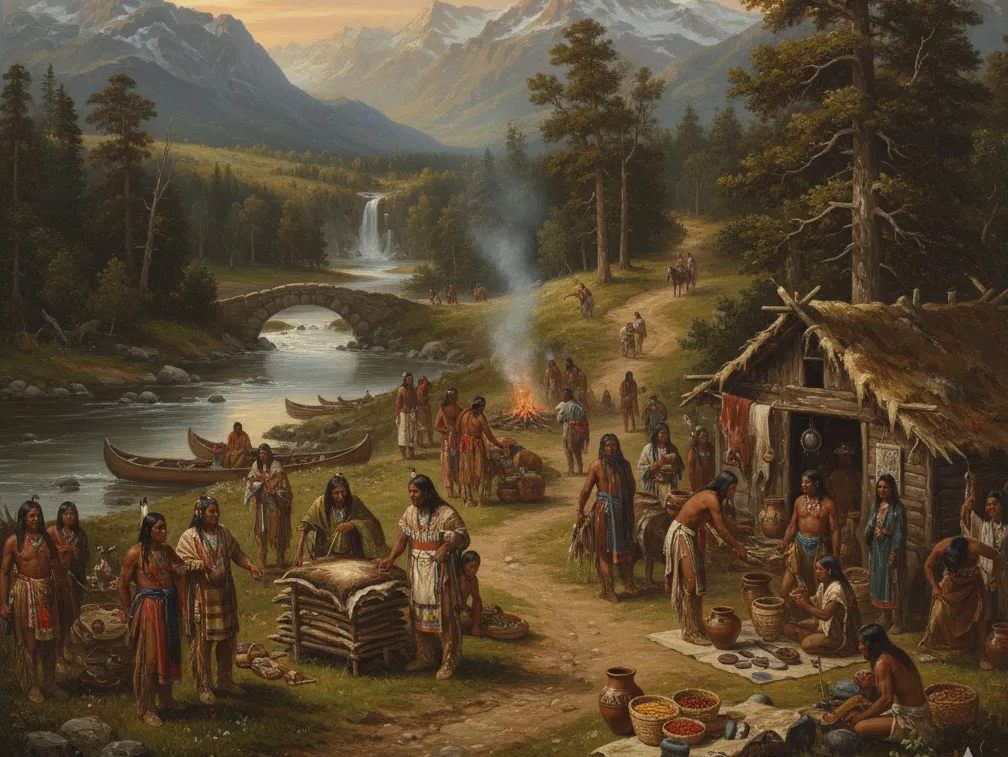
Visual depiction of trading posts for exchange of goods.
Native American tribes built wide trade networks across North America. These networks linked many groups, even those living far apart. Instead of using money, tribes exchanged goods and resources with each other. This system helped them get what they needed to live, grow, and solve problems.
People traded many items. Coastal tribes collected shells and fish from the ocean. Tribes living near rivers or lakes traded fresh water, fish, and wild plants. Some groups mined copper from the earth. Others crafted beautiful pottery, baskets, and stone tools. Each tribe had special goods to offer. These items traveled along ancient trade routes, sometimes for hundreds or even thousands of miles.
Trade was not only about goods. It was about building relationships between tribes. Trading helped people learn about each other’s languages, ideas, and customs. It made tribes stronger and more united. If one tribe needed food during a dry season, they could trade with another group who had extra. This sharing helped everyone survive hard times.
Some of the most important trade routes crossed the continent. For example, the Mississippi River was like a highway for trade. Tribes from the Great Lakes sent copper down the river. Shells from the Gulf Coast moved north. People walked, paddled canoes, or rode horses to move goods. Trade centers and marketplaces grew up at busy crossroads. These places often became villages or towns.
Native American trade networks were very organized. Some tribes became well known as traders and traveled great distances. They learned to speak several languages and made peace with neighbors to trade safely. Everyone had to trust each other. If someone broke a promise, they might not be allowed to trade again.
Trade shaped daily life. It brought new foods, tools, and ideas to many tribes. It also helped spread art styles and technology. Through trade, Native Americans solved problems and built a web of friendship across the land. Their trade networks lasted for hundreds of years, long before Europeans arrived.
Interesting Fact: Some trade beads and shells have been found thousands of miles from where they came, showing just how far Native American trade networks reached.
What did tribes use instead of money?
They exchanged goodsThey used coinsThey used beads as moneyThey did not trade
Which river was an important trade route?
Mississippi RiverAmazon RiverColorado RiverRio Grande
What did coastal tribes often trade?
Shells and fishCopper and goldWheat and cornHorses and cows
Why did tribes build trade networks?
To get needed resourcesTo grow wheatTo fight warsTo build pyramids
How did trade help tribes?
It helped them surviveIt made them richIt stopped them tradingIt made them weak
What happened if someone broke a promise?
They could not trade againThey got more goodsThey became a chiefThey traded with Europeans
Trade beads were found far from their origin. True or false?
TrueFalse
What is a 'resource'?
Something people needA place to sleepA type of basketA kind of river
Perfect For:
👩🏫 Teachers
• Reading comprehension practice
• Auto-graded assessments
• Literacy skill development
👨👩👧👦 Parents
• Reading practice at home
• Comprehension improvement
• Educational reading time
🏠 Homeschoolers
• Reading curriculum support
• Independent reading practice
• Progress monitoring
Reading Features:
📖
Reading Passage
Engaging fiction or nonfiction text
❓
Comprehension Quiz
Auto-graded questions
📊
Instant Feedback
Immediate results and scoring
📄
Printable Version
Download for offline reading
🔊
Read Aloud
Voice-over with word highlighting
Reviews & Ratings
No reviews yet. Be the first to share your experience!
Related Content
The 13 Original Colonies: An Overview
This engaging U.S. history reading passage introduces students to the 13 original colonies. It presents the story of how...
D2.HIS.1-4.3-5RI.4.3RI.4.4RI.4.10
The French and Indian War
This educational history reading passage explores the French and Indian War, a major conflict in North America before th...
D2.HIS.1-4.3-5RI.4.1RI.4.3RI.4.4
Unfair Taxes and the Stamp Act
This engaging U.S. history reading passage explores the story of the Stamp Act and unfair taxes in colonial America. Ali...
D2.HIS.1-4.3-5RI.4.1RI.4.3
Paul Revere's Midnight Ride
This U.S. History reading passage explores the famous Midnight Ride of Paul Revere, a key event in the American Revoluti...
D2.HIS.1-4.3-5RI.4.3RI.4.4RI.4.10
The Declaration of Independence and Thomas Jefferson
This engaging passage teaches students about the Declaration of Independence and Thomas Jefferson, one of America's Foun...
D2.HIS.1-4.3-5RI.4.1RI.4.2RI.4.3
Soldiers at Valley Forge in Winter
Explore the inspiring story of the Continental Army at Valley Forge during the harsh winter of 1777-1778. This history r...
D2.HIS.1-4.3-5RI.4.3RI.4.4RI.5.3
The Treaty of Paris 1783
This passage introduces students to the Treaty of Paris 1783, the important agreement that officially ended the American...
D2.HIS.1-4.3-5RI.4.3RI.4.4RI.4.10
The Star-Spangled Banner and War
This reading passage explores the inspiring story of 'The Star-Spangled Banner' and its origins during the War of 1812. ...
D2.HIS.1-4.3-5RI.4.1RI.4.3RI.4.4
Thomas Jefferson and the Louisiana Purchase
This engaging U.S. history reading passage teaches students about Thomas Jefferson and the Louisiana Purchase, one of th...
D2.HIS.1-4.3-5RI.4.3RI.5.3
James Madison and the War of 1812
This engaging U.S. history reading passage focuses on James Madison and the War of 1812. Students learn about key events...
D2.HIS.1-4.3-5RI.4.1RI.4.3RI.4.4
The First Political Parties Form
This engaging passage explores the formation of America's first political parties, highlighting the Federalists and Demo...
D2.HIS.1-4.3-5RI.4.3RI.4.4
James Monroe and the Monroe Doctrine
This engaging U.S. history reading passage introduces students to President James Monroe and the Monroe Doctrine, a key ...
D2.HIS.1-4.3-5RI.4.1RI.4.2RI.4.3
Americans Move West: The Oregon Trail
This engaging history passage explores the Oregon Trail and the westward movement of Americans in the 1800s. Students wi...
D2.HIS.1-4.3-5RI.4.3RI.4.4RI.5.3
Cowboys and Cattle Drives
This engaging U.S. History reading passage introduces students to the world of cowboys and cattle drives, a key part of ...
D2.HIS.1-4.3-5RI.4.3RI.4.4RI.5.3
Life in a Frontier Town
This passage explores the daily life and challenges faced by people living in a frontier town in the early United States...
D2.HIS.1-4.3-5RI.4.3RI.4.4W.4.2
Homestead Act: Free Land for Settlers
This engaging history reading passage explores the Homestead Act and its impact on American settlers moving west. Studen...
D2.HIS.1-4.3-5RI.4.3RI.4.4
Dangers on the Oregon Trail
This reading passage explores the many dangers faced by pioneers on the Oregon Trail, one of the most significant journe...
D2.HIS.1-4.3-5RI.4.1RI.4.3RI.4.4
Native Americans Lose Their Lands: The Trail of Tears
This reading passage explores the story of the Trail of Tears, focusing on the experiences of Native Americans as they l...
D2.HIS.1-4.3-5RI.4.3RI.4.4RI.4.7
Sherman's March to the Sea
This U.S. history reading passage explores Sherman's March to the Sea, a turning point during the Civil War. Students wi...