This comprehensive 400-500 word reading passage examines the connection between wildfires and climate change for middle school students in grades 6-8. Aligned with NGSS Earth Science standards, the passage explains how rising temperatures and prolonged droughts create ideal conditions for larger, more intense wildfires. Students explore the concept of climate change as a threat multiplier, understanding that while lightning and human activity start most fires, warming conditions make them more likely to spread. The passage includes real-world examples from the American West and discusses broader impacts including air quality degradation and carbon release. Audio-integrated features support diverse learners, while differentiated versions ensure accessibility for English Language Learners and struggling readers. Activities include comprehension questions, writing prompts, and graphic organizers that help students analyze cause-and-effect relationships in Earth systems.
Written by Workybooks TeamPublished by Workybooks
Preview
Sample passage and quiz content
CONTENT PREVIEW
Expand content preview
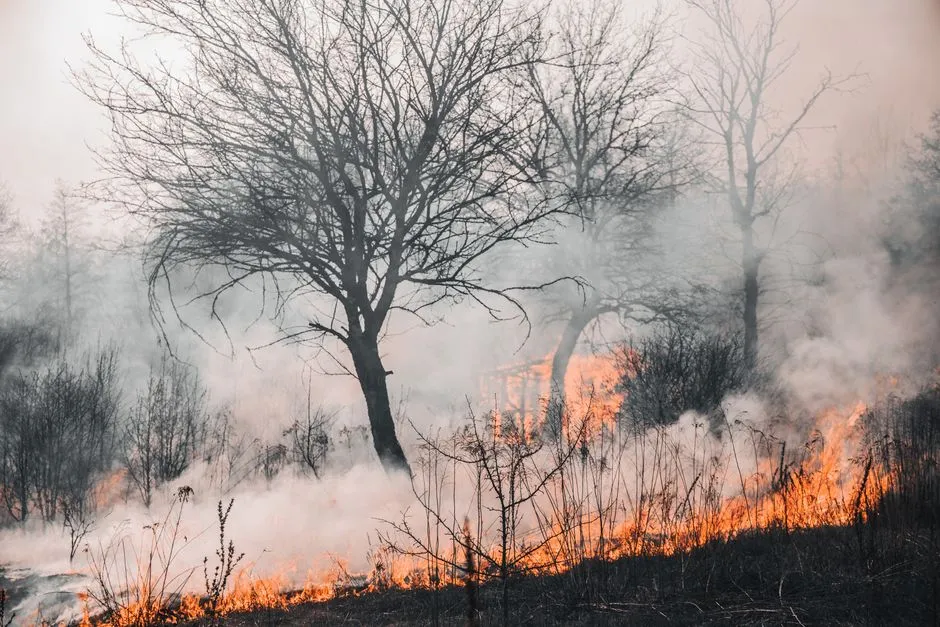
"A devastating wildfire engulfing trees and landscape in Kyiv Oblast, creating a smoke-filled, haunting environment." by Vladyslav Dukhin / Pexels.
Wildfires need three things to burn: fuel, oxygen, and heat. Climate change affects one of these ingredients dramatically. A warming climate creates drier conditions across many regions. Hotter temperatures cause water to evaporate more quickly from soil and plants. This process turns forests, grasslands, and brush into ready kindling. Scientists observe that fire seasons now last longer than they did decades ago. Evidence shows that some regions experience fire conditions for two to three months longer each year.
Climate change does not start most wildfires. Lightning strikes cause many natural fires. People start others, sometimes accidentally. However, climate change acts as a threat multiplier. When forests are already dry from drought, fires can spread more easily. They grow larger and burn more intensely. Higher temperatures also create stronger winds in some areas. These winds can push flames across landscapes faster. The combination of dry fuel and favorable conditions means fires can become difficult to control.
The American West provides a clear example of this pattern. States like California, Oregon, and Colorado have experienced increasingly severe fire seasons. Data from recent decades shows that the area burned by wildfires has grown significantly. The 2020 fire season in California burned over four million acres. Scientists explain that prolonged droughts and record-breaking heat contributed to these massive fires. Mountain snowpack melts earlier in warmer springs. This early melting means less water is available during summer months.
Wildfires create consequences that reach far beyond burned forests. Smoke from large fires can travel hundreds or thousands of miles. This smoke contains tiny particles called particulate matter. These particles harm air quality and can cause breathing problems for people far from the flames. Burned forests also release stored carbon into the atmosphere. Trees absorb carbon dioxide as they grow. When they burn, this carbon returns to the air as carbon dioxide. This release can contribute to further warming, creating a feedback loop.
Understanding the connection between wildfires and climate change matters for communities and ecosystems. Fire management strategies may need to adapt to longer, more intense fire seasons. Protecting air quality becomes more challenging when smoke events occur more frequently. The relationship between climate and fire demonstrates how changes in one part of Earth's system can affect many others.
Interesting Fact: Some tree species, like certain pines, actually need fire to reproduce. Their cones only open and release seeds when exposed to high heat from flames.
What three things does a wildfire need to burn?
Fuel, oxygen, and heatWind, trees, and lightningDrought, smoke, and carbonWater, soil, and plants
According to the passage, what starts most wildfires?
Climate change directly ignites the firesLightning strikes and human activityDroughts automatically cause firesHot temperatures spontaneously combust forests
What does the term 'threat multiplier' mean in the context of climate change and wildfires?
Climate change starts more fires than beforeClimate change makes existing fire risks worseClimate change reduces the number of firesClimate change only affects small fires
What is particulate matter?
Large pieces of burned woodWater droplets in cloudsTiny particles in smoke that can harm breathingCarbon stored in trees
How does climate change affect fire seasons?
Fire seasons are now shorterFire seasons last two to three months longer in some regionsFire seasons only occur in winterFire seasons have not changed
Why does smoke from wildfires harm air quality far from the fire?
Smoke stays only near the fireSmoke contains particulate matter that travels hundreds of milesSmoke makes the air colderSmoke only affects plants, not people
What happens to carbon stored in trees when they burn?
It stays in the soil foreverIt turns into waterIt is released into the atmosphere as carbon dioxideIt disappears completely
How much land did California wildfires burn in 2020?
Over four million acresAbout one thousand acresExactly two million acresLess than 500 acres
True or False: Climate change is the direct cause that starts most wildfires.
TrueFalse
True or False: When burned forests release carbon dioxide, it can contribute to further warming.
TrueFalse
Who it's for
Perfect for the way you teach
Teachers
Build comprehension skills
Auto-graded quiz
Differentiated reading
Parents
Read together at home
Improve fluency
Quiet reading time
Homeschoolers
Reading curriculum support
Independent practice
Track Lexile growth
Topics
wildfiresclimate changedroughtfire seasonair qualitycarbon emissionsthreat multiplierNGSSmiddle school science
Reviews & Ratings
No reviews yet. Be the first to share your experience!
More reading you might love
19 more
What Is Earth Science?
This engaging middle school science passage introduces students to the field of Earth science, aligning with NGSS standa...
MS-ESS1MS-ESS2MS-ESS3SEP
Bird Migration and Climate Change
This engaging 400-500 word science passage explores how climate change affects bird migration patterns and populations, ...
MS-LS2-4: CONSTRUCT AN ARGUMENT SUPPORTED BY EMPIRICAL EVIDENCE THAT CHANGES TO PHYSICAL OR BIOLOGICAL COMPONENTS OF AN ECOSYSTEM AFFECT POPULATIONS.
Transportation and Climate Change
This engaging science passage for grades 6-8 explores the vital role that transportation plays in climate change. Studen...
Deforestation and Climate Change
This engaging science passage, aligned with NGSS standards, explains how deforestation contributes to climate change for...
Droughts and Climate Change
This 500-word informational science passage for grades 6-8 examines the relationship between droughts and climate change...
Tools and Technology in Earth Science
This middle school science reading passage explores the wide range of tools and technologies used in Earth science, from...
MS-ESS2-2MS-ESS3-2MS-ETS1-1MS-PS4-3
Habitat Loss and Climate Change
This engaging 500-word science passage explores how climate change drives habitat loss and threatens wildlife population...
MS-LS2-4: CONSTRUCT AN ARGUMENT SUPPORTED BY EMPIRICAL EVIDENCE THAT CHANGES TO PHYSICAL OR BIOLOGICAL COMPONENTS OF AN ECOSYSTEM AFFECT POPULATIONS.
Climate Change: Solutions and Mitigation
This passage explores scientific solutions and mitigation strategies for climate change, designed for middle school scie...
MS-ESS3-4MS-ESS3-5
Amazon Rainforest and Climate Change
This 400-500 word informational science passage for grades 6-8 explores the Amazon Rainforest and Climate Change, aligne...
Extreme Weather and Climate Change
This Grade 6-8 science passage, aligned to NGSS standards, explores the impact of climate change on extreme weather even...
Climate Change and Food Security
This comprehensive 400-500 word reading passage examines the critical relationship between climate change and food secur...
Climate Change: Causes
This comprehensive middle school science passage explores the causes of climate change by examining both natural and hum...
MS-ESS3-5MS-LS2-4
Effects of Climate Change
This comprehensive middle school science passage explores the effects of climate change on Earth's systems and life, ali...
MS-ESS3-5MS-LS4-4
Arctic Fox and Climate Change
This 400-500 word informational science passage examines how climate change threatens Arctic fox populations through mul...
Flooding and Climate Change
This comprehensive 500-word reading passage examines the relationship between flooding and climate change for middle sch...
Climate Change: Vulnerable Ecosystems
This middle school science passage, aligned with NGSS standards MS-ESS3-5 and MS-LS2-4, helps students understand how cl...
MS-ESS3-5MS-LS2-4
Climate Through Earth's History
This engaging passage for grades 6-8 explores how Earth's climate has naturally changed over millions of years, highligh...
MS-ESS1-4MS-ESS2-6
Climate Change and Water Scarcity
This 400-500 word informational science reading passage for grades 6-8 examines how climate change threatens freshwater ...
MS-ESS3-5
Public Transportation and Climate Change
This 400-500 word reading passage examines the relationship between public transportation and climate change for middle ...