Coral Reefs and Climate Change
Interactive passage with audio narration, comprehension questions, and printable PDF.
By completing this purchase you agree to our Terms of Use and Privacy Policy. Your subscription renews automatically until you cancel. You can cancel anytime from your account settings. All sales are final and non-refundable. Digital content is available for download in your account immediately upon purchase.
What's included
Coral Reefs and Climate Change preview and details
About this printable Coral Reefs and Climate Change science reading passage, NGSS-aligned (Grades 5-8)
Sample passage and quiz from Coral Reefs and Climate Change
Reading passage and comprehension quiz preview
Coral Reefs and Climate Change
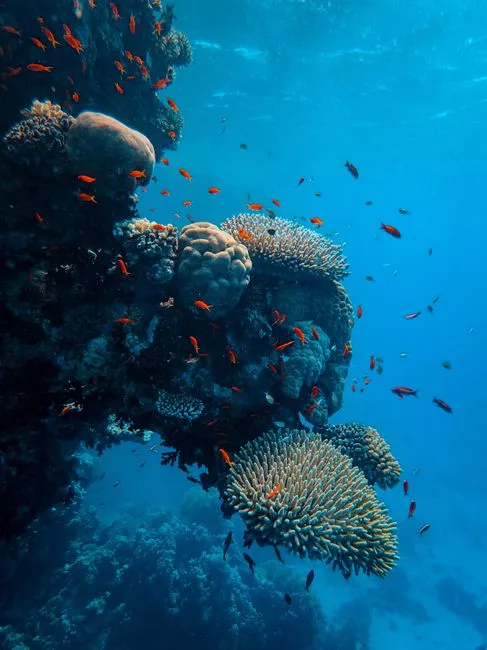
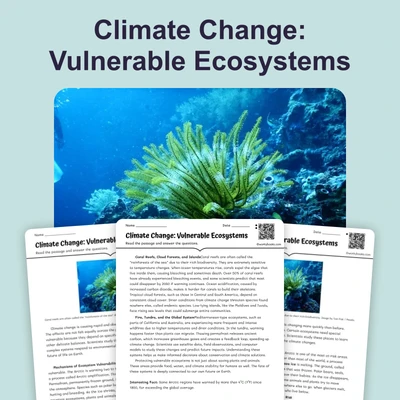
"A stunning underwater scene with colorful corals and fish in the Red Sea." by Francesco Ungaro / Pexels.
Coral reefs are often called the rainforests of the sea. They cover less than one percent of the ocean floor. Yet these underwater structures shelter about a quarter of all marine species. Scientists estimate that over one million species depend on coral reefs for food and habitat.
The secret to coral success lies in a special partnership. Tiny coral animals called polyps build hard limestone skeletons around their soft bodies. Inside each polyp live even tinier algae called zooxanthellae. This relationship is called symbiosis because both organisms benefit. The algae use sunlight to make food through photosynthesis. They share most of this food with the coral polyps. In return, the polyps provide the algae with a safe home and nutrients.
Climate change threatens this delicate partnership in two main ways. First, rising ocean temperatures stress coral polyps. When water gets too warm, the polyps expel their zooxanthellae partners. Without the colorful algae inside, the coral turns ghostly white. Scientists call this process coral bleaching. Bleached coral is not dead yet, but it is starving. The coral can recover if temperatures drop quickly. However, if the heat lasts for weeks or months, the coral dies.
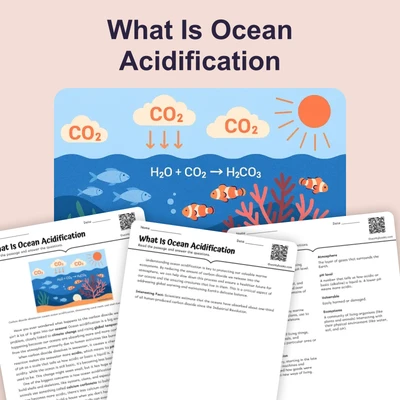
Second, ocean acidification makes survival even harder for corals. The ocean absorbs carbon dioxide from the atmosphere. This gas reacts with seawater to form carbonic acid. The acid reduces the availability of carbonate ions that corals need to build their skeletons. Evidence shows that corals grow more slowly in acidic water. Some may stop building skeletons altogether.
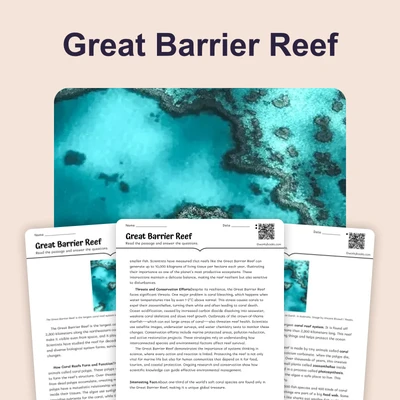
The Great Barrier Reef in Australia demonstrates these threats. In 2016 and 2017, back-to-back heat waves caused massive bleaching events. Scientists observed that nearly half of the corals in some areas died. The reef has started to recover in cooler years, but scientists worry about its long-term survival.
Coral reef loss matters far beyond their beauty. Reefs protect coastlines from storms and erosion by breaking up wave energy. They provide food and income for over 500 million people worldwide through fishing and tourism. When reefs die, these benefits disappear. Understanding how climate change affects coral reefs can help scientists and communities develop strategies to protect these vital ecosystems.
Interesting Fact: Some coral species may be more heat-tolerant than others. Scientists are studying these hardy corals to understand how reefs might adapt to warmer oceans in the future.
Comprehension quiz (10 questions)
1. What percentage of the ocean floor do coral reefs cover?
2. What do zooxanthellae provide to coral polyps?
3. In the passage, the term 'symbiosis' refers to:
4. What does the term 'coral bleaching' describe?
5. Based on the passage, what can you infer about bleached coral?
6. How does ocean acidification affect coral reefs?
7. What happened to the Great Barrier Reef in 2016 and 2017?
8. If ocean temperatures continue to rise, which outcome is most likely for coral reefs?
9. True or False: Coral reefs shelter about a quarter of all marine species despite covering less than one percent of the ocean floor.
10. True or False: Bleached coral is already dead and cannot recover.
Perfect for the way you teach
- Build comprehension skills
- Auto-graded quiz
- Differentiated reading
- Read together at home
- Improve fluency
- Quiet reading time
- Reading curriculum support
- Independent practice
- Track Lexile growth