This comprehensive 400-500 word reading passage examines the critical relationship between climate change and food security for middle school students in grades 6-8. Aligned with NGSS Earth Science standards, the passage explores how climate impacts such as droughts, floods, heatwaves, and shifting climate zones threaten agricultural systems and food availability worldwide. Students learn how environmental stresses cascade through farms and markets to affect what people eat and whether they can access nutritious food. The passage includes real-world examples, scientific vocabulary development, and connects climate science to human systems. Audio-integrated features support diverse learners. Activities include comprehension questions, writing prompts, and graphic organizers that help students analyze cause-and-effect relationships and apply scientific concepts to real-world food security challenges.
Written by Workybooks TeamPublished by Workybooks
Preview
Sample passage and quiz content
CONTENT PREVIEW
Expand content preview
Food security means people can reliably get enough safe, nutritious food. Climate change threatens this security at every step of our food system. Rising temperatures, changing rainfall patterns, and extreme weather events disrupt how we grow, harvest, and distribute food around the world.
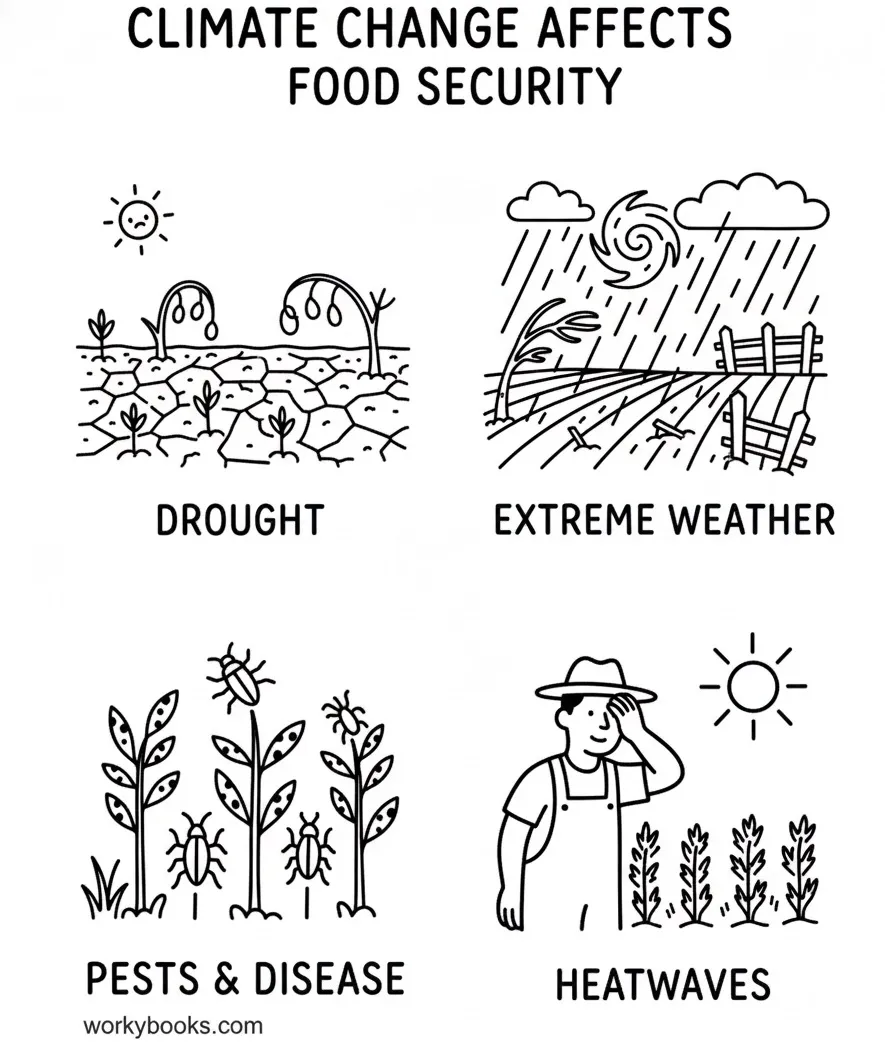
Climate impacts damage food production in multiple ways. Droughts dry out soil and reduce water available for crops. Heatwaves stress plants and lower crop yields. Heavy floods wash away fields and drown crops before harvest. Scientists observe that these extreme weather events are becoming more frequent and intense. Shifting climate zones push growing regions outside their ideal temperature ranges. Crops that thrived in certain areas for generations may no longer grow well there. Warming ocean temperatures also disrupt fish populations that millions of people depend on for protein.
When harvests fail or shrink, food becomes scarcer in markets. Evidence shows that reduced supply drives prices higher. Poor families and developing countries face the greatest challenges because they spend larger portions of income on food. In 2022, East Africa experienced its worst drought in 40 years. Crops failed across Kenya, Somalia, and Ethiopia. Millions of people faced severe food shortages. Prices for basic foods like corn and wheat rose sharply, making it harder for families to afford meals.
The connection between climate and food creates a cascading effect through Earth's systems. A drought does not stay in the atmosphere. It travels through soil, plants, and markets to affect what people eat. Agricultural systems depend on stable climate conditions. When those conditions change rapidly, food security weakens. Understanding these connections helps scientists and farmers develop solutions like drought-resistant crops and improved irrigation methods. Protecting our climate means protecting our ability to feed growing populations.
Interesting Fact: Scientists estimate that for every degree Celsius of warming, global wheat yields can decrease by about 6 percent. This means climate change could reduce the world's wheat supply significantly in coming decades.
What does food security mean?
People can reliably get enough safe, nutritious foodFood is stored in secure warehousesOnly wealthy countries have access to foodFarmers use security systems to protect crops
Which climate impact is NOT mentioned as damaging food production?
Droughts that dry out soilVolcanic eruptions that cover fields with ashHeatwaves that stress plantsFloods that wash away crops
What does the term 'crop yields' mean in the passage?
The types of crops farmers choose to plantThe amount of agricultural product harvested per unit of landThe speed at which crops growThe quality of soil in farming areas
According to the passage, what happened in East Africa in 2022?
The region experienced record rainfall and floodingNew farming methods doubled crop productionThe worst drought in 40 years caused crop failuresOcean temperatures cooled and increased fish populations
Why do poor families and developing countries face the greatest food security challenges?
They have less farmland availableThey spend larger portions of income on foodThey grow different types of cropsThey experience less extreme weather
How does the passage explain the connection between climate and food?
Climate only affects food during harvest seasonClimate impacts stay in the atmosphere and do not affect foodClimate creates a cascading effect through soil, plants, and marketsClimate has no measurable impact on food production
What solution is mentioned to help address food security challenges?
Stopping all farming activitiesDeveloping drought-resistant crops and improved irrigationMoving all farms to colder climate zonesReducing the global population
Based on the passage, what can be inferred about shifting climate zones?
They help crops grow better in all locationsThey only affect coastal farming regionsThey can make traditional growing areas unsuitable for certain cropsThey have no impact on where food can be produced
True or False: Scientists observe that extreme weather events are becoming less frequent and less intense.
TrueFalse
True or False: For every degree Celsius of warming, global wheat yields can decrease by about 6 percent.
TrueFalse
Who it's for
Perfect for the way you teach
Teachers
Build comprehension skills
Auto-graded quiz
Differentiated reading
Parents
Read together at home
Improve fluency
Quiet reading time
Homeschoolers
Reading curriculum support
Independent practice
Track Lexile growth
Topics
climate changefood securityagriculturedroughtextreme weathercrop yieldsfood systemsNGSSmiddle school scienceenvironmental science
Reviews & Ratings
No reviews yet. Be the first to share your experience!
More reading you might love
19 more
What Is Earth Science?
This engaging middle school science passage introduces students to the field of Earth science, aligning with NGSS standa...
MS-ESS1MS-ESS2MS-ESS3SEP
Bird Migration and Climate Change
This engaging 400-500 word science passage explores how climate change affects bird migration patterns and populations, ...
MS-LS2-4: CONSTRUCT AN ARGUMENT SUPPORTED BY EMPIRICAL EVIDENCE THAT CHANGES TO PHYSICAL OR BIOLOGICAL COMPONENTS OF AN ECOSYSTEM AFFECT POPULATIONS.
Transportation and Climate Change
This engaging science passage for grades 6-8 explores the vital role that transportation plays in climate change. Studen...
Deforestation and Climate Change
This engaging science passage, aligned with NGSS standards, explains how deforestation contributes to climate change for...
Droughts and Climate Change
This 500-word informational science passage for grades 6-8 examines the relationship between droughts and climate change...
Wildfires and Climate Change
This comprehensive 400-500 word reading passage examines the connection between wildfires and climate change for middle ...
Tools and Technology in Earth Science
This middle school science reading passage explores the wide range of tools and technologies used in Earth science, from...
MS-ESS2-2MS-ESS3-2MS-ETS1-1MS-PS4-3
Habitat Loss and Climate Change
This engaging 500-word science passage explores how climate change drives habitat loss and threatens wildlife population...
MS-LS2-4: CONSTRUCT AN ARGUMENT SUPPORTED BY EMPIRICAL EVIDENCE THAT CHANGES TO PHYSICAL OR BIOLOGICAL COMPONENTS OF AN ECOSYSTEM AFFECT POPULATIONS.
Climate Change: Solutions and Mitigation
This passage explores scientific solutions and mitigation strategies for climate change, designed for middle school scie...
MS-ESS3-4MS-ESS3-5
Amazon Rainforest and Climate Change
This 400-500 word informational science passage for grades 6-8 explores the Amazon Rainforest and Climate Change, aligne...
Extreme Weather and Climate Change
This Grade 6-8 science passage, aligned to NGSS standards, explores the impact of climate change on extreme weather even...
Climate Change: Causes
This comprehensive middle school science passage explores the causes of climate change by examining both natural and hum...
MS-ESS3-5MS-LS2-4
Effects of Climate Change
This comprehensive middle school science passage explores the effects of climate change on Earth's systems and life, ali...
MS-ESS3-5MS-LS4-4
Arctic Fox and Climate Change
This 400-500 word informational science passage examines how climate change threatens Arctic fox populations through mul...
Flooding and Climate Change
This comprehensive 500-word reading passage examines the relationship between flooding and climate change for middle sch...
Climate Change: Vulnerable Ecosystems
This middle school science passage, aligned with NGSS standards MS-ESS3-5 and MS-LS2-4, helps students understand how cl...
MS-ESS3-5MS-LS2-4
Climate Through Earth's History
This engaging passage for grades 6-8 explores how Earth's climate has naturally changed over millions of years, highligh...
MS-ESS1-4MS-ESS2-6
Climate Change and Water Scarcity
This 400-500 word informational science reading passage for grades 6-8 examines how climate change threatens freshwater ...
MS-ESS3-5
Public Transportation and Climate Change
This 400-500 word reading passage examines the relationship between public transportation and climate change for middle ...