Economic Costs of Climate Change
Interactive passage with audio narration, comprehension questions, and printable PDF.
By completing this purchase you agree to our Terms of Use and Privacy Policy. Your subscription renews automatically until you cancel. You can cancel anytime from your account settings. All sales are final and non-refundable. Digital content is available for download in your account immediately upon purchase.
What's included
Economic Costs of Climate Change preview and details
About this printable Economic Costs of Climate Change science reading passage, NGSS-aligned (Grades 5-8)
Sample passage and quiz from Economic Costs of Climate Change
Reading passage and comprehension quiz preview
Economic Costs of Climate Change
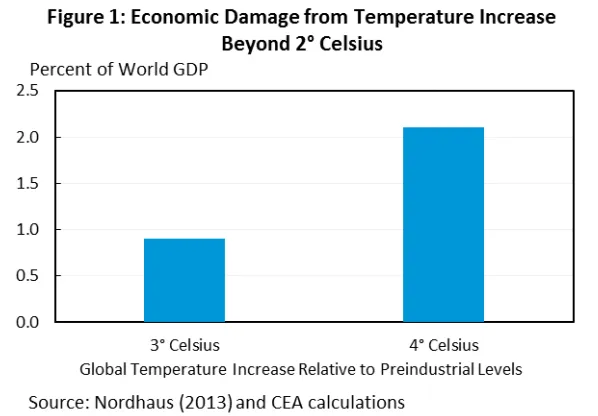
Figure 1 from the 2014 report "The Cost of Delaying Action to Stem Climate Change". Economic damage to the world economy (in percent of World GDP) by temperature increases of 3 and 4 degrees relative to pre-industrial levels. Source: Nordhaus, William D. 2013. The Climate Casino: Risk, Uncertainty, and Economics for a Warming World. New Haven: Yale University Press. and calculations by Council of Economic Advisers/ Wikimedia Commons
Climate change comes with a massive price tag that affects communities worldwide. When temperatures rise and weather patterns shift, the economic consequences touch nearly every part of society. Scientists observe that disasters worsened by warming create enormous financial burdens for families, businesses, and governments.
Natural disasters demonstrate some of the clearest economic impacts of climate change. Hurricanes, floods, and wildfires cause billions of dollars in damage each year. Evidence shows these events are becoming more frequent and severe as the planet warms. Communities must spend vast sums rebuilding homes, repairing roads, and restoring businesses after disasters strike. In 2017, Hurricane Harvey caused approximately $125 billion in damage to Texas and Louisiana. Recovery from such events can take years and drain local budgets.
Agriculture faces significant economic losses as climate patterns change. Farmers depend on predictable weather to grow crops successfully. When droughts last longer or floods arrive unexpectedly, harvests fail and income disappears. Heat waves can damage crops before they mature. These agricultural losses affect food prices and farmer livelihoods. Scientists explain that changing temperature and precipitation patterns make farming more unpredictable and risky.
Insurance costs rise sharply in areas facing climate risks. Companies must charge higher premiums to cover increasing disaster claims. Some insurers stop offering coverage in high-risk regions entirely. Homeowners in coastal areas or wildfire zones may find insurance unaffordable or unavailable. This creates financial vulnerability for families who cannot protect their largest investment.
Health care expenses climb as climate change affects human well-being. Extreme heat causes illness and requires emergency treatment. Air pollution from wildfires worsens respiratory conditions like asthma. Diseases spread by insects expand into new regions as temperatures warm. These health impacts create costs for individuals, families, and medical systems.
Infrastructure faces strain during extreme weather events. Power grids can fail during heat waves when demand peaks. Roads buckle in extreme heat. Water systems struggle during droughts. Repairing and upgrading infrastructure to handle climate impacts requires substantial investment. Outdoor workers lose income when temperatures become too dangerous for labor.
Economic impacts fall unevenly across communities and nations. Poorer regions often suffer the most severe consequences despite contributing least to warming. Developing countries may lack resources for adaptation or recovery. Within wealthy nations, low-income neighborhoods frequently face greater climate risks and have fewer resources to respond. This creates issues of climate justice that scientists and policymakers increasingly recognize.
Economists emphasize an important principle about climate costs. Taking action now to reduce warming is generally far cheaper than paying for damages later. Investing in clean energy, efficient buildings, and protective infrastructure costs less than repeatedly rebuilding after disasters. Mitigation efforts today can prevent much larger expenses in coming decades. This economic reality matters for communities making decisions about climate response.
Interesting Fact: Scientists estimate that every dollar spent on disaster preparedness can save approximately six dollars in future disaster costs, making climate adaptation a smart economic investment.
Comprehension quiz (10 questions)
1. What is one major way that climate change creates economic costs for communities?
2. According to the passage, approximately how much damage did Hurricane Harvey cause in 2017?
3. What does the term 'precipitation' mean in the context of this passage?
4. What does 'climate justice' refer to in the passage?
5. Why do insurance companies charge higher premiums in areas facing climate risks?
6. Based on the passage, what can be inferred about the relationship between poverty and climate impacts?
7. What key economic principle do economists emphasize about climate action?
8. How might climate change affect outdoor workers according to the passage?
9. True or False: According to the passage, farmers can easily predict weather patterns despite climate change.
10. True or False: Scientists estimate that every dollar spent on disaster preparedness can save approximately six dollars in future disaster costs.
Perfect for the way you teach
- Build comprehension skills
- Auto-graded quiz
- Differentiated reading
- Read together at home
- Improve fluency
- Quiet reading time
- Reading curriculum support
- Independent practice
- Track Lexile growth