Ghana Empire
Interactive passage with audio narration, comprehension questions, and printable PDF.
By completing this purchase you agree to our Terms of Use and Privacy Policy. Your subscription renews automatically until you cancel. You can cancel anytime from your account settings. All sales are final and non-refundable. Digital content is available for download in your account immediately upon purchase.
What's included
Ghana Empire preview and details
About this printable Ghana Empire reading passage (Grades 5-8)
Sample passage and quiz from Ghana Empire
Reading passage and comprehension quiz preview
Ghana Empire
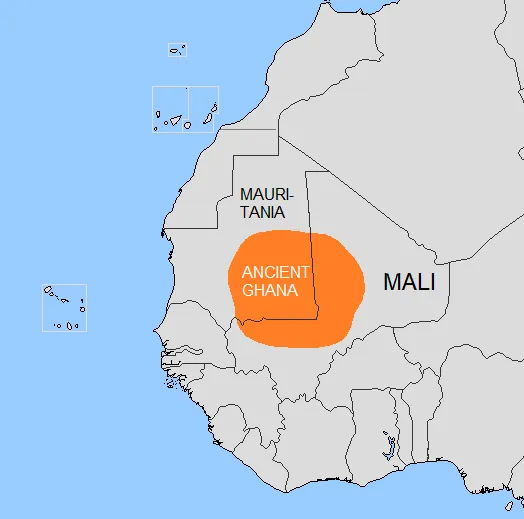
"Ancient Ghana map" /
Source: Wikimedia Commons
The Empire of Ghana was a powerful West African civilization that flourished from approximately 700 to 1200 CE. Located between the Sahara Desert and the forests of West Africa, Ghana became famous for its control over the gold trade. Its success was closely tied to geography, natural resources, and skilled leadership.
Ghana's territory lay between major sources of gold in the south and salt mines in the north. Control of these resources made Ghana a central player in trans-Saharan trade, the exchange of goods across the great Sahara Desert. Traders from North Africa traveled in caravans with camels, bringing salt, cloth, and tools to exchange for gold, ivory, and slaves. Archaeological evidence, such as the ruins of Koumbi Saleh—the capital city—shows bustling marketplaces and strong defensive walls built of stone and mud.
The king of Ghana, known as the "Ghana," held absolute power. He controlled the army, set taxes, and decided trade rules. One unique method Ghana used to regulate trade was the silent barter system. In this system, traders left goods at a trading spot and left; other traders then placed gold or other items in exchange, allowing both sides to trade without speaking or meeting. This helped keep peace and protected the locations of gold mines. According to Arab historian Al-Bakri, who visited the region in the 11th century, the king kept all gold nuggets for himself and only allowed gold dust to be traded, making the king very wealthy and powerful.
Ghana's wealth attracted attention from neighboring societies. The king's court was organized with officials who managed taxes, trade, and military matters. There was a clear social hierarchy: at the top were the king and his family, followed by nobles, traders, skilled workers, and at the bottom, enslaved people. Religion also played a role. While most people practiced traditional African religions, some traders brought Islam to the region, leading to a blend of beliefs and cultural exchange. Over time, as trade routes shifted and new powers rose, Ghana’s authority weakened, especially after attacks by the Almoravids, a group from North Africa, around 1076 CE. Eventually, the Empire of Mali replaced Ghana as the most powerful state in West Africa.
The Empire of Ghana set the stage for future West African civilizations by demonstrating the importance of controlling resources and trade routes. Its legacy can be seen in later empires, such as Mali and Songhai, which also prospered by managing gold and trade. Studying Ghana helps us understand how geography, economic strategy, and cultural exchange shape civilizations.
This connects to broader themes in world history, such as the rise of civilizations, the impact of trade, and the importance of leadership in shaping societies.
Interesting Fact: Some historians believe the word "Ghana" means "warrior king" and was originally a royal title, not the name of the empire itself.
Comprehension quiz (8 questions)
1. What was Ghana famous for?
2. What is silent barter?
3. Who attacked Ghana around 1076 CE?
4. Why did Ghana become wealthy?
5. What role did geography play?
6. What was the social hierarchy?
7. Ghana lasted from 700 to 1200 CE.
8. What does 'caravans' mean?
Perfect for the way you teach
- Build comprehension skills
- Auto-graded quiz
- Differentiated reading
- Read together at home
- Improve fluency
- Quiet reading time
- Reading curriculum support
- Independent practice
- Track Lexile growth