Daily Life in Ancient Greece
Interactive passage with audio narration, comprehension questions, and printable PDF.
By completing this purchase you agree to our Terms of Use and Privacy Policy. Your subscription renews automatically until you cancel. You can cancel anytime from your account settings. All sales are final and non-refundable. Digital content is available for download in your account immediately upon purchase.
What's included
Part of this bundle

Daily Life in Ancient Greece preview and details
About this printable Daily Life in Ancient Greece reading passage (Grades 5-8)
Sample passage and quiz from Daily Life in Ancient Greece
Reading passage and comprehension quiz preview
Daily Life in Ancient Greece
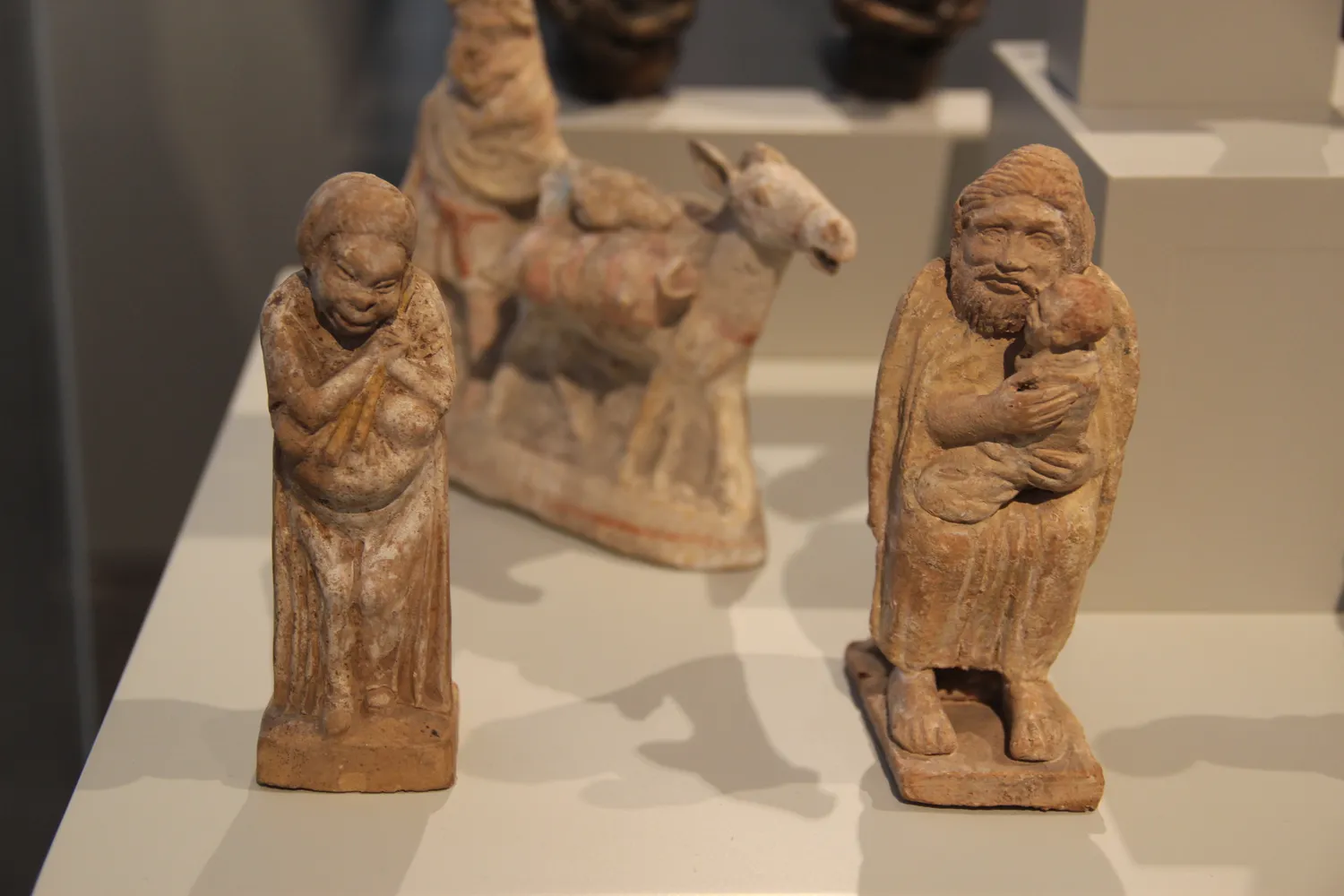
"Ancient Greece Clay Statues of Ordinary People, 3rd-1st Century BC (28453972890)" by Gary Todd from Xinzheng, China / Wikimedia Commons
Ancient Greece developed between 800 and 300 BCE along the rocky coasts and mountains of southern Europe. The region was not a single country, but a collection of city-states such as Athens, Sparta, and Corinth. Each city-state had its own government, laws, and customs, but all Greeks shared a common language and religious beliefs.
Life in Ancient Greece centered around the agora, the public marketplace. This open space was the heart of daily activity, where citizens traded goods, discussed politics, and gathered for festivals. Archaeological discoveries, like pottery shards and ancient coins found in the agora of Athens, reveal how people bought food, tools, and clothing. Men often spent their days in public debates or voting on laws, especially in democratic Athens, while women managed the household and raised children. Enslaved people, who made up a significant part of the population, performed much of the manual labor.
The geography of Greece shaped its society. Because mountains separated the city-states, travel was difficult, and communities developed independently. The Greeks became expert sailors, using the Mediterranean Sea to trade with Egypt, Persia, and other civilizations. Olive oil, wine, and pottery were important exports. The mild climate allowed for outdoor gatherings and athletic competitions such as the Olympic Games, first held in Olympia in 776 BCE, according to ancient records.
Social hierarchy defined people's roles. Free-born male citizens had the most rights, especially in Athens where they participated in an early form of democracy. Women, foreigners, and enslaved people had fewer rights and were often excluded from political life. Education focused on philosophy, literature, and physical fitness, as seen in the writings of Plato and in sculptures of athletes recovered from archaeological sites. Spartan society, by contrast, emphasized military training for all male citizens from a young age, as described by the historian Xenophon.
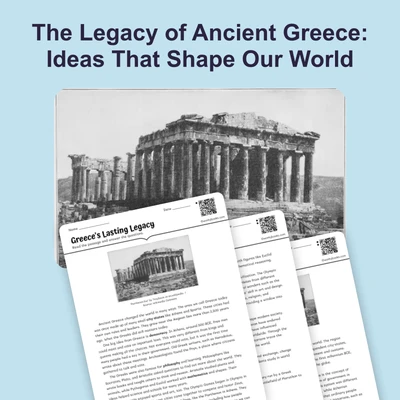
Ancient Greece's influence continues today. Greek architecture, like the Parthenon temple built between 447 and 432 BCE, inspires modern buildings. Democratic ideas from Athens shaped later governments. The legacy of Greek myths, art, and science is still studied around the world. Although each city-state was unique, together they created a civilization whose achievements shaped Western culture for centuries.
Studying Ancient Greece helps us understand how geography, social structures, and human choices interact to shape societies—an important theme throughout world history.
Interesting Fact: The word "marathon" comes from the ancient Greek runner Pheidippides, who, according to legend, ran from the town of Marathon to Athens (about 26 miles) to announce victory in battle.
Comprehension quiz (8 questions)
1. What was the agora used for?
2. Which city-state focused on military training?
3. When were the first Olympic Games held?
4. Why did Greek city-states develop independently?
5. What did men in Athens often do?
6. What was a key export of Ancient Greece?
7. Ancient Greece was a single unified country. True or false?
8. What does 'hierarchy' mean?
Perfect for the way you teach
- Build comprehension skills
- Auto-graded quiz
- Differentiated reading
- Read together at home
- Improve fluency
- Quiet reading time
- Reading curriculum support
- Independent practice
- Track Lexile growth