This engaging history reading passage explores the life and legacy of Aristotle, one of Ancient Greece's most influential philosophers. Students will learn how Aristotle shaped the fields of logic, science, and education, and how his teachings influenced Alexander the Great. The passage includes key vocabulary, primary source examples, and a clear explanation of Aristotle's role in the development of Western thought. Activities include a multiple-choice quiz, writing prompts, graphic organizers, and a timeline. The resource is aligned with CA HSS 6.4 and CCSS RH.6-8.2 standards. Audio read aloud and a full Spanish translation are provided, making this an accessible and rigorous resource for all learners.
Written by Workybooks TeamPublished by Workybooks
Preview
Sample passage and quiz content
CONTENT PREVIEW
Expand content preview
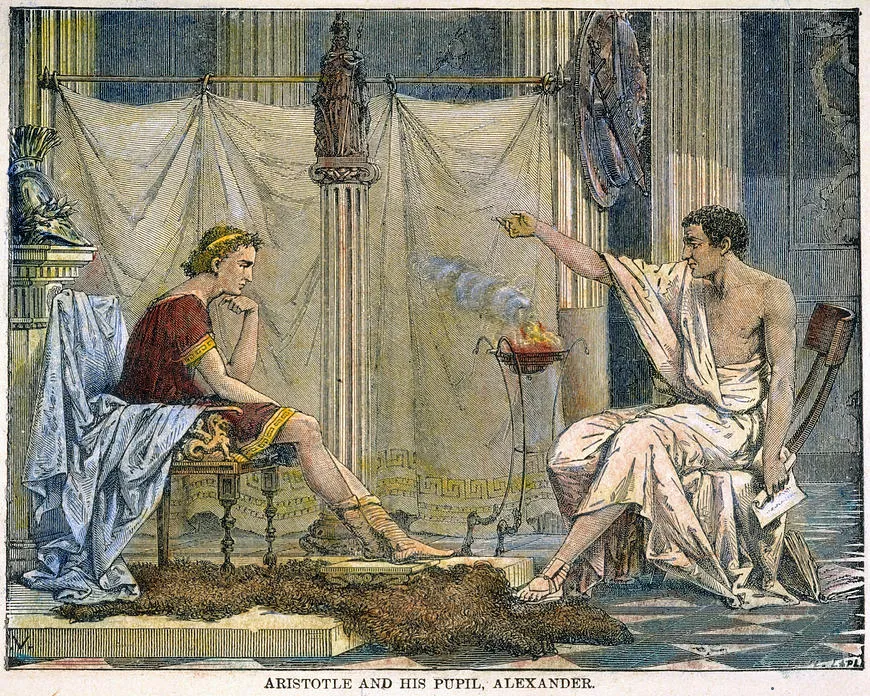
"Alexander and Aristotle" by Charles Laplante / Wikimedia Commons
Aristotle was a Greek philosopher born in 384 BCE in Stagira, a city in northern Greece. He is recognized as one of the greatest thinkers in ancient history. Aristotle studied under the famous philosopher Plato at Plato’s Academy in Athens. Later, Aristotle became a teacher himself and founded his own school, the Lyceum, where he taught for many years.
Aristotle made significant contributions to many fields, including logic, science, ethics, and politics. He was one of the first people to try to classify living things based on shared characteristics, which is an early form of biological taxonomy. Aristotle’s work on observation and reasoning laid the foundation for the scientific method. For example, in his book "History of Animals," Aristotle described and compared over 500 animal species, using direct observation as evidence. He believed that careful study of the natural world could help people understand universal truths.
In 343 BCE, Aristotle was invited by King Philip II of Macedon to tutor his son, Alexander, who would later become known as Alexander the Great. Aristotle taught Alexander about philosophy, geography, medicine, and Greek literature. Some historians believe Aristotle’s lessons shaped Alexander’s respect for different cultures and his interest in learning. Ancient sources, such as Plutarch, describe how Aristotle influenced Alexander’s curiosity and leadership style, though the exact details are sometimes debated.
Aristotle’s impact continued long after his death in 322 BCE. His writings were studied by scholars in the Greek, Roman, and Islamic worlds. During the Middle Ages, his ideas were rediscovered in Europe and became central to university education. Many modern scientific and philosophical terms come from Aristotle’s original Greek words. Despite some errors in his theories, Aristotle’s emphasis on evidence and logic set him apart from earlier thinkers who relied on myth or tradition. He encouraged students to question, investigate, and seek rational explanations.
Aristotle’s life and work demonstrate the importance of education, critical thinking, and the exchange of ideas across cultures. Understanding his legacy helps us see how ancient Greece influenced how people everywhere study the world and solve problems.
Interesting Fact: Aristotle’s school, the Lyceum, had one of the world’s first libraries and may have operated as an early scientific research center.
Where was Aristotle born?
StagiraAthensSpartaRome
Who was Aristotle's famous student?
Alexander the GreatSocratesPlatoCaesar
What school did Aristotle found?
LyceumAcademyLibrary of AlexandriaAgora
How did Aristotle study animals?
Used observationRead old mythsListened to storiesGuessed the facts
Why was logic important to Aristotle?
For clear reasoningTo write storiesTo fight battlesTo build temples
What effect did Aristotle have on later science?
Founded scientific methodCreated new religionsBuilt pyramidsRuled Greece
Aristotle was born in 384 BCE. True or false?
TrueFalse
What does 'taxonomy' mean?
Classifying living thingsBuilding templesStudying starsMaking art
Who it's for
Perfect for the way you teach
Teachers
Build comprehension skills
Auto-graded quiz
Differentiated reading
Parents
Read together at home
Improve fluency
Quiet reading time
Homeschoolers
Reading curriculum support
Independent practice
Track Lexile growth
Topics
AristotleAncient GreecelogicscienceAlexander the Greatphilosophyhistory reading passageCA HSS 6.4CCSS RH.6-8.2
Reviews & Ratings
No reviews yet. Be the first to share your experience!
More reading you might love
19 more
Greek Art and Architecture
This engaging passage explores the art and architecture of ancient Greece, focusing on the Parthenon and the mathematica...
CA HSS 6.4RH.6-8.1RH.6-8.2RH.6-8.4
Alexander the Great
This engaging reading passage explores the life and achievements of Alexander the Great, one of the most influential rul...
CA HSS 6.4RI.6.3RI.6.4W.6.2
Hellenistic Age
This engaging passage examines the rise and legacy of the Hellenistic World following the conquests of Alexander the Gre...
CA HSS 6.4RH.6-8.2RH.6-8.4
Legacy of Ancient Greece
This engaging history reading passage explores the enduring legacy of Ancient Greece and its profound influence on the m...
CA HSS 6.4RH.6-8.2RH.6-8.4RH.6-8.10
Persian Wars
This comprehensive history reading passage examines the Persian Wars, a defining conflict between ancient Greece and the...
CA HSS 6.4TEKS 6.13RI.6.1RI.7.3
Greek Philosophers
This comprehensive history reading passage explores the origins and impact of Greek philosophy, focusing on Socrates, Pl...
CA HSS 6.4RH.6-8.1RH.6-8.2RH.6-8.4
Democracy in Ancient Athens
This history reading passage explores the origins and practice of direct democracy in Ancient Athens, one of the world's...
CA HSS 6.4CCSS.RI.6.1CCSS.RI.6.3CCSS.RI.7.1
Greek Mythology and Gods
This reading passage explores the fascinating world of Greek mythology, including the stories of gods, heroes, and legen...
CA HSS 6.4RH.6-8.1RH.6-8.2RH.6-8.4
Sophocles the Playwright
This passage explores the life and legacy of Sophocles, one of the most influential playwrights of ancient Greece, whose...
CA HSS 6.4CCSS.ELA-LITERACY.RI.6.1CCSS.ELA-LITERACY.RI.7.3CCSS.ELA-LITERACY.RI.8.3
Herodotus
This engaging history reading passage introduces students to Herodotus, known as the 'Father of History,' and his major ...
CA HSS 6.4CCSS.RI.6.3CCSS.RI.6.4
Thucydides the Historian
This rigorous passage introduces students to Thucydides, the ancient Greek historian who chronicled the Peloponnesian Wa...
CA HSS 6.4CCSS RH.6-8.1CCSS RH.6-8.2CCSS RH.6-8.4
Finding Lost Cities
This passage explores the revolutionary impact of modern technology, specifically drones and satellites, on the field of...
CA HSS 6.2CA HSS 6.4RI.6.1RI.7.1
Daily Life in Ancient Greece
This engaging history reading passage explores life in Ancient Greece, focusing on the development of Greek city-states,...
CA HSS 6.4RH.6-8.1RH.6-8.2WHST.6-8.2
Ancient Philosophy in Greece and China
This engaging history reading passage explores the foundations and contrasts of ancient philosophy in Greece and China, ...
CA HSS 6.4RH.6-8.1RH.6-8.2RH.6-8.4
Pericles of Athens
This passage explores the life and achievements of Pericles, the influential leader of Athens during its Golden Age. Stu...
CA HSS 6.4.3CCSS RH.6-8.2CCSS WHST.6-8.2
Founding of Rome
This educational passage explores the legendary origins of Ancient Rome through the stories of Romulus and Aeneas, two i...
CA HSS 6.7CCSS RH.6-8.1CCSS RH.6-8.2CCSS RH.6-8.4
Chinese Invention of Paper
This passage examines the revolutionary invention of paper making during the Han Dynasty in ancient China, highlighting ...
CA HSS 6.6.7CCSS RH.6-8.2CCSS RH.6-8.4
Human Impact on Extinctions
This passage explores how Paleolithic people, or early humans, shaped their environment through the use of fire, hunting...
CA HSS 6.1CCSS RH.6-8.2CCSS RI.6.4
How Early Humans Survived the Ice Age
This passage explores how Paleolithic people adapted to a variety of landscapes, including coastal regions, mountains, p...