Ancient Philosophy in Greece and China
Interactive passage with audio narration, comprehension questions, and printable PDF.
By completing this purchase you agree to our Terms of Use and Privacy Policy. Your subscription renews automatically until you cancel. You can cancel anytime from your account settings. All sales are final and non-refundable. Digital content is available for download in your account immediately upon purchase.
What's included
Ancient Philosophy in Greece and China preview and details
About this printable Ancient Philosophy in Greece and China reading passage (Grades 5-8)
Sample passage and quiz from Ancient Philosophy in Greece and China
Reading passage and comprehension quiz preview
Ancient Philosophy in Greece and China
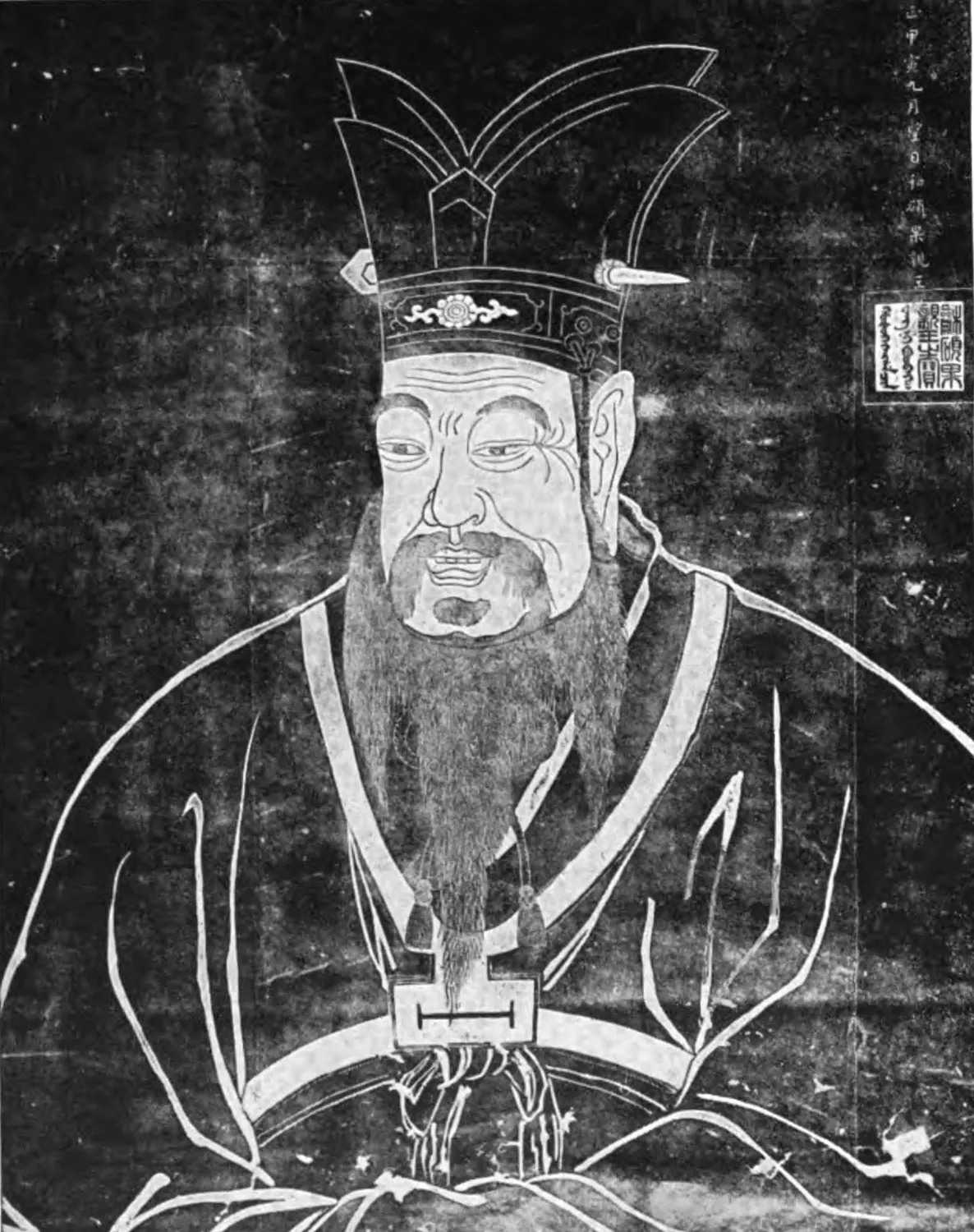
"Confucius 1727" by Unknown authorUnknown author /
Source: Wikimedia Commons (Public domain).
Philosophy in ancient times developed in both Greece and China, but each civilization took a different approach to understanding the world and guiding society. In ancient Greece, thinkers known as philosophers used reason and debate to explore the nature of truth, knowledge, and justice. In contrast, Chinese philosophers such as Confucius focused on moral values and the importance of proper behavior within society. By comparing these two traditions, we can see how geography, politics, and daily life shaped their philosophies.
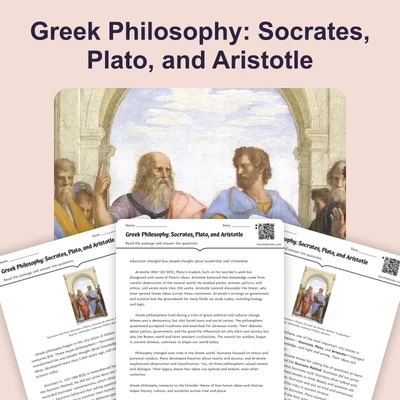
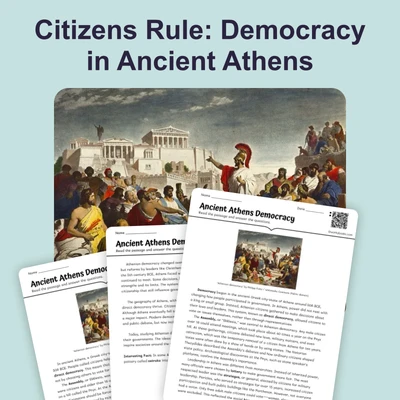
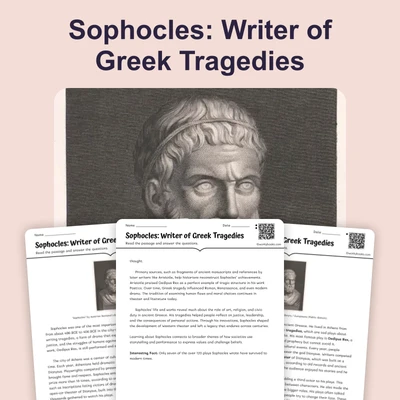
In Greece, beginning around the 6th century BCE, philosophy flourished in city-states like Athens. Famous philosophers such as Socrates, Plato, and Aristotle questioned traditional beliefs and encouraged their students to think critically. Socrates, for example, used the Socratic Method, a form of questioning that helped people examine their own ideas. Plato wrote about a just society in his book 'The Republic,' using dialogue as a teaching tool. Archaeological evidence, such as inscribed tablets and records of public debates, shows that philosophy was connected to the democratic life of Athens, where citizens gathered in the agora to discuss ideas. Greek philosophy emphasized logic, evidence, and the search for universal truths.
In China, philosophy developed during the Zhou Dynasty (c. 1046–256 BCE), a time of social change and political conflict. Confucius (551–479 BCE) taught that harmony in society depended on respect, kindness, and fulfilling one’s role in the family and state. His ideas were recorded in the 'Analects,' a collection of his sayings, which became a primary source for historians. Another influential philosopher, Laozi, founded Daoism, encouraging people to live simply and in balance with nature. Archaeologists have found ancient texts and ritual objects that reveal the importance of ethical behavior and rituals in Chinese society. Chinese philosophy focused on how to achieve order and peace within the community, rather than on abstract reasoning.
Although Greek and Chinese philosophers had different goals, both traditions influenced their societies for centuries. Greek ideas about reason and democracy shaped the development of Western thought, while Chinese ethics guided government and family life throughout East Asia. Over time, both philosophies adapted to changing historical contexts. For example, Confucianism became the basis for civil service exams in China, and Greek ideas were spread to new lands by Alexander the Great.
Understanding these two philosophical traditions helps us see how people in different places and times have tried to answer important questions about life, society, and the universe. Studying ancient philosophy connects to broader themes in history, such as the development of government, the role of education, and the search for meaning.
Interesting Fact: The word “philosophy” comes from Greek and means “love of wisdom.” In China, Confucius is still honored today, and his birthday is celebrated as Teacher’s Day.
Comprehension quiz (8 questions)
1. Who used the Socratic Method?
2. What book did Plato write?
3. Which city-state was known for philosophy?
4. Why did Confucius teach about respect?
5. How did geography shape Greek philosophy?
6. What was a major focus in Chinese philosophy?
7. Greek ideas spread with Alexander the Great. True or false?
8. What is a primary source?
Perfect for the way you teach
- Build comprehension skills
- Auto-graded quiz
- Differentiated reading
- Read together at home
- Improve fluency
- Quiet reading time
- Reading curriculum support
- Independent practice
- Track Lexile growth