Hellenistic Age
Interactive passage with audio narration, comprehension questions, and printable PDF.
By completing this purchase you agree to our Terms of Use and Privacy Policy. Your subscription renews automatically until you cancel. You can cancel anytime from your account settings. All sales are final and non-refundable. Digital content is available for download in your account immediately upon purchase.
What's included
Part of this bundle

Hellenistic Age preview and details
About this printable Hellenistic Age reading passage (Grades 5-8)
Sample passage and quiz from Hellenistic Age
Reading passage and comprehension quiz preview
Hellenistic Period
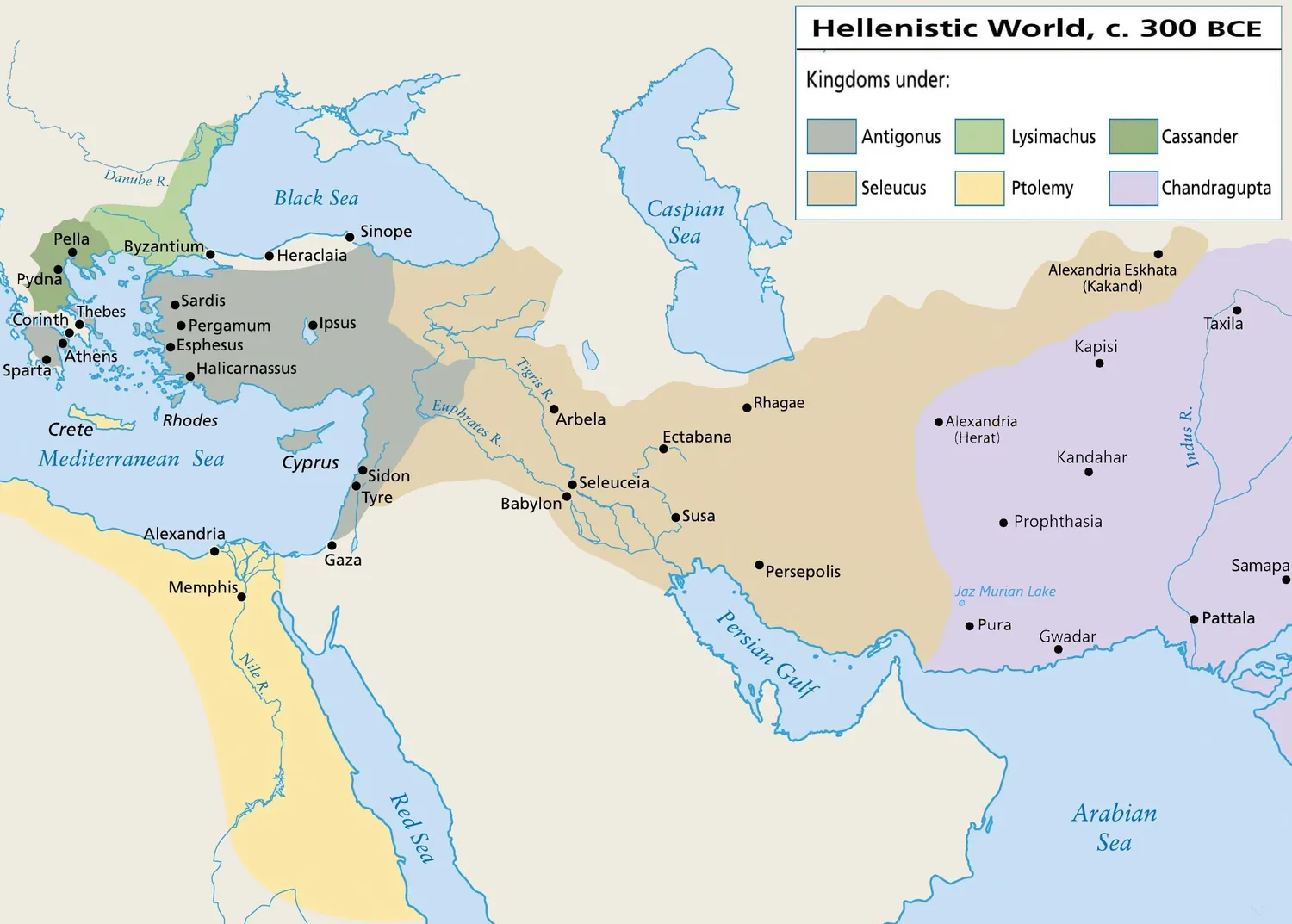
"Hellenistic World 300 BCE Standard map" by Buddhamitra sangha /
Source: Wikimedia Commons (CC0).
The Hellenistic World began after the death of Alexander the Great in 323 BCE. During this period, Greek culture spread across vast regions, blending with the traditions of Egypt, Persia, and parts of India. The term "Hellenistic" comes from the Greek word for Greece, "Hellas," and describes the era when Greek ideas mixed with other cultures to form something new and unique.
Alexander the Great, king of Macedonia, conquered a massive empire stretching from Greece to Egypt and as far east as India. He founded many new cities, the most famous being Alexandria in Egypt. Archaeological evidence, such as the Rosetta Stone discovered in Alexandria, shows how languages and cultures interacted in these cities. In Alexandria, people spoke Greek, but also used Egyptian and other local languages. The city became a center for learning, attracting scholars from across the ancient world. Its famous Library of Alexandria collected texts from many lands, making it a symbol of cultural diffusion—the spreading and mixing of ideas between societies.
After Alexander’s death, his generals divided the empire into several kingdoms. These included the Ptolemaic Kingdom in Egypt and the Seleucid Empire in Persia. Each kingdom kept some Greek customs, such as art and architecture, but local rulers also adapted traditions to fit their own societies. For example, the Ptolemies in Egypt ruled as pharaohs, wearing traditional Egyptian crowns while building Greek-style temples. Coins from this period often show Greek gods alongside local symbols, proving this blend of cultures. Social life also changed; people from different backgrounds could rise in status through trade, learning, or military service, although the elite often spoke Greek and held power.
The geography of the Hellenistic world helped connect people. New roads and ports made travel and trade easier. Merchants traded goods such as papyrus from Egypt, spices from India, and olive oil from Greece. Scientific and mathematical advances flourished. The mathematician Euclid lived in Alexandria, and the astronomer Eratosthenes calculated the Earth's circumference there. These achievements were possible because people of many backgrounds exchanged knowledge and worked together.
The Hellenistic period lasted until around 30 BCE, when the Romans conquered the last of the Hellenistic kingdoms. However, the legacy of the Hellenistic world continued to influence art, science, language, and government for centuries. The blending of cultures during this era helped shape the modern Mediterranean and the world beyond.
Today, historians study the Hellenistic world to understand how cultural exchange can lead to innovation and change. The story of this period connects to the larger themes of world history, such as the movement of peoples, the power of ideas, and the impact of geography on societies.
Interesting Fact: The Lighthouse of Alexandria, one of the Seven Wonders of the Ancient World, guided ships safely into the city’s busy harbor for centuries.
Comprehension quiz (8 questions)
1. When did the Hellenistic era begin?
2. Which city was famous for its library?
3. Who calculated the Earth's circumference?
4. What is cultural diffusion?
5. Why did many people move to Alexandria?
6. How did geography help the Hellenistic world?
7. The Romans ended Hellenistic rule. True or false?
8. What is an empire?
Perfect for the way you teach
- Build comprehension skills
- Auto-graded quiz
- Differentiated reading
- Read together at home
- Improve fluency
- Quiet reading time
- Reading curriculum support
- Independent practice
- Track Lexile growth