Does Mars have an Atmosphere? — Reading Comprehension
Rate this
Premium Resource
Present
Present in classroom. No work saved
Assign
Classroom with student accounts, Track progress
Quick Play
No student accounts, assign with a link
Grades
3
4
5
6
7
8
PRINT+DIGITAL RESOURCE
This learning resource is available in interactive and printable formats. The interactive worksheet can be played online and assigned to students. The Printable PDF version can be downloaded and printed for completion by hand.
This science reading passage for middle school students delves into the fascinating topic of the Martian atmosphere. It explains the composition of Mars's atmosphere, primarily carbon dioxide, and contrasts it with Earth's atmosphere. The passage explores the key reasons for the atmosphere's thinness, linking it to the planet's weaker gravity and lack of a protective magnetic field, which allowed the solar wind to strip away gas over billions of years. It also discusses the dynamic nature of Martian weather, including global dust storms and seasonal pressure changes caused by the freezing and thawing of polar ice caps. This content aligns with NGSS standards related to Earth and Space Science (MS-ESS2-4) and provides a comprehensive overview for students to understand planetary evolution and atmospheric dynamics. The passage is followed by 8 multiple-choice questions designed to assess comprehension and critical thinking skills.
CONTENT PREVIEW
Expand content preview
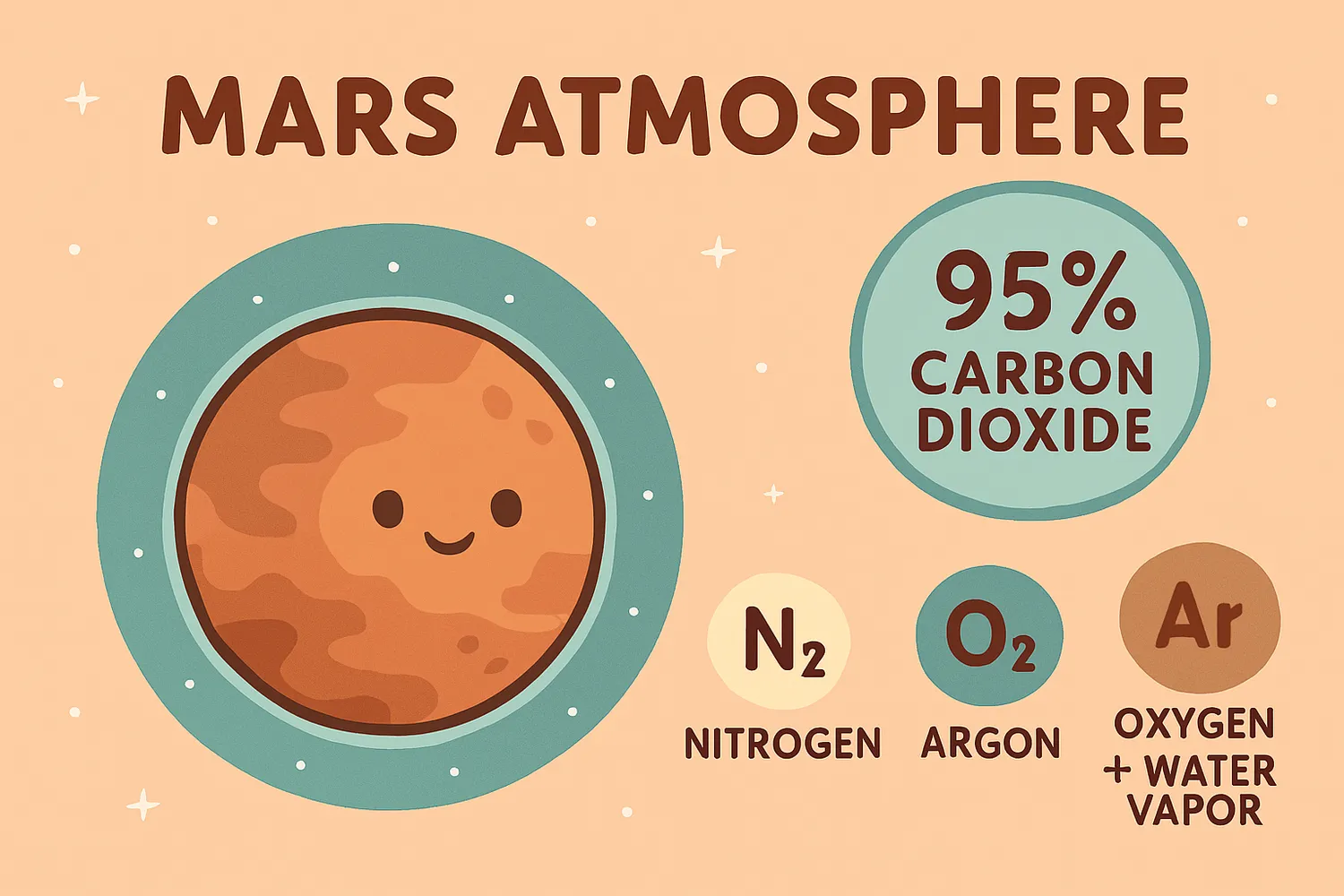
Mars's surface showing the thin atmosphere and a swirling dust storm, with a view of the sun's solar wind impacting the planet.
Mars possesses an atmosphere, but its nature is a far cry from the life-sustaining blanket of air surrounding Earth. This atmosphere is best described as thin and tenuous, with a surface pressure that is less than one percent of Earth's at sea level. The primary component of the Martian atmosphere is carbon dioxide, which makes up about 95% of its total volume. Minor components include nitrogen, argon, and trace amounts of oxygen and water vapor. This composition is a key reason why life as we know it could not survive on the Martian surface without artificial support.
The thinness of the Martian atmosphere is a direct consequence of the planet's weaker gravity and the absence of a global magnetic field. Unlike Earth's magnetosphere, which deflects the constant stream of charged particles known as the solar wind, Mars lacks this protection. Over billions of years, the solar wind has stripped away much of the planet's original, thicker atmosphere. This process of atmospheric loss has transformed Mars from a potentially warmer, wetter world into the cold, dry desert it is today. Evidence suggests that in the past, Mars had a much more substantial atmosphere that allowed liquid water to exist on its surface.
Despite its thinness, the Martian atmosphere is a dynamic system. It experiences distinct weather patterns, including powerful global dust storms that can obscure the entire planet for months at a time. The atmosphere also has seasons, which are influenced by the freezing and unfreezing of carbon dioxide at the polar ice caps. As a polar cap freezes during its winter, it removes a significant amount of carbon dioxide from the atmosphere, causing a measurable drop in global atmospheric pressure. This cycle reverses as the cap thaws in the summer.
Fun Fact: The average surface temperature on Mars is about -80°F (-62°C), but because of the thin atmosphere, there is a huge temperature difference between day and night, and between the equator and the poles.
What is the primary component of the Martian atmosphere?
OxygenNitrogenCarbon dioxideArgon
How does the surface pressure of Mars's atmosphere compare to Earth's?
It is more than double Earth's pressure.It is roughly the same as Earth's pressure.It is less than one percent of Earth's pressure.It is about half of Earth's pressure.
What is a primary reason Mars's atmosphere is so thin?
High temperaturesStrong volcanic activityWeaker gravity and lack of a magnetic fieldThe presence of too much oxygen
Which of the following best describes the historical climate of Mars based on evidence?
It has always been a cold, dry desert.It was once warmer with liquid water.It was hotter with a thicker oxygen atmosphere.It had no atmosphere at all.
What phenomenon is responsible for stripping away Mars's atmosphere over time?
The greenhouse effectThe solar windGlobal dust stormsVolcanic outgassing
What happens to the atmospheric pressure on Mars during its winter?
It increases as carbon dioxide freezes.It decreases as carbon dioxide freezes.It remains constant throughout the year.It decreases due to increased dust storms.
Which of these is a direct consequence of Mars's thin atmosphere?
The planet has two moons.Liquid water can't exist on the surface for long.Mars experiences frequent earthquakes.The planet has a red appearance.
If an astronaut were to step onto the surface of Mars without a spacesuit, what would be the most immediate danger related to the atmosphere?
The high concentration of nitrogen would be toxic.The low pressure would cause their bodily fluids to boil.The high levels of oxygen would be explosive.The atmosphere would be too thick to move through.
Perfect For:
👩🏫 Teachers
• Reading comprehension practice
• Auto-graded assessments
• Literacy skill development
👨👩👧👦 Parents
• Reading practice at home
• Comprehension improvement
• Educational reading time
🏠 Homeschoolers
• Reading curriculum support
• Independent reading practice
• Progress monitoring
Reading Features:
📖
Reading Passage
Engaging fiction or nonfiction text
❓
Comprehension Quiz
Auto-graded questions
📊
Instant Feedback
Immediate results and scoring
📄
Printable Version
Download for offline reading
🔊
Read Aloud
Voice-over with word highlighting
Reviews & Ratings
No reviews yet. Be the first to share your experience!
Related Content
Climate and weather activity
This worksheet is perfect for understanding the differences between climate and weather. Students will read the phrases ...
Climate and Weather — Distinguishing Characterstics
This worksheet highlights the differences between climate and weather. The chart format makes comparing and contrasting ...
Comparing Weather and Climate Texts
This reading comprehension worksheet has 5th graders read two informational texts about Weather and Climate. Students th...
RI.5.9
Tools and Technology in Earth Science
This middle school science reading passage explores the wide range of tools and technologies used in Earth science, from...
MS-ESS2-2MS-ESS3-2MS-ETS1-1MS-PS4-3
What Is Space Weather and How Does It Affect the Earth?
This NGSS-aligned science passage for middle school explains what space weather is and how it affects Earth. Students le...
MS-ESS2-2
What Is Earth Science?
This engaging middle school science passage introduces students to the field of Earth science, aligning with NGSS standa...
MS-ESS1MS-ESS2MS-ESS3SEP
Extreme Weather and Climate Change
This Grade 6-8 science passage, aligned to NGSS standards, explores the impact of climate change on extreme weather even...
What Is The Difference Between Climate Model And Weather Model?
This reading passage delves into the fundamental differences between weather models and climate models, explaining their...
Scientific Inquiry in Earth Science
This passage explores scientific inquiry in Earth science for grades 6-8, aligned with NGSS standards MS-ESS1-4, MS-ESS2...
MS-ESS1-4MS-ESS2-1MS-ESS3-5SEP
Earth's Major Climate Zones Explained
This engaging science passage for grades 6-8 explains Earth's major climate zones, including tropical, temperate, and po...
Climate Through Earth's History
This engaging passage for grades 6-8 explores how Earth's climate has naturally changed over millions of years, highligh...
MS-ESS1-4MS-ESS2-6
Earth: Our Home in Space
This engaging Grade 4-5 science passage, aligned to NGSS, introduces students to Earth's special place in the solar syst...
Weather vs. Climate
This comprehensive passage for grades 6-8 explores the difference between weather and climate, aligning with NGSS standa...
MS-ESS2-6
How is Climate Different from Weather?
This passage distinguishes climate from weather for young readers. It defines climate as the usual weather patterns over...
RI.3.1RI.4.14.ESS2.D
Air Masses and Weather
This audio-integrated passage, "Air Masses and Weather," is designed for 6th-grade students to understand how the moveme...
Antarctica Climate
This engaging science passage for grades 6-8 explores Antarctica, the coldest climate zone on Earth. Students will learn...
Climate Zones Word Sort
This word sort activity helps students understand different climate zones through real-world locations. Students classif...
How Climate Change Affects Weather
This middle school science passage explores how and why weather patterns are changing globally. Students will learn abou...
MS-ESS3-5
Polar Bears and Climate
This informational text on polar bears is a great way to practice reading comprehension. Students will read the passage ...
RI.4.1W.4.72-LS4-1RF.4.4
Escape Velocity and Space Travel
This middle school science passage introduces students to the concept of escape velocity—the minimum speed required to b...