Earthquake Hazards and Damage — Reading Comprehension
Rate this
Premium Resource
Present
Present in classroom. No work saved
Assign
Classroom with student accounts, Track progress
Quick Play
No student accounts, assign with a link
Grades
5
6
7
8
Standards
MS-ESS3-2
PRINT+DIGITAL RESOURCE
This learning resource is available in interactive and printable formats. The interactive worksheet can be played online and assigned to students. The Printable PDF version can be downloaded and printed for completion by hand.
This middle school science reading passage examines the hazards and damage caused by earthquakes, aligned with NGSS MS-ESS3-2. Students will learn about ground shaking, landslides, surface rupture, tsunamis, fires, and how factors like magnitude, geology, and engineering influence the impact. Real-world examples such as San Francisco 1906, Alaska 1964, Haiti 2010, and Japan 2011 are included to illustrate the variety of earthquake effects. The passage encourages scientific thinking about how we know what we know, emphasizing mechanisms like liquefaction and aftershocks. Glossary terms, comprehension questions, writing prompts, and graphic organizers support learning and accessibility. This resource is suitable for audio integration and helps students build vocabulary and analytical skills while preparing for real-world challenges.
CONTENT PREVIEW
Expand content preview
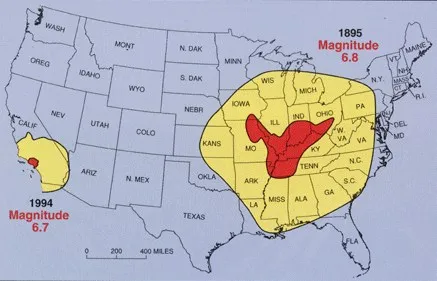
Damage-range comparison between a moderate New Madrid zone earthquake (1895, magnitude 6.8), and a similar Los Angeles event (1994, magnitude 6.7). Yellow indicates where shaking was felt; red indicates at least minor damage to buildings and their contents. Wikimedia Commons (Public domain).
Earthquakes are sudden movements of the Earth's surface that can cause widespread damage and danger. These natural events are important to study because they threaten lives, property, and infrastructure in many parts of the world. Understanding earthquake hazards helps scientists, engineers, and communities prepare and reduce risk. This passage explores the main hazards caused by earthquakes, explains why they occur, and examines their impacts using real-world examples.
Ground Shaking and Surface Rupture
The most immediate hazard from an earthquake is ground shaking. The intensity of shaking depends on the earthquake's magnitude (the amount of energy released), the distance from the earthquake's center, and the local geology. For example, areas with soft sediments can experience more intense shaking because the ground acts like a sponge, amplifying the waves. Sometimes this causes liquefaction, when the ground temporarily behaves like a liquid, causing buildings and roads to sink or tilt. Another hazard is surface rupture, where the ground splits open along a fault line, breaking roads, pipes, and structures above.
Landslides, Tsunamis, and Fires
Earthquake shaking can trigger landslides on unstable slopes, especially in mountains or areas with loose soil. These landslides can bury homes and block roads, making rescue and recovery difficult. Under the ocean, earthquakes can cause tsunamis: giant waves formed when the seafloor suddenly moves. Tsunamis travel rapidly across oceans, flooding coastlines and causing destruction far from the earthquake's origin. Fires are another major hazard, often started by ruptured gas lines or broken electrical wires during an earthquake. Fires can spread quickly if water lines are damaged and firefighters cannot respond.
Building Collapse, Infrastructure Damage, and Aftershocks
The type and age of construction play a major role in earthquake damage. Older or poorly engineered buildings are more likely to collapse, trapping people inside. Earthquakes also damage infrastructure like bridges, roads, and utilities (electricity, water, sewage). After the main shock, aftershocks—smaller earthquakes—can continue for days or weeks, causing more damage and danger. Historic examples show the range of earthquake impacts: the 1906 San Francisco earthquake caused fires that destroyed much of the city; the 1964 Alaska earthquake led to landslides and tsunamis; the 2010 Haiti earthquake had massive building collapses; and the 2011 Japan earthquake triggered a devastating tsunami.
Understanding how earthquakes cause multiple hazards helps communities improve safety through engineering, emergency planning, and education. By studying past events and local geology, scientists can identify high-risk areas and develop better ways to reduce earthquake damage. These efforts support the broader scientific principle that human actions and natural systems are interconnected.
Interesting Fact: The energy released by a magnitude 8 earthquake can be over 1,000 times greater than a magnitude 6 earthquake, showing how small differences in magnitude can cause huge changes in damage.
What is the primary hazard caused directly by an earthquake?
Soft sediments can amplify shaking and increase damageHard rocks always cause bigger tsunamisLocal geology does not matterOnly mountains are affected
What is liquefaction?
When the ground behaves like a liquid during strong shakingWhen water turns into iceWhen rocks melt underwaterWhen the air becomes very humid
Which type of hazard can bury homes and block roads after an earthquake?
TsunamisLandslidesFiresSurface rupture
In the passage, what does the word 'infrastructure' mean?
Systems like roads, bridges, and utilitiesThe shape of mountainsTypes of soilMethods of earthquake measurement
Why are aftershocks dangerous?
They can cause additional damage after the main earthquakeThey always cause tsunamisThey only affect oceansThey make earthquakes easier to predict
Which historical earthquake caused a major tsunami and nuclear disaster?
San Francisco 1906Japan 2011Alaska 1964Haiti 2010
If a city is built on soft, wet soil, what is one likely effect during an earthquake?
Liquefaction may occur, causing buildings to sink or tiltThe city will be protected from all damageOnly the mountains will shakeNo aftershocks will happen
True or False: Fires after earthquakes are often caused by broken gas or electrical lines.
TrueFalse
True or False: All earthquakes cause tsunamis.
TrueFalse
Perfect For:
👩🏫 Teachers
• Reading comprehension practice
• Auto-graded assessments
• Literacy skill development
👨👩👧👦 Parents
• Reading practice at home
• Comprehension improvement
• Educational reading time
🏠 Homeschoolers
• Reading curriculum support
• Independent reading practice
• Progress monitoring
Reading Features:
📖
Reading Passage
Engaging fiction or nonfiction text
❓
Comprehension Quiz
Auto-graded questions
📊
Instant Feedback
Immediate results and scoring
📄
Printable Version
Download for offline reading
🔊
Read Aloud
Voice-over with word highlighting
Reviews & Ratings
No reviews yet. Be the first to share your experience!
Related Content
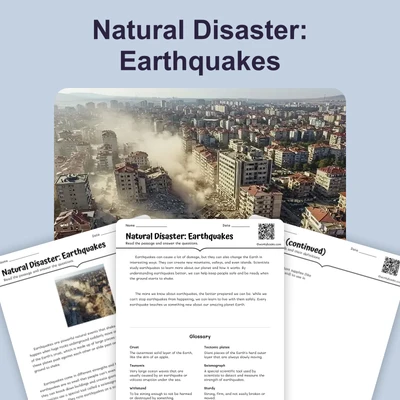
Natural Disaster: Earthquake
Earthquakes occur when tectonic plates move, causing the ground to shake. Understanding earthquakes helps us prepare and...
RI.3.1RI.4.4RI.4.2RI.5.2
Volcanic Eruptions: Causes, Types, and Key Features
This science passage explains volcanic eruptions, aligned with NGSS MS-ESS3-2 (natural hazards) and ESS2-2 (Earth’s syst...
MS-ESS3-2MS-ESS2-2RST.6-8.3
Kīlauea Volcano: Hawaii’s Ever-Changing Landscape
This passage details Kīlauea's volcanic history and status, aligned with NGSS MS-ESS3-2 (natural hazards) and ESS2-3 (Ea...
MS-ESS3-2MS-ESS2-3RST.6-8.2
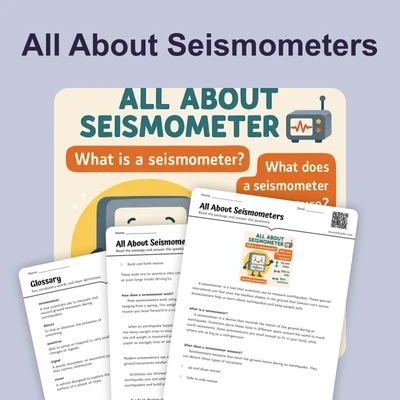
All About Seismometers
This informational science passage explores seismometers and their role in measuring earthquakes, designed specifically ...
MS-ESS3-2MS-ESS2-3RST.6-8.2
What Is the Difference Between Magma and Lava?
This educational reading passage explains the critical difference between magma and molten rock beneath Earth's surface ...
MS-ESS2-3MS-ESS3-2RST.6-8.4
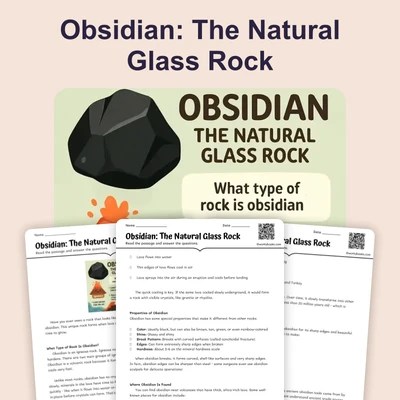
Obsidian: The Natural Glass Rock
This science reading passage explores obsidian, a volcanic glass that forms when lava cools so rapidly that crystals can...
MS-ESS2-3MS-ESS3-2RST.6-8.4
Measuring Hurricane Intensity – The Saffir-Simpson Hurricane Wind Scale
This NGSS-aligned science reading passage explains how the Saffir-Simpson Hurricane Wind Scale is used to measure the in...
MS-ESS3-2
Tools and Technology in Earth Science
This middle school science reading passage explores the wide range of tools and technologies used in Earth science, from...
MS-ESS2-2MS-ESS3-2MS-ETS1-1MS-PS4-3
Types of Maps
This engaging science passage for grades 6-8 introduces students to the various types of maps and their uses, supporting...
MS-ESS2-2MS-ESS3-2MS-ETS1-1MS-ETS1-4
Mass Movements
This NGSS-aligned passage introduces middle school students to the science of mass movements—gravity-driven motions of r...
MS-ESS2-1MS-ESS3-2
What Causes Earthquakes?
This middle school science passage explains what causes earthquakes, focusing on the interactions between tectonic plate...
MS-ESS2-2MS-ESS3-2
Floods: Causes and Types
This middle school science passage provides a comprehensive look at floods, their causes, types, and impacts, addressing...
MS-ESS3-2
Hurricanes and Tropical Cyclones
This in-depth passage for grades 6-8 covers hurricanes and tropical cyclones, aligning with NGSS standards MS-ESS3-2 and...
MS-ESS3-2MS-ESS2-5
Hurricane Preparedness and Safety
This passage explores the science and practical strategies of hurricane preparedness and safety, designed for middle sch...
MS-ESS3-2MS-ETS1-1
Tornadoes
This informational science passage for grades 6-8 explores the science of tornadoes, aligning with NGSS standards MS-ESS...
MS-ESS3-2MS-ESS2-5
Tsunamis
This middle school science passage explores tsunamis, focusing on their causes, characteristics, and impacts. Students w...
MS-ESS3-2
Tsunami Warning and Safety
This comprehensive middle school science passage examines the systems and science behind tsunami warning and safety. Ali...
MS-ESS3-2
Earthquake Zones and Patterns
This informational science passage introduces middle school students to the global distribution of earthquakes, focusing...
MS-ESS2-2MS-ESS3-2
Seismic Waves
This comprehensive middle school passage introduces students to seismic waves, the energy released during earthquakes. A...