This learning resource is available in interactive and printable formats. The interactive worksheet can be played online and assigned to students. The Printable PDF version can be downloaded and printed for completion by hand.
This middle school science passage explores tsunamis, focusing on their causes, characteristics, and impacts. Students will learn how underwater earthquakes, volcanic eruptions, submarine landslides, and even asteroid impacts can generate these powerful waves. The passage explains the unique features of tsunamis, such as their long wavelength and high speed in deep water, and how their height increases near shorelines. Real-world examples like the 2004 Indian Ocean tsunami and the 2011 Japan tsunami illustrate both the dangers and the importance of warning systems, including seismic monitoring and deep-ocean buoys. Vocabulary is highlighted and explained, and the content is designed for grades 6-8, aligning with NGSS standard MS-ESS3-2. Activities include comprehension questions, writing prompts, and graphic organizers. The passage is audio-integrated and includes both English and Spanish versions, plus a simplified adaptation for struggling readers.
CONTENT PREVIEW
Expand content preview
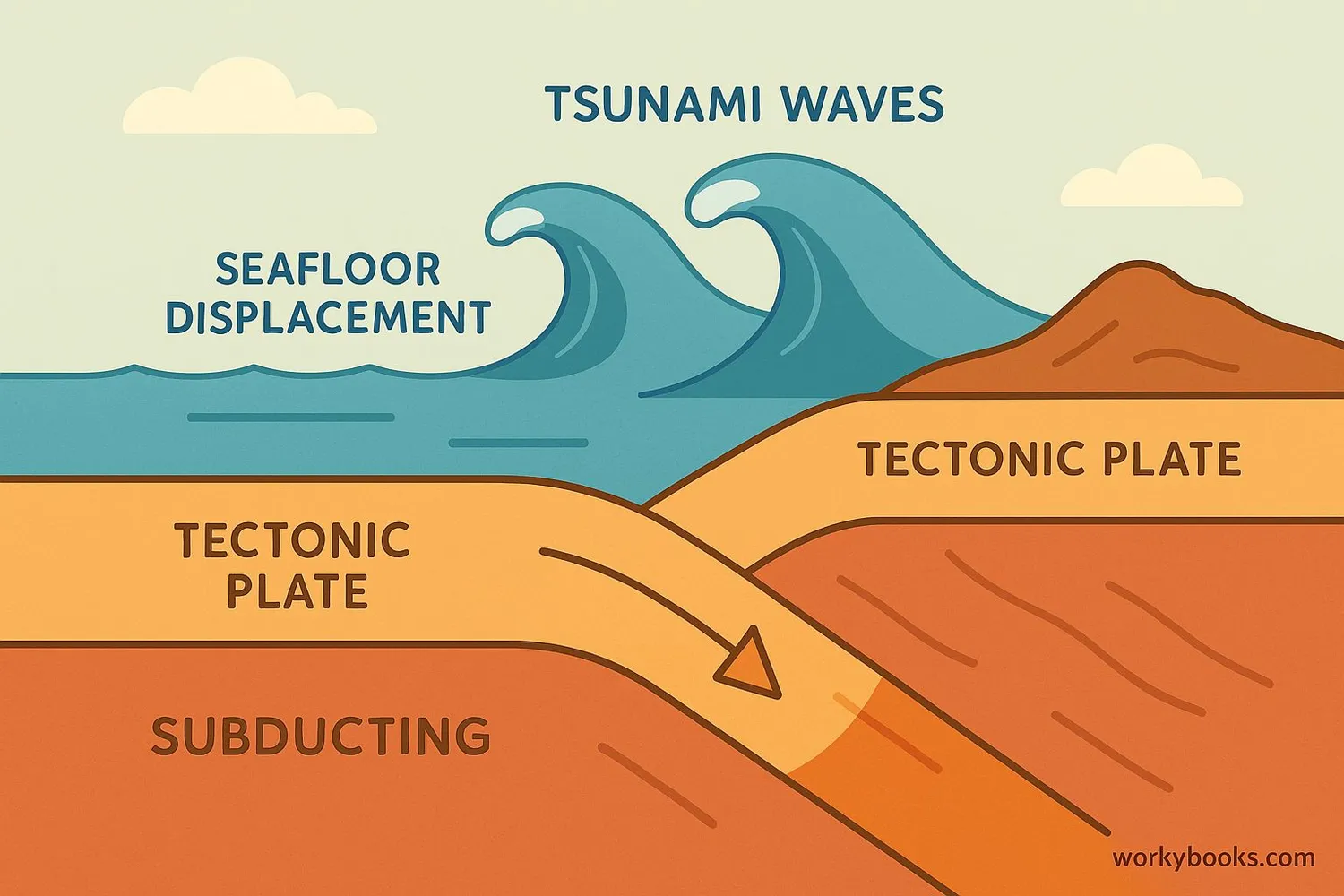
Diagram showing how earthquakes cause tsunamis
Tsunamis are among the most dangerous natural hazards affecting coastal areas around the world. These enormous ocean waves can travel across entire oceans and cause catastrophic damage when they reach land. Understanding how tsunamis form and why they are so destructive is essential for protecting people and communities. Scientific research and improved warning systems have saved lives, but tsunamis remain a significant threat in many regions.
How Tsunamis Are Generated Most tsunamis are caused by underwater earthquakes that suddenly shift the ocean floor. When the seafloor moves, it displaces a massive amount of water, creating waves that spread outward in all directions. Other triggers include volcanic eruptions, submarine landslides, and rare events like asteroid impacts. Tsunami waves are different from regular ocean waves; they have a very long wavelength—often over 100 kilometers—and can move at speeds between 500 and 800 kilometers per hour in deep water. Although they may pass unnoticed in the open ocean, their height increases dramatically as they approach shallow coastal areas, sometimes reaching over 30 meters. This process is called wave amplification.
Tsunami Warning Signs and Case Studies There are several warning signs of an approaching tsunami. A strong earthquake felt near the coast is the most common signal. People may also notice the ocean receding unusually far from shore, or hear a loud, roaring sound. History provides powerful examples of tsunami impacts. In 2004, the Indian Ocean tsunami killed more than 230,000 people in over a dozen countries. The disaster revealed weaknesses in global warning systems and led to the development of new technologies. In 2011, a massive earthquake off the coast of Japan triggered a tsunami that caused a nuclear disaster at Fukushima. Even with advanced preparedness, the event showed that tsunamis can overwhelm even well-equipped nations.
Warning Systems and Scientific Understanding Modern tsunami warning systems use seismic monitoring to detect undersea earthquakes, as well as deep-ocean buoys (part of the DART network) and tide gauges to track changes in sea level. These instruments send data to communication networks that alert emergency services and the public. Scientists continue to study tsunami behavior, using computer models and historical data to improve predictions. By understanding the chain of events—from tectonic activity to wave movement to coastal impact—societies can better prepare for future tsunamis and reduce the loss of life and property.
Recognizing the signs of a possible tsunami and knowing how to respond can be the difference between safety and tragedy. As climate and coastal populations change, learning about tsunamis remains a vital part of science education and disaster preparedness.
Interesting Fact: Some tsunami waves have traveled across entire oceans in less than a day, affecting countries thousands of kilometers from where they started.
100-200 km/h500-800 km/h50-100 km/hOver 1,000 km/h
Which of the following is a warning sign of a tsunami?
Sudden drop in ocean water levelA rainbow appearsThe sky turns greenSudden snow
What does 'wave amplification' mean?
Waves get shorter in the oceanWaves slow down in deep waterWaves grow taller as they reach shallow waterWaves disappear before reaching land
In the context of tsunamis, what is a 'deep-ocean buoy' used for?
To measure water pressure and detect tsunamisTo catch fishTo track whalesTo create waves
Why did the 2004 Indian Ocean tsunami lead to new warning technologies?
Because many people were affected and warning systems were not effectiveBecause there were no earthquakesBecause the ocean water was very warmBecause it caused a volcanic eruption
What can scientists use to improve tsunami predictions?
Ancient mythsComputer models and historical dataRandom guessesWeather balloons
True or False: Tsunami waves are usually very tall when they are far from land.
TrueFalse
True or False: All tsunamis are caused by asteroid impacts.
TrueFalse
If you feel a strong earthquake while at the beach, what should you do?
Move to higher ground immediatelyGo swimmingStay on the beach and watch the oceanCall a friend and wait
Perfect For:
👩🏫 Teachers
• Reading comprehension practice
• Auto-graded assessments
• Literacy skill development
👨👩👧👦 Parents
• Reading practice at home
• Comprehension improvement
• Educational reading time
🏠 Homeschoolers
• Reading curriculum support
• Independent reading practice
• Progress monitoring
Reading Features:
📖
Reading Passage
Engaging fiction or nonfiction text
❓
Comprehension Quiz
Auto-graded questions
📊
Instant Feedback
Immediate results and scoring
📄
Printable Version
Download for offline reading
🔊
Read Aloud
Voice-over with word highlighting
Reviews & Ratings
No reviews yet. Be the first to share your experience!
Related Content
Natural Disaster: Earthquake
Earthquakes occur when tectonic plates move, causing the ground to shake. Understanding earthquakes helps us prepare and...
RI.3.1RI.4.4RI.4.2RI.5.2
Volcanic Eruptions: Causes, Types, and Key Features
This science passage explains volcanic eruptions, aligned with NGSS MS-ESS3-2 (natural hazards) and ESS2-2 (Earth’s syst...
MS-ESS3-2MS-ESS2-2RST.6-8.3
Kīlauea Volcano: Hawaii’s Ever-Changing Landscape
This passage details Kīlauea's volcanic history and status, aligned with NGSS MS-ESS3-2 (natural hazards) and ESS2-3 (Ea...
MS-ESS3-2MS-ESS2-3RST.6-8.2
All About Seismometers
This informational science passage explores seismometers and their role in measuring earthquakes, designed specifically ...
MS-ESS3-2MS-ESS2-3RST.6-8.2
What Is the Difference Between Magma and Lava?
This educational reading passage explains the critical difference between magma and molten rock beneath Earth's surface ...
MS-ESS2-3MS-ESS3-2RST.6-8.4
Obsidian: The Natural Glass Rock
This science reading passage explores obsidian, a volcanic glass that forms when lava cools so rapidly that crystals can...
MS-ESS2-3MS-ESS3-2RST.6-8.4
Measuring Hurricane Intensity – The Saffir-Simpson Hurricane Wind Scale
This NGSS-aligned science reading passage explains how the Saffir-Simpson Hurricane Wind Scale is used to measure the in...
MS-ESS3-2
Tools and Technology in Earth Science
This middle school science reading passage explores the wide range of tools and technologies used in Earth science, from...
MS-ESS2-2MS-ESS3-2MS-ETS1-1MS-PS4-3
Types of Maps
This engaging science passage for grades 6-8 introduces students to the various types of maps and their uses, supporting...
MS-ESS2-2MS-ESS3-2MS-ETS1-1MS-ETS1-4
Mass Movements
This NGSS-aligned passage introduces middle school students to the science of mass movements—gravity-driven motions of r...
MS-ESS2-1MS-ESS3-2
What Causes Earthquakes?
This middle school science passage explains what causes earthquakes, focusing on the interactions between tectonic plate...
MS-ESS2-2MS-ESS3-2
Floods: Causes and Types
This middle school science passage provides a comprehensive look at floods, their causes, types, and impacts, addressing...
MS-ESS3-2
Hurricanes and Tropical Cyclones
This in-depth passage for grades 6-8 covers hurricanes and tropical cyclones, aligning with NGSS standards MS-ESS3-2 and...
MS-ESS3-2MS-ESS2-5
Hurricane Preparedness and Safety
This passage explores the science and practical strategies of hurricane preparedness and safety, designed for middle sch...
MS-ESS3-2MS-ETS1-1
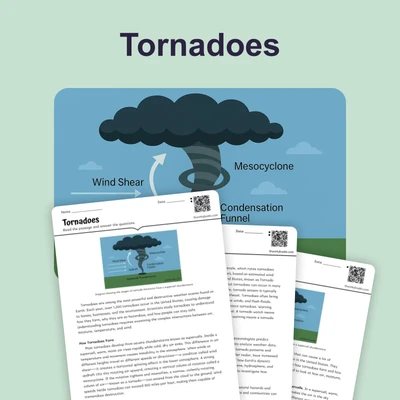
Tornadoes
This informational science passage for grades 6-8 explores the science of tornadoes, aligning with NGSS standards MS-ESS...
MS-ESS3-2MS-ESS2-5
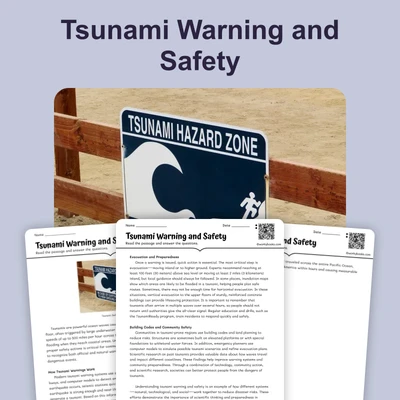
Tsunami Warning and Safety
This comprehensive middle school science passage examines the systems and science behind tsunami warning and safety. Ali...
MS-ESS3-2
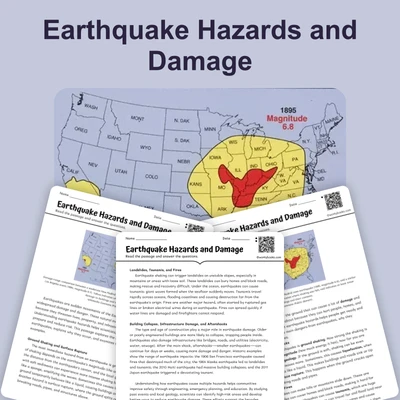
Earthquake Hazards and Damage
This middle school science reading passage examines the hazards and damage caused by earthquakes, aligned with NGSS MS-E...
MS-ESS3-2
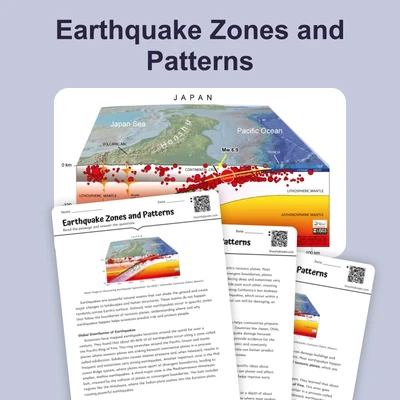
Earthquake Zones and Patterns
This informational science passage introduces middle school students to the global distribution of earthquakes, focusing...
MS-ESS2-2MS-ESS3-2
Seismic Waves
This comprehensive middle school passage introduces students to seismic waves, the energy released during earthquakes. A...