Factories Change America
Interactive passage with audio narration, comprehension questions, and printable PDF.
By completing this purchase you agree to our Terms of Use and Privacy Policy. Your subscription renews automatically until you cancel. You can cancel anytime from your account settings. All sales are final and non-refundable. Digital content is available for download in your account immediately upon purchase.
What's included
Factories Change America preview and details
About this printable Factories Change America reading passage (Grades 6-8)
Sample passage and quiz from Factories Change America
Reading passage and comprehension quiz preview
Factories Change America
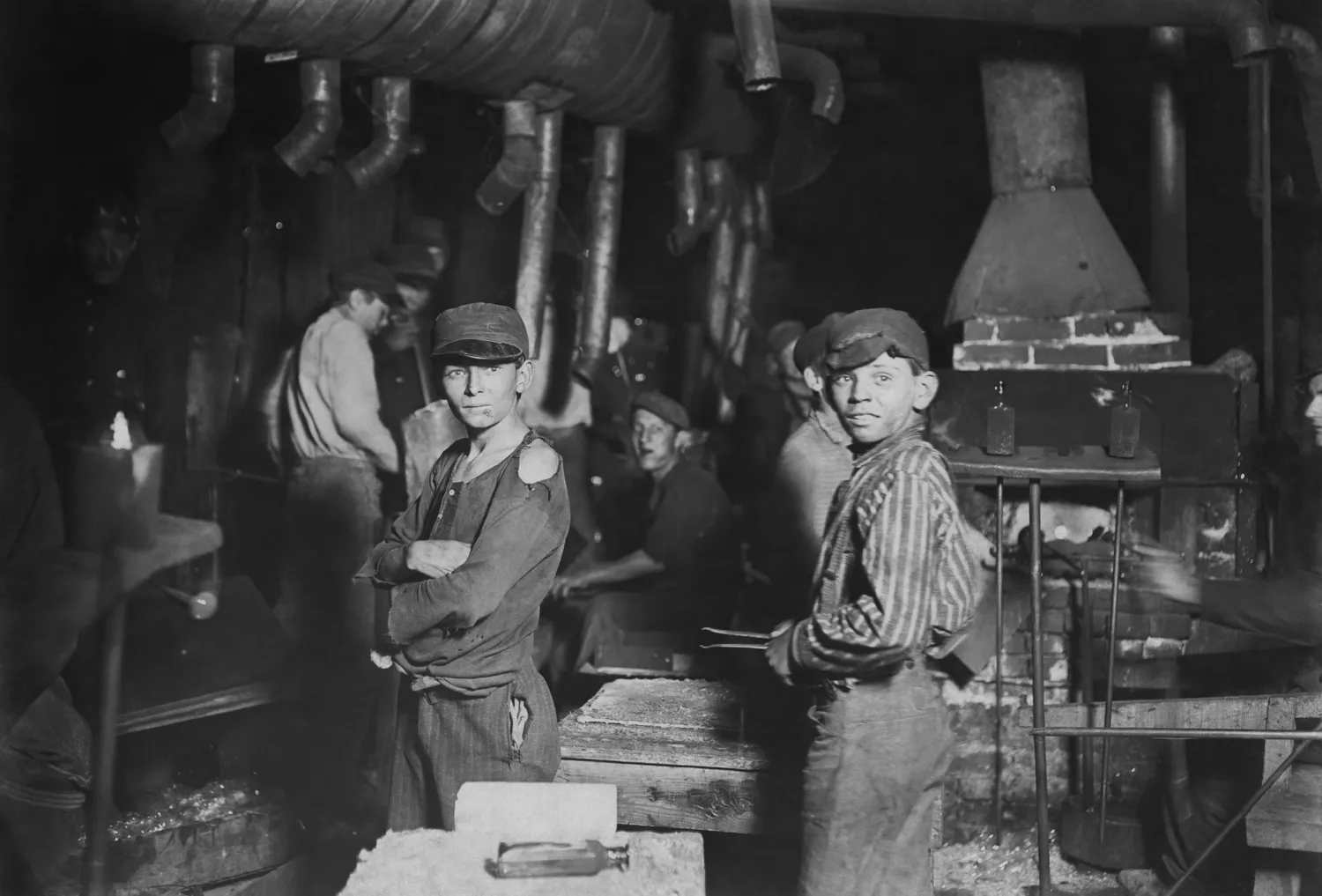
"Midnight at the glassworks2" by Lewis Wickes Hine,
Wikimedia Commons
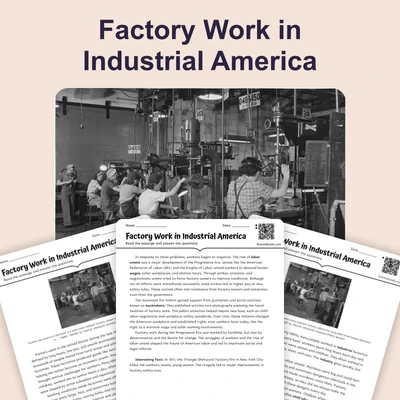
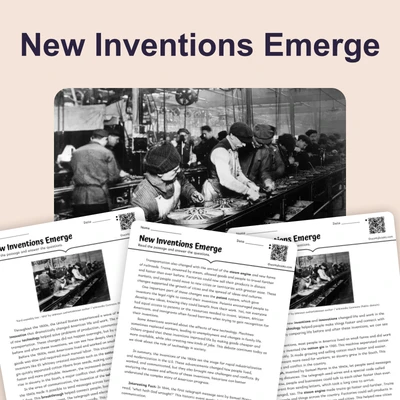
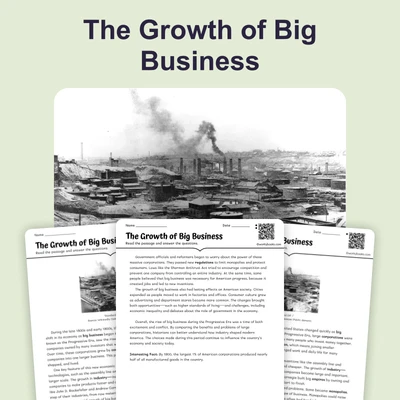
During the late 1800s and early 1900s, factories dramatically changed the way Americans lived and worked. The rise of industry meant that more goods could be produced faster and at lower costs. Instead of making products by hand, workers operated machines in large buildings called factories. This change, known as mass production, allowed companies to create thousands of identical items at once. The shift from handcraft to machine-made goods was a key feature of the Progressive Era, a time of rapid economic and social transformation.
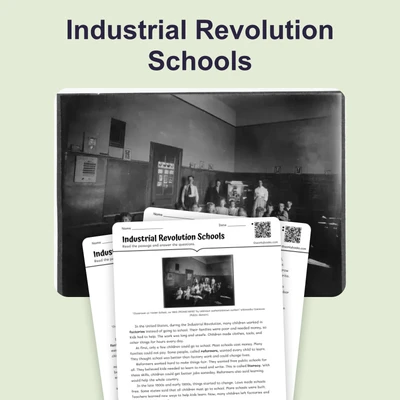
The development of mass production solved several problems. Before factories, people had to rely on skilled craftspeople, which made goods expensive and sometimes scarce. With factories, products such as clothing, shoes, and tools became more affordable for ordinary families. However, the growth of factories also created new challenges. Many workers, including women and children, faced long hours, low pay, and unsafe conditions. Factory owners focused on efficiency and profit, sometimes at the expense of workers’ health and safety. These issues led to debates and reforms during the Progressive Era, including new labor laws to protect workers.
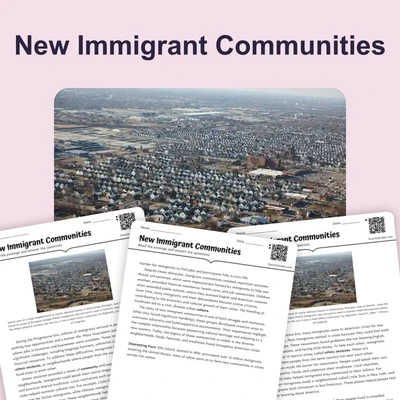
Another major effect of factories was urbanization. As factories were built in cities, people moved from rural areas to urban centers in search of jobs. The population of cities like New York, Chicago, and Detroit soared. Crowded living conditions and pollution became serious problems, but cities also offered new opportunities for cultural exchange, education, and entertainment. The growth of urban areas changed American society, creating a divide between rural and urban experiences.
Factories also transformed the American economy. New technologies, such as the assembly line, made production even faster and more efficient. Business leaders like Henry Ford became famous for introducing innovative methods that lowered the cost of goods like automobiles, making them available to millions. Immigrants played a crucial role in this economic transformation, providing much of the labor force in factories and helping to build vibrant city communities. However, competition for jobs sometimes led to tensions between different groups.
The rise of factories during the Progressive Era had both positive and negative consequences. While factories provided new jobs and made products more accessible, they also led to difficult working and living conditions for many Americans. Over time, reformers and workers organized to demand better pay, safer workplaces, and shorter hours. These efforts eventually resulted in important changes to workplace laws and standards.
As the United States became more industrialized, the daily lives of Americans changed. People had access to new products and technologies, but they also had to adjust to a faster-paced, more crowded way of life. Factories reshaped not only the economy but also the culture and social structure of the nation.
Interesting Fact: In 1913, Henry Ford’s assembly line reduced the time to build a car from twelve hours to just ninety-three minutes, forever changing mass production in America.
Comprehension quiz (8 questions)
1. When did factories grow in America?
2. Who introduced the moving assembly line?
3. What did mass production replace?
4. Why did people move to cities?
5. How did mass production impact prices?
6. What problem did labor laws address?
7. Factories made city life less crowded. True or false?
8. What does urbanization mean?
Perfect for the way you teach
- Build comprehension skills
- Auto-graded quiz
- Differentiated reading
- Read together at home
- Improve fluency
- Quiet reading time
- Reading curriculum support
- Independent practice
- Track Lexile growth