This learning resource is available in interactive and printable formats. The interactive worksheet can be played online and assigned to students. The Printable PDF version can be downloaded and printed for completion by hand.
Bend or Break is an engaging Grade 5 science reading passage aligned with NGSS standard PS1.A that introduces students to flexibility as an important material property. Through clear explanations and relatable examples, students discover why some materials like rubber bands bend easily while others like dry sticks snap when force is applied. The passage explores how understanding flexibility helps engineers, designers, and everyday people choose appropriate materials for different purposes. Students learn the difference between flexible and brittle materials through real-world applications like phone cases, bridges, and playground equipment. This audio-integrated resource includes a simplified differentiated version for diverse learners, Spanish translations of both passages, comprehension activities, writing prompts, and graphic organizers. The content builds foundational understanding of material properties without requiring advanced prior knowledge, making complex scientific concepts accessible to all fifth-grade learners.
CONTENT PREVIEW
Expand content preview
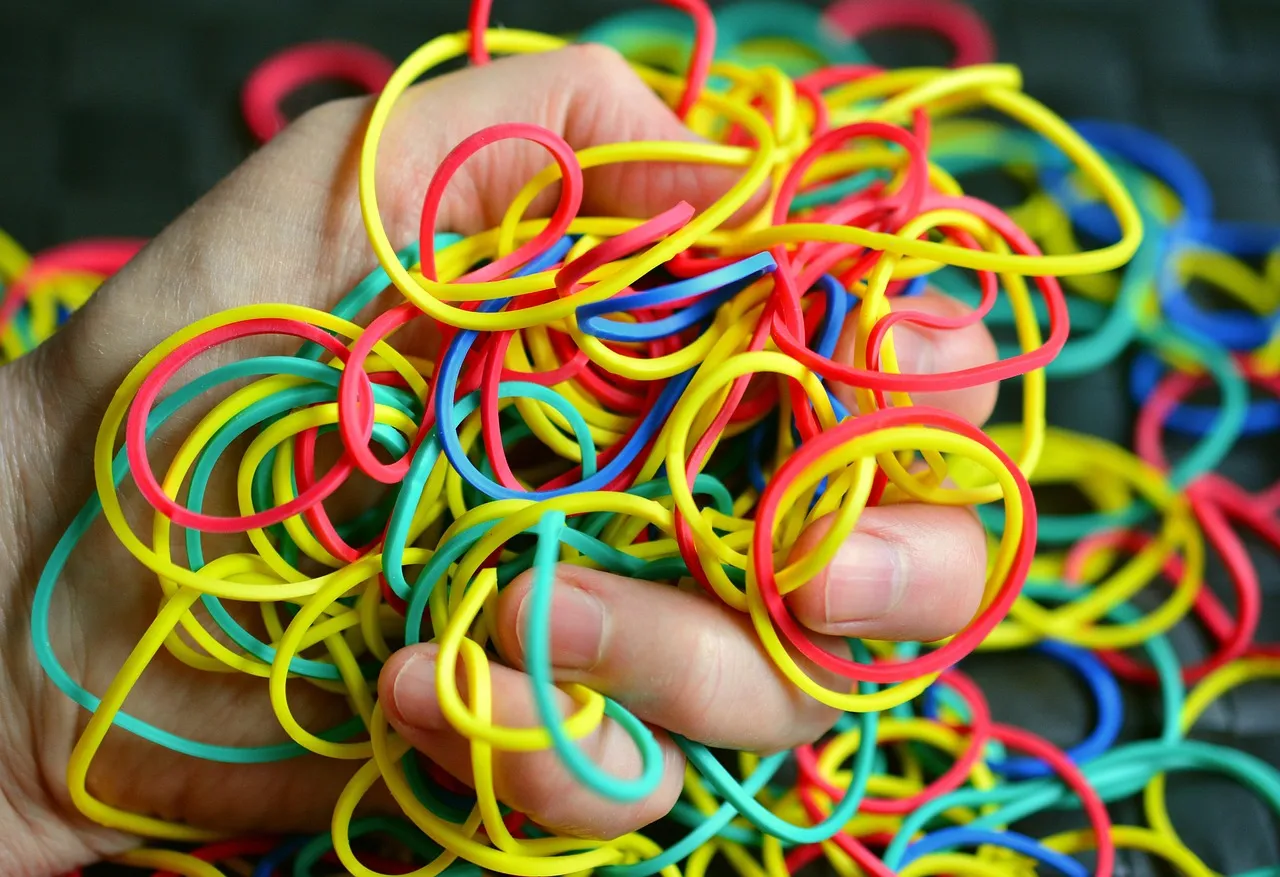
Rubber bands are flexible because they bend when you pull or twist them, but they return to their original shape. Image by congerdesign / Pixabay.
Flexibility is a property of materials that describes whether something bends without breaking or snaps when you apply force to it. When you push, pull, or twist a material, flexibility tells you how it will respond. Understanding flexibility helps us choose the right materials for different jobs and keeps people safe.
Some materials are very flexible, meaning they bend easily and return to their original shape. A rubber band is flexible because you can stretch it, and it bounces back. A bendy straw can curve without breaking. Flexible materials can handle force by changing shape temporarily. Other materials are brittle, which means they break or snap instead of bending. A dry stick is brittle—if you try to bend it, it cracks in half. A piece of chalk snaps easily when you press too hard. Brittle materials cannot change shape much before they break.
The flexibility of a material depends on how its tiny particles are connected. Think of flexible materials like a group of friends holding hands loosely—they can move around each other. Brittle materials are more like friends standing in a tight, stiff line—if someone pushes too hard, the line breaks apart. Scientists call the point where a material breaks its breaking point. Every material has a breaking point, but flexible materials can bend much more before reaching it.
Flexibility matters in everyday life. Engineers choose flexible materials for things that need to bend without breaking, like phone cases, shoe soles, and garden hoses. They choose brittle materials when they need something stiff and hard, like ceramic plates or glass windows. Even bridges use both types—flexible cables that can sway in the wind and strong concrete that holds weight. When you pick up a plastic water bottle, you can squeeze it because plastic is flexible. The glass bottle on the shelf is brittle and would shatter if you squeezed it the same way.
Understanding flexibility helps us use materials wisely and safely. A flexible diving board bends when you jump on it, storing energy and then springing you into the air. A brittle diving board would simply break. A flexible tree branch bends in a storm and survives, while a brittle branch snaps off. By testing materials and learning about their properties, we can predict how they will behave and choose the best one for each job.
Interesting Fact: Scientists have created a new material called graphene that is both incredibly flexible and incredibly strong—it can bend like rubber but is actually 200 times stronger than steel!
What does flexibility describe about materials?
Whether materials bend or breakWhat color materials areHow heavy materials feelHow much materials cost
Which material is an example of flexible?
A dry stickA piece of chalkA rubber bandA glass window
What is the breaking point?
When material changes color permanentlyWhen material finally breaks apartWhen material becomes very coldWhen material gets very heavy
Why do engineers choose flexible materials?
For things needing to bendBecause they are always cheapBecause they look prettyFor things that never move
What happens to brittle materials?
They bend and return to shapeThey stretch like rubber bandsThey break instead of bendingThey never change at all
Why can a plastic bottle be squeezed?
Because plastic is brittle materialBecause plastic is flexible materialBecause plastic has no particlesBecause plastic is made of glass
All materials have a breaking point.
TrueFalse
What does brittle mean?
Bends easily without breakingBreaks or snaps easilyChanges color when heatedFeels very smooth
Perfect For:
👩🏫 Teachers
• Reading comprehension practice
• Auto-graded assessments
• Literacy skill development
👨👩👧👦 Parents
• Reading practice at home
• Comprehension improvement
• Educational reading time
🏠 Homeschoolers
• Reading curriculum support
• Independent reading practice
• Progress monitoring
Reading Features:
📖
Reading Passage
Engaging fiction or nonfiction text
❓
Comprehension Quiz
Auto-graded questions
📊
Instant Feedback
Immediate results and scoring
📄
Printable Version
Download for offline reading
🔊
Read Aloud
Voice-over with word highlighting
Reviews & Ratings
No reviews yet. Be the first to share your experience!
Related Content
Physical Properties of Matter
This comprehensive reading passage introduces grades 6-8 students to the concept of physical properties of matter, perfe...
MS-PS1-1
Changes in Matter
This engaging science passage introduces Grade 4-5 students to the concept of how matter can change, meeting NGSS standa...
What Are Physical Changes?
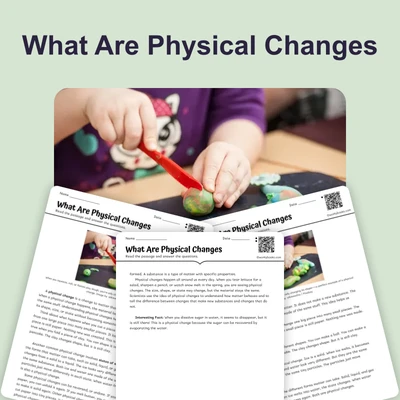
This engaging Grade 4-5 science passage introduces students to the concept of physical changes in matter, aligning with ...
Kinetic Theory of Matter
This middle school science reading passage introduces students to the kinetic theory of matter, aligning with NGSS MS-PS...
MS-PS1-4
The Nature of Science
This passage explores the nature of science for middle school students, aligning with NGSS standards MS-ETS1-4, MS-PS1-1...
MS-ETS1-4MS-PS1-1MS-LS1-1
Evaporation as Physical Change
This middle school science passage examines the process of evaporation, a fundamental physical change where a liquid tur...
MS-PS1-4
Particle Model of Matter
This comprehensive science reading passage for grades 6-8 explores the particle model of matter, aligning with NGSS stan...
MS-PS1-1MS-PS1-4
Physical Changes: Deposition
This middle school science passage explores the concept of deposition, a type of physical change where matter transition...
MS-PS1-4
Sublimation as Physical Change
This educational passage for grades 6-8 explores the science of sublimation—a physical change where a solid transforms d...
MS-PS1-4
Physical Changes: Condensation
This middle school science passage explores the process of condensation, the physical change where a gas becomes a liqui...
MS-PS1-4
Is Evaporation a Physical Change
"This reading passage is designed for middle school students to explore the concept of evaporation and its classificatio...
Chemical Properties of Matter
This engaging middle school science passage explores the chemical properties of matter, focusing on how these properties...
MS-PS1-2
Science Vocabulary
This worksheet on domain-specific words will help students learn some science vocabulary. Students will be asked to matc...
L.3.6L.3.4.A
Simple Machines Science Report
This science writing task requires students to clearly explain how three simple machines work using precise domain-speci...
W.5.4
Matter States Word Sort
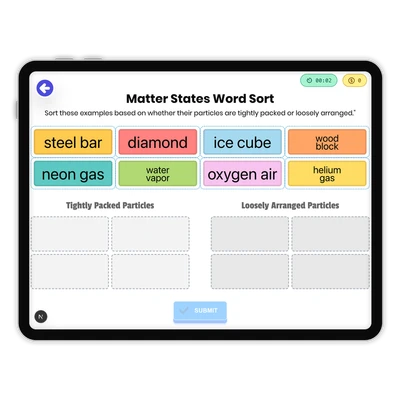
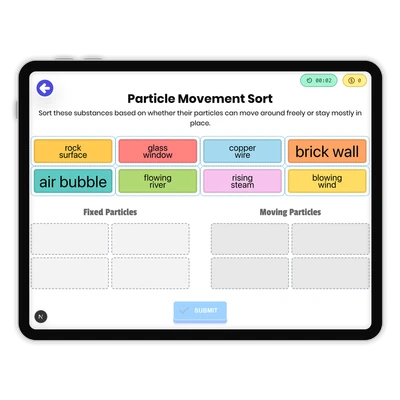
This interactive word sort focuses on helping students understand the different states of matter through real-world exam...
PS1.A
The Idea of the Atom
This informational science passage introduces middle school students (grades 6-8) to the concept that all matter is made...
MS-PS1-1
What Is Earth Science?
This engaging middle school science passage introduces students to the field of Earth science, aligning with NGSS standa...
MS-ESS1MS-ESS2MS-ESS3SEP
What Is Density?
This comprehensive science passage introduces middle school students (grades 6-8) to the concept of density, aligned wit...
MS-PS1-1
Matter States Word Sort
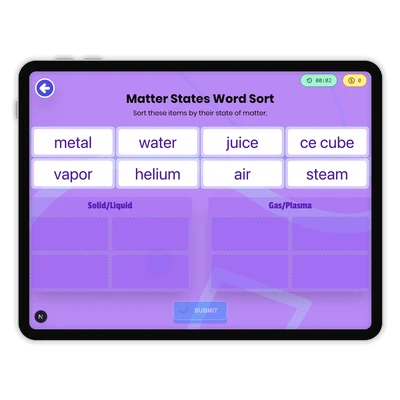
This classification activity helps students understand how particles are arranged in different states of matter. Student...
5-PS1-1
Citizen Science and Ecological Monitoring
This engaging passage for grades 6-8 introduces the concept of citizen science and its critical role in ecological monit...