This educational passage explores the legendary origins of Ancient Rome through the stories of Romulus and Aeneas, two important figures whose tales shaped Roman identity. Students will analyze the impact of myth and history, using evidence from literary and archaeological sources. The passage addresses cause-and-effect, change over time, and connections to Rome's geography and society. Activities include a multiple-choice quiz, writing prompts, graphic organizers, a timeline, and a glossary, all designed to build critical thinking and historical literacy. Spanish translations are provided for accessibility. The content aligns with California HSS 6.7 and Common Core RH.6-8.1, making it suitable for integrated history-ELA instruction. A relevant public domain image and a prompt for a coloring page are also included. This resource supports students in learning about Rome's mythical beginnings, its influence on Roman civilization, and the importance of stories in shaping cultures.
Written by Workybooks TeamPublished by Workybooks
Preview
Sample passage and quiz content
CONTENT PREVIEW
Expand content preview
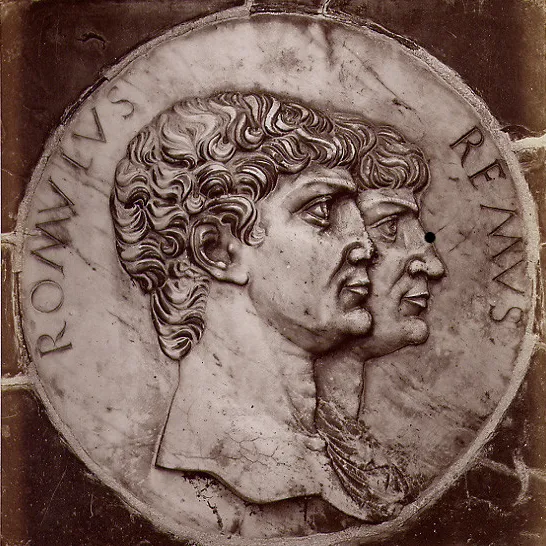
"Romulus" by Carlo Brogi / Wikimedia Commons (Public domain).
Ancient Rome traces its legendary roots to two famous figures: Aeneas and Romulus. These stories, preserved in literature and art, helped shape Roman identity and values for centuries. Although their tales blend mythology and history, they offer insight into how Romans understood their origins and the foundation of their city-state.
The earliest story begins with Aeneas, a hero from the destroyed city of Troy. According to the Roman poet Virgil’s epic, the Aeneid (written around 19 BCE), Aeneas escaped Troy and, after a long journey across the Mediterranean Sea, arrived in Italy. Archaeological evidence from the region of Latium, including ancient burials and pottery, supports the idea of early contacts between Greek, Etruscan, and native Latin peoples, though there is no direct proof of Aeneas himself. Aeneas was said to have formed alliances with local tribes and became an ancestor of the Romans, linking Rome to the wider Mediterranean world and its heroic past.
The second legend centers on Romulus and his twin brother Remus. According to the historian Livy and many Roman sources, the twins were abandoned as infants and raised by a she-wolf near the Tiber River. They grew up to found a new settlement. In a tragic conflict, Romulus killed Remus and became the first ruler of Rome in 753 BCE, as marked by the traditional Roman calendar. Archaeological findings, such as the remains of early huts on the Palatine Hill, provide evidence that people lived in this region during the 8th century BCE. These discoveries support the idea that Rome’s location, with its hills and river access, was ideal for settlement and trade.
Both legends explain Rome’s rise by stressing bravery, leadership, and connections to powerful ancestors. The story of Aeneas gave Rome a noble heritage reaching back to Troy, while the tale of Romulus highlighted unity and the challenges of founding a city. Over time, these stories were used in political speeches, art, and rituals to reinforce Roman values and social hierarchy. They also justified Rome’s expansion, suggesting the city’s destiny to rule other lands.
The significance of these legends lies in their lasting influence on Roman culture, government, and identity. Whether or not Aeneas and Romulus truly existed, their stories helped Romans connect their city to ancient traditions and explain their place in the world. Today, historians compare these myths with archaeological and written evidence to better understand how societies use stories to shape their past and future.
Learning about Rome’s legendary founders helps us see how myths, geography, and cultural identity are linked throughout history.
Interesting Fact: The she-wolf that nursed Romulus and Remus became a powerful symbol of Rome and can still be seen in statues and coins from ancient times.
Who was Aeneas?
A Trojan hero and ancestor of RomansRome's first emperorA Greek philosopherA Roman soldier
What did Romulus do to Remus?
He helped Remus become kingHe killed RemusHe traveled with Remus to TroyHe left Remus in Greece
Where did the she-wolf care for the twins?
Near the Tiber RiverOn the AlpsIn the city of TroyOn the Appian Way
Why are the stories of Aeneas and Romulus important?
They taught Roman values and identityThey ended Roman ruleThey started the Greek empireThey stopped all wars
What does archaeological evidence show about Rome?
People lived there in the 8th century BCEAeneas built the ColosseumIt was founded by GreeksOnly Remus ruled the city
How did the legends justify Roman expansion?
By suggesting Rome's destiny to ruleBy describing Greek heroesBy telling about lost citiesBy ignoring their history
Aeneas escaped from Troy. (True or False)
TrueFalse
What is a 'hierarchy'?
A system of ranking peopleA type of Roman buildingA group of soldiersA kind of pottery
Who it's for
Perfect for the way you teach
Teachers
Build comprehension skills
Auto-graded quiz
Differentiated reading
Parents
Read together at home
Improve fluency
Quiet reading time
Homeschoolers
Reading curriculum support
Independent practice
Track Lexile growth
Topics
Ancient RomeRomulusAeneasRoman mythologycity foundationprimary sourcesLatinhistory reading
Reviews & Ratings
No reviews yet. Be the first to share your experience!
More reading you might love
19 more
Etruscans of Early Italy
This engaging history reading passage explores the vital role of the Etruscans in shaping Ancient Rome. Students will di...
CA HSS 6.7RH.6-8.1RH.6-8.2RH.6-8.4
Livy the Roman Historian
This passage introduces students to Livy, one of Ancient Rome's most significant historians, whose writings help us unde...
CA HSS 6.7CCSS.RI.6.1CCSS.RI.7.1CCSS.RI.8.1
Patricians and Plebeians of Rome
This educational passage explores the complex relationship between Ancient Rome's Patricians and Plebeians, focusing on ...
CA HSS 6.7RH.6-8.2RH.6-8.4
Twelve Tables of Roman Law
This detailed history reading passage explores the development and significance of the Twelve Tables, Rome's first writt...
CA HSS 6.7RI.6.1RI.6.2W.6.2
Legacy of Ancient Rome
This passage explores the profound legacy of Ancient Rome and how its beliefs, innovations, and systems continue to shap...
CA HSS 6.7RH.6-8.2
Rise of Christianity in Rome
This comprehensive history reading passage explores the rise of Christianity within the context of Ancient Rome, detaili...
CA HSS 6.7RH.6-8.1RH.6-8.2RH.6-8.4
Trade in the Roman Empire
This engaging passage explores the trade networks of the Roman Empire, highlighting their vast reach across Europe, Afri...
CA HSS 6.7RH.6-8.1RH.6-8.4WHST.6-8.2
Medieval Monastery
This passage explores how monasteries helped preserve knowledge following the fall of the Western Roman Empire, a crucia...
CA HSS 6.7RI.6.1RI.6.2RI.7.3
Cincinnatus and Roman Virtue
This rigorous history reading passage explores the story of Cincinnatus, a Roman farmer who became a dictator in a time ...
CA HSS 6.7CCSS.ELA-LITERACY.RI.6.1CCSS.ELA-LITERACY.RI.7.3
Cicero the Roman Orator
This engaging history reading passage explores the life and legacy of Cicero, one of ancient Rome’s most influential sta...
CA HSS 6.7CCSS RH.6-8.2CCSS RH.6-8.4
Social Classes of Ancient Rome
This comprehensive reading passage explores the structure of ancient Roman society, focusing on the distinctions between...
CA HSS 6.7RH.6-8.1RH.6-8.2RH.6-8.4
Han Dynasty Suspension Bridges
This passage explores the invention and impact of suspension bridges during the Han Dynasty in Ancient China, covering h...
CA HSS 6.6CCSS RH.6-8.1CCSS RH.6-8.4CCSS RH.6-8.7
Han Dynasty Wheelbarrow
This passage explores the invention and historical significance of the wheelbarrow during the Han dynasty in ancient Chi...
CA HSS 6.6CCSS RH.6-8.1RH.6-8.2RH.6-8.4
Han Dynasty Moldboard Plow
This engaging history reading passage explores the development and impact of the moldboard plow during the Han Dynasty i...
CA HSS 6.6.4CCSS RH.6-8.1RH.6-8.2RH.6-8.4
China's Terracotta Army
This passage explores the fascinating discovery of the Terra-Cotta Army near Xi’an, China, and its significance in ancie...
CA HSS 6.1CCSS RH.6-8.1CCSS RH.6-8.4CCSS RH.6-8.7
Lascaux Cave Paintings
This engaging passage introduces students to the prehistoric art of Lascaux Cave, a remarkable archaeological discovery ...
CA HSS 6.2.1CCSS RH.6-8.1CCSS RH.6-8.4
Out of Africa: First Migration
This comprehensive history reading passage explores the Out of Africa movement and how early humans migrated across cont...
CA HSS 6.1.1CCSS RH.6-8.1RH.6-8.2RH.6-8.4
How Early Humans Survived the Ice Age
This passage explores how Paleolithic people adapted to a variety of landscapes, including coastal regions, mountains, p...
CA HSS 6.1CCSS RH.6-8.1CCSS RH.6-8.2CCSS RH.6-8.4
Neolithic Tools
This passage explores the profound impact of new stone tools during the Neolithic period, focusing on how these innovati...