Christianity in the Roman Empire
Interactive passage with audio narration, comprehension questions, and printable PDF.
By completing this purchase you agree to our Terms of Use and Privacy Policy. Your subscription renews automatically until you cancel. You can cancel anytime from your account settings. All sales are final and non-refundable. Digital content is available for download in your account immediately upon purchase.
What's included
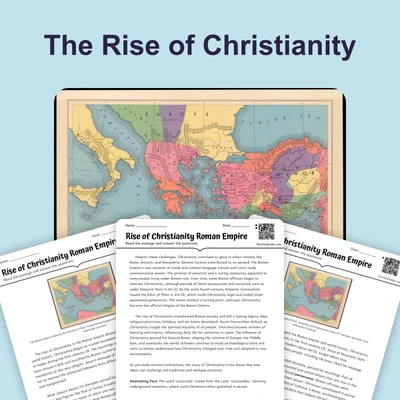
Christianity in the Roman Empire preview and details
About this printable Christianity in the Roman Empire reading passage (Grades 5-8)
Sample passage and quiz from Christianity in the Roman Empire
Reading passage and comprehension quiz preview
Christianity in Rome Around 300 CE
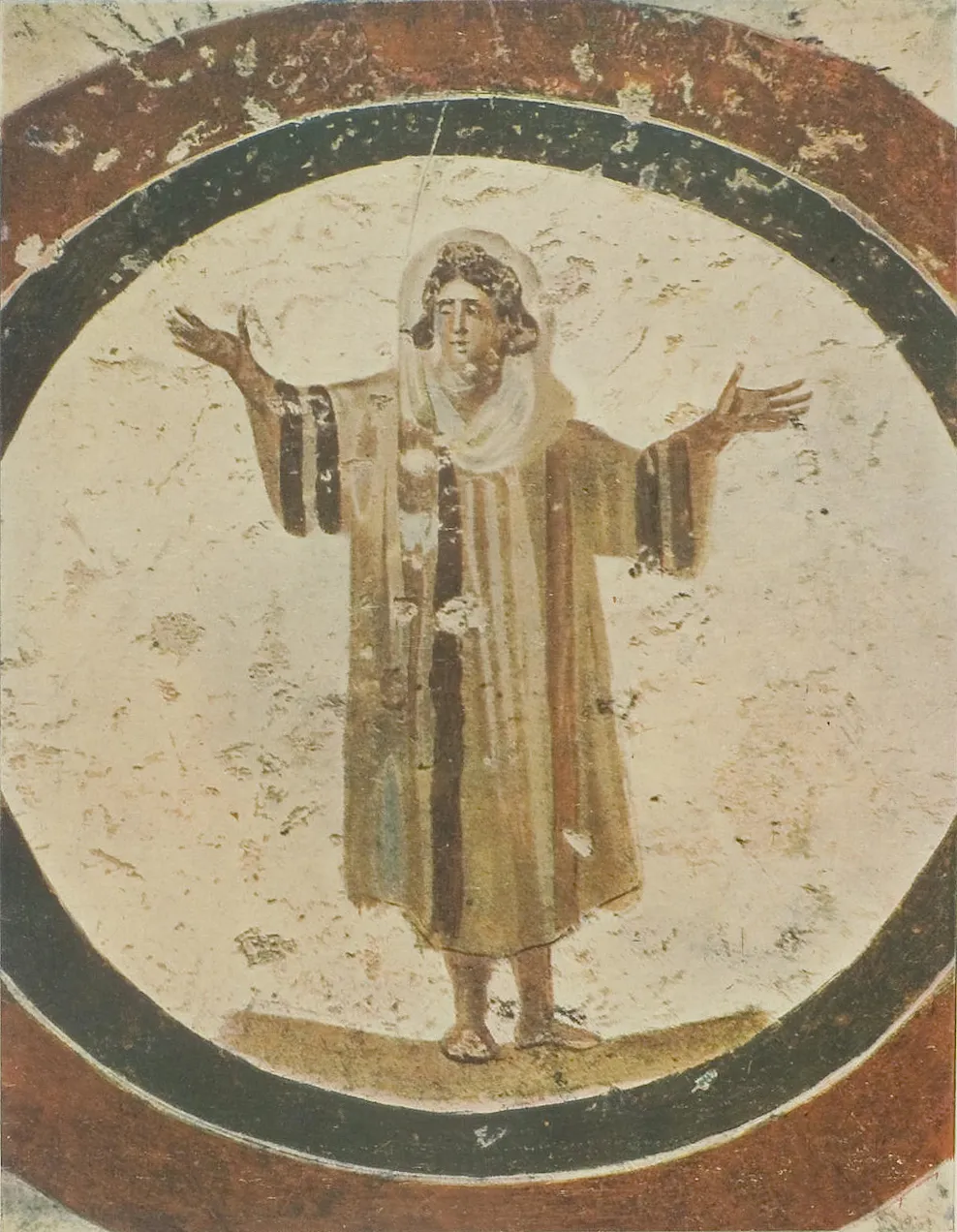
"Christian in Rome in orante praying position, from the book Die Malereien der Katakomben Roms, plate 88" / Wikimedia Commons (Public domain).
The growth of Christianity in the Roman Empire is one of the most significant developments in world history. By 300 CE, this new religion, which began in Judea, had spread throughout the vast territories of Rome, influencing culture, law, and daily life.
Christianity started with the teachings of Jesus of Nazareth around 30 CE in the Roman province of Judea. Jesus’s followers, known as disciples, spread his teachings about love, forgiveness, and salvation. Early Christians used letters, such as those written by Paul, to share their beliefs. Archaeological discoveries, like the catacombs under Rome, show that Christians met in secret to avoid Roman punishment. The Roman government at first saw Christianity as a threat, because Christians refused to worship Roman gods and the emperor. This led to persecution, with many Christians being arrested or even executed, as recorded in sources like the writings of Tacitus and the letters of Pliny the Younger.
Despite persecution, Christianity continued to grow. One reason for its spread was that it welcomed people of all backgrounds, including the poor, slaves, and women, who often had limited rights in Roman society. The religion’s message of hope and eternal life appealed to those suffering under the Roman social hierarchy. Over time, Christian communities grew stronger, meeting in private homes and using symbols like the fish or the cross to identify each other. The empire’s vast network of roads and cities made it possible for ideas to travel quickly from place to place, helping Christianity move from the eastern provinces to cities like Rome, Alexandria, and Carthage.
A major change occurred in the early 4th century when Emperor Constantine came to power. In 313 CE, Constantine issued the Edict of Milan, which made it legal to practice Christianity in the Roman Empire. This ended centuries of persecution. Soon, Christianity gained new followers, and churches were built openly. Constantine himself became a Christian and supported the religion. By the end of the 4th century, Christianity became the official religion of the Roman Empire under Emperor Theodosius.
The rise of Christianity changed Roman society and influenced art, law, and politics for centuries. It helped shape the values of Western civilization and connected people across different regions. The story of Christianity’s growth in the Roman Empire shows how new ideas can challenge old traditions and lead to major social change.
Interesting Fact: Many early Christian symbols, like the fish (Ichthys), were used in secret to avoid detection by Roman authorities.
Comprehension quiz (8 questions)
1. Where did Christianity begin?
2. Who made Christianity legal in Rome?
3. What symbol did early Christians use?
4. Why did Romans persecute Christians?
5. How did roads help Christianity spread?
6. What was the Edict of Milan?
7. Christianity became Rome's official religion. True or false?
8. What does 'persecution' mean?
Perfect for the way you teach
- Build comprehension skills
- Auto-graded quiz
- Differentiated reading
- Read together at home
- Improve fluency
- Quiet reading time
- Reading curriculum support
- Independent practice
- Track Lexile growth