Etruscans of Early Italy
Interactive passage with audio narration, comprehension questions, and printable PDF.
By completing this purchase you agree to our Terms of Use and Privacy Policy. Your subscription renews automatically until you cancel. You can cancel anytime from your account settings. All sales are final and non-refundable. Digital content is available for download in your account immediately upon purchase.
What's included
Etruscans of Early Italy preview and details
About this printable Etruscans of Early Italy reading passage (Grades 5-8)
Sample passage and quiz from Etruscans of Early Italy
Reading passage and comprehension quiz preview
Etruscans of Early Italy
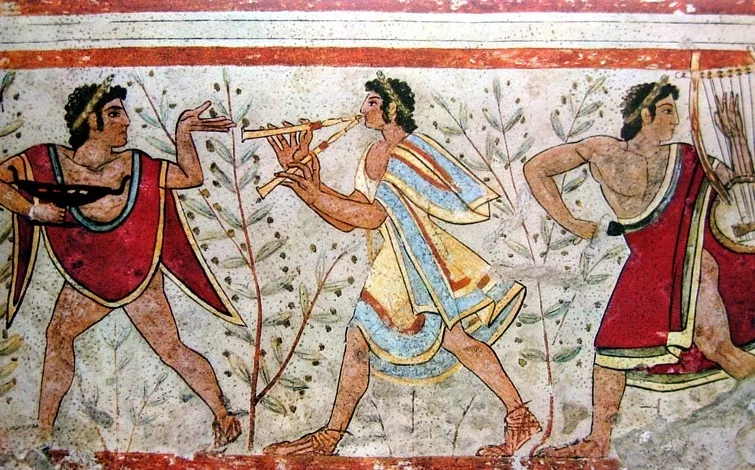
Etruscan Painting
Source: Wikimedia Commons (Public domain).
The Etruscans were a powerful civilization in central Italy who greatly shaped the early development of Rome. Living in the region of Etruria (modern-day Tuscany) from at least the 8th century BCE, the Etruscans established prosperous city-states such as Veii, Tarquinia, and Cerveteri. Their influence on Roman society, culture, and technology is revealed through both archaeological discoveries and ancient writings.
Etruscan society was known for its complex social hierarchy and skilled artisanship. The upper class, called the nobility, controlled much of the land and wealth, while artisans and farmers formed lower social groups. Archaeologists have found elaborate tombs with wall paintings showing banquets and music, which reveal much about Etruscan daily life. One famous example is the Tomb of the Leopards in Tarquinia, dating to the 5th century BCE. These images suggest that Etruscan society valued family gatherings, music, and sports.
The Etruscans had a significant impact on Roman religion and architecture. Many Roman gods, such as Jupiter and Juno, have Etruscan origins. The Etruscans practiced divination, seeking messages from the gods by observing natural signs like lightning or animal livers. Romans adopted these rituals and even Etruscan priests, called augurs. Architecturally, the Etruscans introduced the use of the arch and the engineering of drainage systems, which allowed the Romans to build large temples, bridges, and the Cloaca Maxima, Rome’s main sewer system. According to Roman historians like Livy, the city’s first kings, including Tarquinius Priscus and Tarquinius Superbus, were of Etruscan descent.
Contact between Etruscans and Romans led to both continuity and change. While the Etruscans first ruled Rome as monarchs, over time, the Romans overthrew the monarchy (traditionally in 509 BCE) and established a republic. Yet, many Etruscan customs, such as the triumphal procession and the use of the toga, continued in Roman society for centuries.
The Etruscans played a crucial role in shaping the foundation of Rome. Their advances in technology, religious practices, and social organization helped Rome grow from a small village into a thriving city. By examining Etruscan influences, historians better understand how civilizations borrow and adapt from one another, especially in regions with shared geography like the Italian peninsula.
Interesting Fact: Many Etruscan texts remain undeciphered, so much of what we know comes from archaeological finds and Roman writers.
Comprehension quiz (8 questions)
1. What region did the Etruscans live in?
2. Which city-state had the Tomb of the Leopards?
3. When did the Romans overthrow the monarchy?
4. What did the Etruscans introduce in architecture?
5. How did Etruscan religion influence Rome?
6. What does 'continuity' mean in the passage?
7. The Etruscans practiced divination. True or false?
8. What is an augur?
Perfect for the way you teach
- Build comprehension skills
- Auto-graded quiz
- Differentiated reading
- Read together at home
- Improve fluency
- Quiet reading time
- Reading curriculum support
- Independent practice
- Track Lexile growth