Mansa Musa and Mali Empire
Interactive passage with audio narration, comprehension questions, and printable PDF.
What's included
Mansa Musa and Mali Empire preview and details
About this printable Mansa Musa and Mali Empire reading passage (Grades 5-8)
Sample passage and quiz from Mansa Musa and Mali Empire
Reading passage and comprehension quiz preview
Mansa Musa and Mali Empire
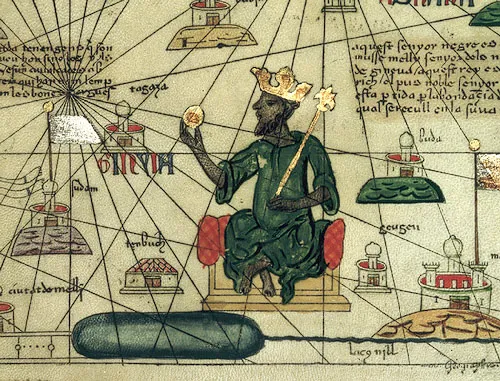
Depiction of Mansa Musa, ruler of the Mali Empire in the 14th century, from a 1375 Catalan Atlas of the known world (mapamundi), drawn by Abraham Cresques of Mallorca. Musa is shown holding a gold nugget and wearing a European-style crown. / Wikimedia Commons
The Mali Empire, located in West Africa, became one of the largest and richest empires in the world during the fourteenth century. Its most celebrated ruler was Mansa Musa, who reigned from 1312 to 1337. Under his leadership, Mali expanded its territory, increased its wealth, and became a center of learning and culture.
The empire’s prosperity was closely connected to the trans-Saharan trade routes. Mali controlled the exchange of gold and salt, two of the most valuable resources in the ancient world. Gold from Mali’s mines was traded for salt from the Sahara Desert. Salt was essential for preserving food and maintaining health. Caravans of camels transported these goods across the desert to North Africa and beyond. As a result, cities like Timbuktu and Gao became bustling centers of commerce and culture.
Mansa Musa is perhaps best known for his famous pilgrimage, or hajj, to the Islamic holy city of Mecca in 1324. He traveled with a vast entourage of thousands of people and hundreds of camels loaded with gold. Ancient accounts describe how Mansa Musa distributed so much gold along his route that he caused a drop in its value in Egypt. This remarkable journey demonstrated the wealth and power of Mali and helped put West Africa on the map for European and Middle Eastern scholars and traders. During his travels, Mansa Musa attracted architects and scholars to return with him to Mali, where they built grand mosques and established schools. The Sankore Mosque in Timbuktu, for example, became a renowned center for Islamic manuscripts and education.
Mansa Musa’s reign brought significant change to Mali. He encouraged the growth of cities, supported the spread of Islam, and invested in education. However, the empire maintained many traditional African customs alongside Islamic practices. Over time, Mali’s power declined due to internal conflict and the rise of rival kingdoms, but its legacy of wealth, scholarship, and cultural exchange continued to influence West Africa for centuries.
The story of Mansa Musa and the Mali Empire shows how geography, trade, and leadership can shape a civilization. By examining primary sources like the Catalan Atlas and archaeological evidence from Timbuktu, historians learn about the connections between Africa and the wider medieval world.
Interesting Fact: Mansa Musa is sometimes called the richest person in history—his fortune was so great it is difficult for historians to estimate its true value!
Comprehension quiz (8 questions)
1. When did Mansa Musa rule Mali?
2. What two goods made Mali rich?
3. Which city became a center of learning?
4. Why was the pilgrimage important?
5. What effect did giving away gold have?
6. How did Mansa Musa improve education?
7. Mansa Musa's pilgrimage was in 1324. True or false?
8. What is a caravan?
Perfect for the way you teach
- Build comprehension skills
- Auto-graded quiz
- Differentiated reading
- Read together at home
- Improve fluency
- Quiet reading time
- Reading curriculum support
- Independent practice
- Track Lexile growth